Global Copper Price Rises 9.3% Weekly; Plate Exchanger Export Quotes Under Pressure




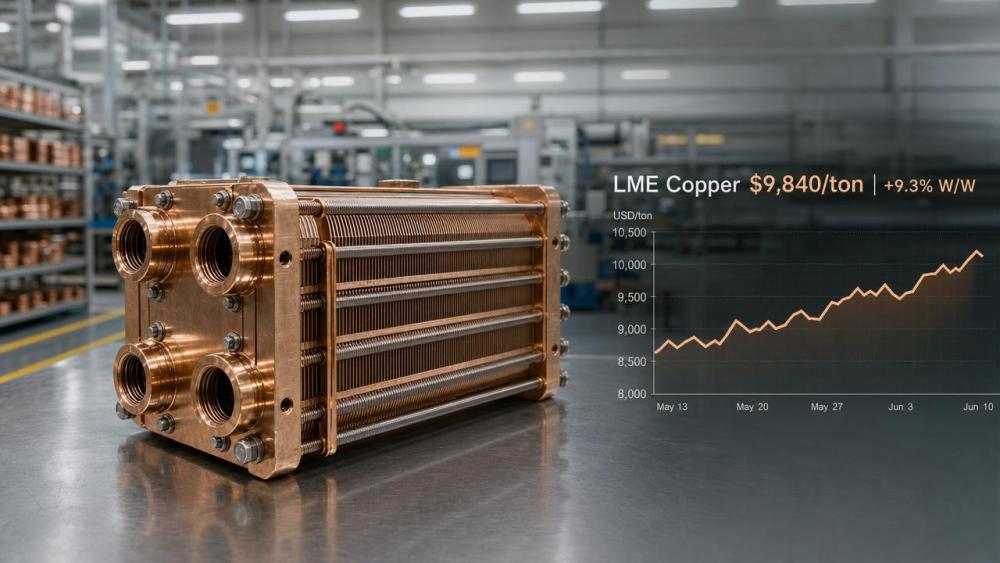
On May 9, 2026, LME copper closed at $9,840/ton — a 9.3% weekly increase and the highest level since October 2025. This sharp price movement is directly affecting global supply chains for plate heat exchangers, particularly export-oriented manufacturers in China, and prompting technical reassessments among European integrators. Stakeholders in thermal equipment manufacturing, non-ferrous materials procurement, and international trade should monitor downstream pricing, lead time shifts, and material substitution trends closely.
Event Overview
On May 9, 2026, the London Metal Exchange (LME) copper price settled at $9,840 per metric ton, reflecting a 9.3% gain over the prior week. This marks the highest closing level since October 2025. As a result, mainstream export quotations for plate heat exchangers from Chinese suppliers increased by 5–7%, with average delivery lead times extended to 12–14 weeks. Multiple European heat exchanger system integrators have initiated technical evaluations of alternative materials — including aluminum brazed plate and titanium thin-wall variants.
Impact on Specific Industry Segments
Direct Exporters (e.g., Chinese plate heat exchanger manufacturers): Rising copper input costs compress margin visibility, while longer lead times risk order deferrals or cancellations. Pricing adjustments are already reflected in new quotations, but competitiveness may erode if end-market pricing power remains weak.
Raw Material Procurement Teams (e.g., thermal equipment OEMs, contract assemblers): Copper accounts for a significant portion of bill-of-materials cost in standard plate exchangers. The price surge increases landed cost uncertainty and challenges fixed-price contract fulfillment, especially where copper exposure is not hedged or indexed.
Heat Exchanger System Integrators (e.g., European HVAC and industrial process firms): Input cost pressure is triggering active evaluation of alternative materials — notably aluminum brazed plate and titanium thin-wall designs — to reduce copper dependency and improve weight-to-performance ratios.
Supply Chain & Logistics Service Providers: Extended production lead times (now 12–14 weeks) affect capacity planning, inventory financing, and just-in-time scheduling. Forward booking windows and buffer stock requirements are likely under review.
What Relevant Enterprises or Practitioners Should Focus On and How to Respond
Monitor LME copper volatility and forward curve signals
Current price strength reflects near-term supply tightness and macro sentiment, but sustainability depends on mine output, scrap availability, and Chinese demand recovery. Track LME three-month forward spreads and warehouse inventories for early directional cues.
Review contractual copper indexing clauses and hedge coverage
For exporters and integrators operating under fixed-price contracts, assess whether existing agreements include copper price adjustment mechanisms or currency-copper correlation clauses. Where absent, prioritize clause negotiation in upcoming tenders.
Evaluate material substitution progress on a case-by-case basis
Aluminum brazed and titanium alternatives require validation across thermal performance, pressure rating, corrosion resistance, and service life. Current activity is technical assessment — not commercial deployment. Prioritize validation for high-volume, low-risk applications first.
Adjust production planning and customer communication timelines
With quoted lead times now at 12–14 weeks, update internal capacity models and proactively align delivery expectations with key customers — particularly those with seasonal or project-driven demand cycles.
Editorial Perspective / Industry Observation
Observably, this copper price spike functions primarily as a near-term cost signal rather than an immediate structural shift. While it has triggered material reassessment, no large-scale adoption of non-copper alternatives has been confirmed. Analysis shows that the current response — price pass-through and lead time extension — remains reactive and consistent with past commodity cycles. From an industry perspective, the more consequential development is the acceleration of lightweighting and composite process validation efforts among Chinese manufacturers, which suggests a longer-term strategic pivot beyond short-term pricing management. It is better understood as a stress test for supply chain agility and material innovation readiness — not yet a tipping point toward copper displacement.
In summary, the May 9, 2026 copper price surge highlights persistent vulnerability to base metal volatility within the plate heat exchanger value chain. Its primary significance lies in exposing operational dependencies — particularly on copper-intensive designs and inflexible lead time models. For now, it is best interpreted as a catalyst for tactical recalibration (pricing, scheduling, hedging) and a prompt for mid-term investment in material diversification and process validation — not as evidence of an irreversible technology transition.
Source: London Metal Exchange (LME) official settlement data, May 9, 2026; publicly reported export quotation adjustments and lead time updates from Chinese plate heat exchanger exporters; verified statements on alternative material assessments from European thermal integration firms. Note: Ongoing monitoring is required for confirmation of commercial-scale adoption of aluminum or titanium alternatives — no such deployment has been confirmed to date.
Ready when you are. Send us a message to get started.
Related News
- How corrugation angle affects heat transfer in plate heat exchangersAuthor :Thermodynamics Analyst

- When do plate heat exchangers suit Middle East seawater cooling?Author :Thermodynamics Analyst

- When does gasketed plate heat exchanger technology suit your process?Author :Thermodynamics Analyst

- When does heat recovery improve data center cooling efficiency?Author :Thermodynamics Analyst

- How Do I Verify Heat Transfer Calculations in a Supplier Quotation?Author :Thermodynamics Analyst

- How to evaluate a plate heat exchangers supplier before orderingAuthor :Thermodynamics Analyst

- EU Tightens Fatigue Checks for Plate Heat ExchangersAuthor :Thermodynamics Analyst

- EU PFAS Rule Adds New Export Filing for Cooling EquipmentAuthor :Thermodynamics Analyst

- EU EN 13445-4:2026 Adds Fatigue Report RequirementAuthor :Thermodynamics Analyst

- EU Updates EN 13445-4 for Plate ExchangersAuthor :Thermodynamics Analyst

- How to Compare Energy-Efficient Heat Exchange SolutionsAuthor :Thermodynamics Analyst

- Brazed Plate Exchanger Design: 7 Factors That Affect Heat TransferAuthor :Thermodynamics Analyst

- EU CBAM Pilot List Adds Plate ExchangersAuthor :Thermodynamics Analyst

- How Heat Exchange Systems Improve Temperature Control StabilityAuthor :Thermodynamics Analyst

- Japan to Require Efficiency Labels for Plate ExchangersAuthor :Thermodynamics Analyst

- EU REACH Adds PFAS Ban for Plate Heat ExchangersAuthor :Thermodynamics Analyst

- India Enforces BIS Rule for Plate Heat ExchangersAuthor :Thermodynamics Analyst

- DIN EN 13445-6:2026 Tightens Plate Exchanger CE RulesAuthor :Thermodynamics Analyst

- EU REACH Restricts PFAS Seals for Plate Heat ExchangersAuthor :Thermodynamics Analyst

- India Mandates BIS Certification for Imported Plate ExchangersAuthor :Thermodynamics Analyst

- Vietnam Requires QR Labels on Imported Plate Heat ExchangersAuthor :Thermodynamics Analyst

- EU EN 13445-4:2026 Tightens NDT Rules for Heat ExchangersAuthor :Thermodynamics Analyst

- EPA Clears R-1234ze(E) for Plate Exchanger SystemsAuthor :Thermodynamics Analyst
 for Plate Exchanger Systems")
- Heat Exchange Equipment Selection: Key Performance Checks Before You Compare ModelsAuthor :Thermodynamics Analyst

- ASHRAE 90.1-2026 Raises Plate Exchanger Efficiency ThresholdAuthor :Thermodynamics Analyst

- Heat Exchange Systems: How to Choose the Right SetupAuthor :Thermodynamics Analyst

- EPA SNAP 89 Takes Effect for Plate ExchangersAuthor :Thermodynamics Analyst

- How to Compare Heat Exchange Solutions for Lower Energy UseAuthor :Thermodynamics Analyst

- EPA SNAP 89 Expands Filing Rules for Plate Heat ExchangersAuthor :Thermodynamics Analyst

- EPA SNAP update adds filing rule for plate heat exchangersAuthor :Thermodynamics Analyst

- Industrial Heat Recovery: Where the Payback Is Fastest in 2026Author :Thermodynamics Analyst

- California EPR Deadline Nears for Cooling Equipment MakersAuthor :Thermodynamics Analyst

- Heat Exchanger Technology: Plate vs Shell and Tube for EfficiencyAuthor :Thermodynamics Analyst

- Industrial Heat Recovery Options for High-Temperature ProcessesAuthor :Thermodynamics Analyst

- Heat Transfer Problems in Process Lines: Causes and Practical FixesAuthor :Thermodynamics Analyst

- India Tightens Plate Exchanger Import Clearance RulesAuthor :Thermodynamics Analyst