Global Copper Price Rises 9.3% Weekly; Plate Exchanger Export Pricing Adjusted




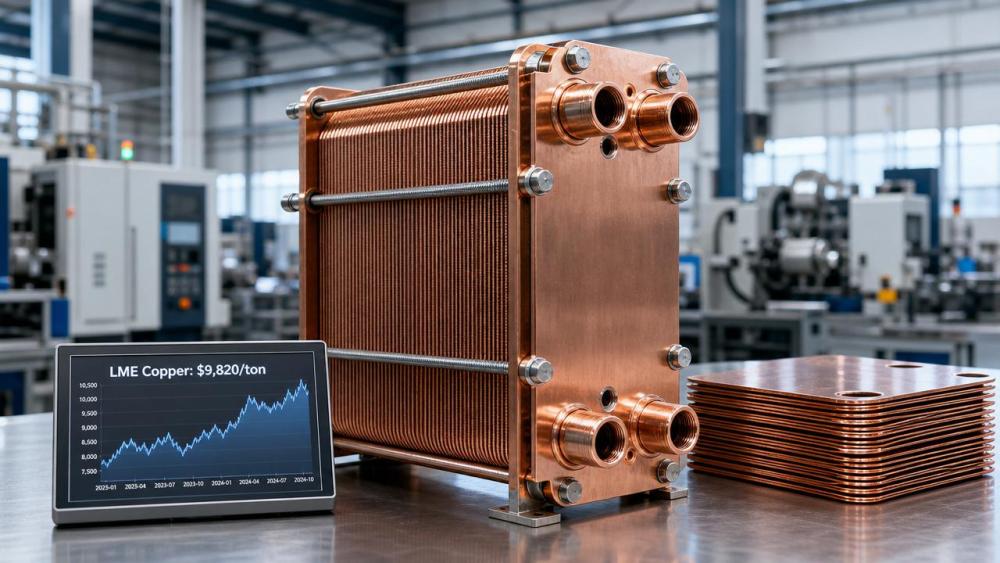
Global copper prices surged 9.3% week-on-week, reaching $9,820/ton on the London Metal Exchange (LME) as of May 16, 2026 — the highest level since 2024. This sharp move is directly impacting pricing and procurement strategies across the plate heat exchanger supply chain, particularly for manufacturers exporting to Europe and North America, and for downstream thermal system integrators.
Event Overview
On May 16, 2026, the LME copper price closed at $9,820 per metric ton, up 9.3% from its level on May 9, 2026. In response, leading Chinese plate heat exchanger manufacturers have increased FOB export quotations to European and U.S. buyers by 3.5–5.2% for new orders. These manufacturers have also introduced a ‘copper price linkage clause’ in new contracts. Separately, multiple European thermal system integrators have stated they are accelerating evaluations of stainless steel and titanium alternatives for heat exchange components.
Impact on Specific Industry Segments
Plate heat exchanger manufacturers (export-oriented): Copper is a primary raw material for many plate exchanger core components (e.g., copper-brass plates, gaskets with copper-based alloys). The 9.3% weekly price jump compresses margins on fixed-price contracts signed prior to mid-May and increases working capital pressure during procurement cycles.
Thermal system integrators (especially in Europe): Rising input costs for copper-based plate exchangers affect bill-of-materials cost structures and project-level profitability. Early signals indicate substitution evaluation is now prioritized — not as a long-term strategic shift, but as a near-term risk-mitigation measure.
Raw material procurement teams (across OEMs and Tier-1 suppliers): Sudden copper volatility disrupts traditional quarterly or semi-annual procurement planning. Contracts without price adjustment mechanisms face immediate margin erosion, especially where copper content exceeds 30% of unit material cost.
Export trading & logistics service providers: Increased quotation volatility raises documentation complexity (e.g., revised commercial invoices, updated Incoterms clauses), and may trigger more frequent renegotiation requests from overseas buyers — affecting order cycle times and administrative load.
What Relevant Enterprises or Practitioners Should Focus On and How to Respond
Monitor contract terms for copper price linkage implementation
Verify whether newly introduced ‘copper price linkage clauses’ reference LME daily settlement prices, lag periods (e.g., 5-day average), and minimum/maximum adjustment thresholds. These parameters determine actual pass-through effectiveness — not just their presence in boilerplate text.
Track copper inventory exposure and procurement timing
Assess current copper-related work-in-progress and finished goods inventory levels relative to open export orders. If copper exposure exceeds 20% of total material cost and delivery windows extend beyond Q3 2026, consider staged procurement or forward cover — but only after evaluating counterparty risk with hedging partners.
Evaluate technical feasibility of alternative materials on a case-by-case basis
Stainless steel and titanium substitutions require revalidation of thermal performance, pressure ratings, and corrosion resistance per application. Do not assume drop-in replacement. Prioritize assessment for non-critical, low-pressure HVAC applications first — not high-efficiency industrial or marine systems.
Prepare for buyer-side negotiation pressure in Q2 2026
European integrators citing ‘alternative material evaluation’ may use this as leverage in pricing discussions. Maintain documented evidence of copper cost impact (e.g., LME screenshots, supplier invoices) to support justification of adjusted FOB quotes — especially where contracts lack automatic indexation.
Editorial Perspective / Industry Observation
Observably, this copper price spike functions less as an isolated commodity event and more as a stress test for pricing agility and material flexibility across the thermal equipment value chain. Analysis shows the 9.3% weekly gain reflects short-term supply constraints rather than structural demand growth — suggesting potential stabilization in coming weeks. However, the rapid adoption of copper linkage clauses and accelerated substitution reviews signal that market participants now treat copper volatility as a recurring operational variable, not an exceptional risk. From an industry perspective, the current situation is better understood as an early-stage pricing recalibration — not yet a full-scale material transition — but one requiring disciplined monitoring of both LME dynamics and buyer-side response patterns.
Conclusion
This event underscores how sudden shifts in base metal pricing can propagate rapidly through precision-engineered equipment supply chains — even when copper is not the dominant structural material. It does not indicate a broad-based shift away from copper in plate exchangers, nor does it imply imminent cost pass-through across all export markets. Instead, it highlights the growing importance of contractual flexibility, real-time cost tracking, and application-specific material validation. Currently, this development is best interpreted as a tactical pricing adjustment triggered by short-term commodity volatility — not a strategic inflection point for material selection or global sourcing models.
Information Sources
Main source: London Metal Exchange (LME) official settlement data, May 9–16, 2026; public statements from three unnamed Chinese plate heat exchanger exporters (reported via industry distribution channels); and comments from four European thermal system integrators (collected in mid-May 2026 vendor briefings).
Points under ongoing observation: Actual implementation rate of copper linkage clauses in executed contracts; timeline and scope of stainless/titanium substitution pilots among European integrators; and any subsequent LME copper price correction beyond May 2026.
Ready when you are. Send us a message to get started.
Related News
- How corrugation angle affects heat transfer in plate heat exchangersAuthor :Thermodynamics Analyst

- When do plate heat exchangers suit Middle East seawater cooling?Author :Thermodynamics Analyst

- When does gasketed plate heat exchanger technology suit your process?Author :Thermodynamics Analyst

- When does heat recovery improve data center cooling efficiency?Author :Thermodynamics Analyst

- How Do I Verify Heat Transfer Calculations in a Supplier Quotation?Author :Thermodynamics Analyst

- How to evaluate a plate heat exchangers supplier before orderingAuthor :Thermodynamics Analyst

- EU Tightens Fatigue Checks for Plate Heat ExchangersAuthor :Thermodynamics Analyst

- EU PFAS Rule Adds New Export Filing for Cooling EquipmentAuthor :Thermodynamics Analyst

- EU EN 13445-4:2026 Adds Fatigue Report RequirementAuthor :Thermodynamics Analyst

- EU Updates EN 13445-4 for Plate ExchangersAuthor :Thermodynamics Analyst

- How to Compare Energy-Efficient Heat Exchange SolutionsAuthor :Thermodynamics Analyst

- Brazed Plate Exchanger Design: 7 Factors That Affect Heat TransferAuthor :Thermodynamics Analyst

- EU CBAM Pilot List Adds Plate ExchangersAuthor :Thermodynamics Analyst

- How Heat Exchange Systems Improve Temperature Control StabilityAuthor :Thermodynamics Analyst

- Japan to Require Efficiency Labels for Plate ExchangersAuthor :Thermodynamics Analyst

- EU REACH Adds PFAS Ban for Plate Heat ExchangersAuthor :Thermodynamics Analyst

- India Enforces BIS Rule for Plate Heat ExchangersAuthor :Thermodynamics Analyst

- DIN EN 13445-6:2026 Tightens Plate Exchanger CE RulesAuthor :Thermodynamics Analyst

- EU REACH Restricts PFAS Seals for Plate Heat ExchangersAuthor :Thermodynamics Analyst

- India Mandates BIS Certification for Imported Plate ExchangersAuthor :Thermodynamics Analyst

- Vietnam Requires QR Labels on Imported Plate Heat ExchangersAuthor :Thermodynamics Analyst

- EU EN 13445-4:2026 Tightens NDT Rules for Heat ExchangersAuthor :Thermodynamics Analyst

- EPA Clears R-1234ze(E) for Plate Exchanger SystemsAuthor :Thermodynamics Analyst
 for Plate Exchanger Systems")
- Heat Exchange Equipment Selection: Key Performance Checks Before You Compare ModelsAuthor :Thermodynamics Analyst

- ASHRAE 90.1-2026 Raises Plate Exchanger Efficiency ThresholdAuthor :Thermodynamics Analyst

- Heat Exchange Systems: How to Choose the Right SetupAuthor :Thermodynamics Analyst

- EPA SNAP 89 Takes Effect for Plate ExchangersAuthor :Thermodynamics Analyst

- How to Compare Heat Exchange Solutions for Lower Energy UseAuthor :Thermodynamics Analyst

- EPA SNAP 89 Expands Filing Rules for Plate Heat ExchangersAuthor :Thermodynamics Analyst

- EPA SNAP update adds filing rule for plate heat exchangersAuthor :Thermodynamics Analyst

- Industrial Heat Recovery: Where the Payback Is Fastest in 2026Author :Thermodynamics Analyst

- California EPR Deadline Nears for Cooling Equipment MakersAuthor :Thermodynamics Analyst

- Heat Exchanger Technology: Plate vs Shell and Tube for EfficiencyAuthor :Thermodynamics Analyst

- Industrial Heat Recovery Options for High-Temperature ProcessesAuthor :Thermodynamics Analyst

- Heat Transfer Problems in Process Lines: Causes and Practical FixesAuthor :Thermodynamics Analyst

- India Tightens Plate Exchanger Import Clearance RulesAuthor :Thermodynamics Analyst