What to check before choosing a steam generation systems supplier




It usually starts with a practical problem, not a strategic one. A plant is expanding, an old boiler room is becoming unreliable, steam quality is drifting, or utility costs are climbing without a clear explanation. Someone is asked to gather supplier options quickly, and the first comparison often looks deceptively simple: capacity, pressure, delivery time, and price. But once technical teams begin asking questions about feedwater quality, load variation, emissions limits, controls integration, or maintenance access, the choice becomes much less straightforward.
That is where many buying decisions go off track. A steam generation system is rarely a standalone purchase. It affects production stability, site safety, fuel use, operator workload, spare parts planning, and future compliance. If you are trying to choose a steam generation systems supplier, the risk is not only selecting the wrong machine. The bigger risk is choosing a supplier that cannot match your process reality, your plant constraints, or the support level needed after commissioning.
When the shortlist looks similar, the real differences are usually hidden
On paper, several suppliers may appear capable of delivering the same duty. They may all offer similar output ranges and familiar technical terms. In practice, the gaps often show up in the details they ask you before they quote. A supplier that asks only for steam capacity and operating pressure may be selling standard equipment without much interest in how the system will actually be used. A supplier that asks about return condensate, start-stop frequency, seasonal load shifts, required steam dryness, water treatment, available utilities, and control architecture is usually trying to avoid mismatches before they become site problems.
This difference matters because steam demand is rarely perfectly steady. Some plants need fast ramp-up in the morning. Others have batch processes with sharp peaks. In some facilities, steam supports sterilization or cleaning cycles where consistency matters more than nominal output. In others, the key issue is reducing idle losses during partial load operation. If the supplier does not understand those patterns, you may end up paying for oversized equipment, unstable control behavior, or unnecessary auxiliary complexity.
Start with your process, not with the brochure
Before comparing suppliers, it helps to collect the information that your own site should know first. This sounds obvious, but it is often where confusion begins. Teams may request quotes while still using rough assumptions, old line drawings, or production figures that no longer match current operation.
A more reliable starting point is to organize a practical operating picture:
- minimum, normal, and peak steam demand
- required pressure at point of use, not only at boiler outlet
- daily and weekly load variation
- fuel availability and site utility limitations
- feedwater source and treatment conditions
- expected condensate recovery rate
- space, ventilation, drainage, and access restrictions
- control system requirements and remote monitoring expectations
This preparation changes the discussion from “Which model is cheapest?” to “Which supplier understands the operating envelope?” That is a much better basis for evaluation. It also helps you detect when a quotation is incomplete. If your site has significant load swings and one proposal says nothing about turndown performance or response time, that omission is not minor.
Technical fit is more than output and pressure
One common mistake is to assume that if a system can produce the required steam pressure and nominal capacity, it is technically suitable. In reality, several secondary factors determine whether the system will perform cleanly and economically over time.
Ask the supplier to explain how the proposed system behaves under partial load. Many plants do not run at peak output all day. Efficiency, control stability, and cycling behavior during low-demand periods can matter just as much as rated capacity. If the answer stays vague, keep asking.
Then look at steam quality. For some applications, wet steam may create process inconsistency, heat transfer issues, or downstream condensate problems. The supplier should be able to discuss separator needs, piping considerations, and the relationship between load pattern and steam quality. A good quotation does not stop at the steam generator itself; it reflects the conditions required to make the whole system usable.
Feedwater handling deserves the same attention. Water quality problems are a familiar source of scale, corrosion, and maintenance interruptions. A capable supplier should ask about treatment, make-up water variability, blowdown approach, and condensate recovery. If they do not, they may be assuming conditions that your site does not actually have.
Customization should solve plant constraints, not create new ones
Some sites need a fairly standard package. Others have difficult installation conditions: low headroom, restricted access routes, unusual exhaust arrangements, legacy control systems, or tight utility corridors. In those cases, the supplier’s ability to adapt matters almost as much as the equipment itself.
Customization, however, should not be treated as automatically better. Extra complexity can increase lead time, documentation burden, spare parts variety, and future troubleshooting effort. The real question is whether customization addresses a genuine operational constraint. A useful supplier can distinguish between necessary adaptation and decorative modification.
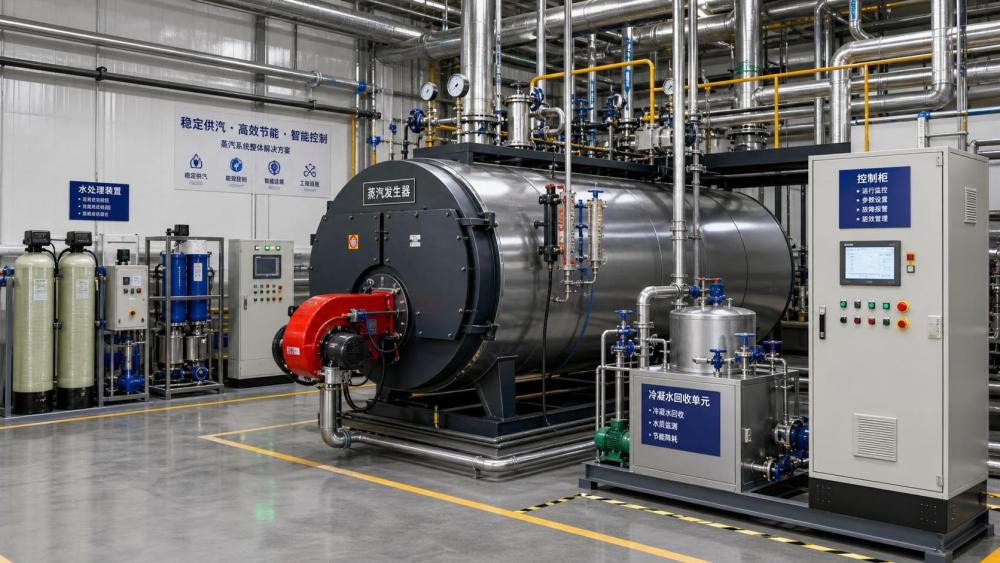
During evaluation, ask for a clear boundary of supply. That includes not only the main steam generation unit, but also burners, pumps, valves, controls, water treatment interfaces, stack or vent requirements, safety devices, skids, insulation scope, and commissioning responsibilities. Many disputes later come from components that both sides assumed were included.
After-sales support is not a side topic
A steam system may operate for years, but its reliability depends on recurring support: commissioning, operator training, maintenance planning, troubleshooting response, spare parts supply, and control adjustments after actual site conditions are observed. This is where many low-price decisions become expensive.
When reviewing a steam generation systems supplier, do not ask only whether support exists. Ask how it works. Is startup handled directly or through a third party? Who performs tuning if operating conditions differ from the design assumptions? How are spare parts identified and ordered? Is there a documented service process for urgent faults? Are control updates or parameter changes manageable locally?
These questions are especially important if your plant team is lean or if the system will be installed in a region where specialist service access may be slower. Strong technical support is not just about emergencies. It affects how quickly your operators become confident, how accurately alarms are interpreted, and how often small issues are corrected before they become shutdowns.
Supplier credibility is easier to test than many people think
You do not need marketing language to judge credibility. You need consistency. A credible supplier usually provides coherent technical documentation, asks relevant application questions, states design assumptions clearly, and does not hide behind broad promises. Their proposal should show that they understand the connection between thermal performance, controls, installation conditions, and maintenance practice.
Look closely at the quality of their responses during the quotation stage. Are technical comments specific or generic? Do they explain limitations openly? Can they describe where responsibility starts and ends? Do drawing packages, utility requirements, and operating assumptions align with each other? Gaps at this stage often grow later.
It can also be useful to review how the supplier discusses adjacent process areas. In industrial sectors that depend on cooling, compressed air, vacuum, and heat exchange performance, steam generation is rarely isolated from the broader thermal picture. Suppliers that understand these interdependencies tend to make fewer oversimplified recommendations, especially where energy efficiency and process stability are both under pressure.
Watch for pricing that is low because scope is thin
Lower pricing is not always a warning sign, but it should trigger a closer reading of scope and assumptions. Some quotations look competitive because they exclude commissioning days, omit controls integration, assume ideal water conditions, leave piping tie-ins to others, or provide only basic instrumentation. None of those exclusions are automatically wrong. The problem begins when they are not obvious.
Instead of asking which proposal is cheapest, ask which one is easiest to compare fairly. Put the offers side by side and normalize them by scope. If one supplier includes start-up support, operator training, and control integration notes while another does not, the price difference may not represent equipment value alone.
This is also where life-cycle thinking becomes practical rather than theoretical. Fuel flexibility, turndown behavior, maintenance intervals, accessibility for routine service, and consumable requirements often have more operational impact than the initial purchase gap. You do not need promised savings figures to recognize that poor maintainability or unstable load response will create cost later.
Questions worth raising before final approval
By the time you are close to a decision, the remaining issues should be very concrete. The most useful questions are usually the ones tied to operating reality:
- How does the system respond during rapid demand changes?
- What site conditions are assumed for water quality and condensate return?
- Which items must be provided by others before commissioning can start?
- What alarms, interlocks, and control interfaces are standard?
- Which maintenance tasks are routine, and what access is required to perform them?
- What parts are considered critical spares at handover?
- How are performance deviations investigated after startup?
If the answers remain abstract, treat that as useful information. Suppliers do not need to claim certainty about every field condition, but they should be able to explain their assumptions, flag unknowns, and show a method for resolving them.
Where information platforms help during selection
For teams comparing options across different technologies or supplier profiles, independent sector intelligence can help separate fashionable claims from practical relevance. In markets shaped by fuel cost shifts, emissions pressure, water constraints, and broader thermal system integration, the choice is easier when technical evaluation is supported by current industry context rather than product literature alone.
That is particularly useful when the discussion touches related topics such as low-NOx combustion direction, integration with heat recovery strategy, the effect of utility quality on reliability, or the way steam generation interacts with cooling and compressed air loads in energy planning. Good buying decisions are rarely made from one document alone; they improve when technical comparison is paired with informed market awareness.
The safest choice is usually the supplier that reduces uncertainty early
In many purchases, people expect the winning supplier to stand out because of a dramatic feature or a noticeably lower price. With steam systems, the better choice is often less dramatic. It is usually the supplier that asks better questions early, defines scope clearly, acknowledges constraints, and gives you enough technical detail to predict installation and operating demands before the order is placed.
If you are evaluating a steam generation systems supplier, the main task is not to find the most impressive presentation. It is to find the supplier whose proposal still makes sense after your operations team, maintenance team, utilities team, and project team have all tested it from their own angle. That kind of alignment tends to prevent the avoidable problems that appear only after the equipment is on site, when changes are slower and more expensive.
In the end, a sound selection process is less about chasing the perfect specification and more about removing assumptions. The more clearly a supplier can connect your process needs, site conditions, service expectations, and long-term operating realities, the easier it becomes to make a decision that holds up after commissioning, not just during procurement review.
Related News
- Boiler Optimization: Cutting Fuel Use Without Compromising Steam ReliabilityAuthor :Thermal Energy Strategist

- How to size thermal fluid systems for stable process temperaturesAuthor :Thermal Energy Strategist

- Industrial Boiler Heat Recovery: Diagnosing Lost Savings in Existing PlantsAuthor :Thermal Energy Strategist

- Boiler Heat Recovery Systems: Sizing Waste-Heat Recovery for Stable Steam LoadsAuthor :Thermal Energy Strategist

- Can Condensing Boilers Cut NOx Emissions Without Creating Corrosion Risks?Author :Thermal Energy Strategist

- Low-NOx Boilers Industry Trends: What New Rules Mean for Plant UpgradesAuthor :Thermal Energy Strategist

- A Practical Roadmap for Industrial Steam System Decarbonization ProjectsAuthor :Thermal Energy Strategist

- Industrial Steam System Vendor Comparison: Criteria Beyond Equipment PriceAuthor :Thermal Energy Strategist

- How to Choose an Industrial Steam Generator for Load Profile, Fuel, and RedundancyAuthor :Thermal Energy Strategist

- When Does a Heat Recovery Steam Generator Make Economic Sense?Author :Thermal Energy Strategist

- How pressure control prevents unstable steam supply in industrial systemsAuthor :Thermal Energy Strategist

- How excess air affects boiler efficiency in steam systemsAuthor :Thermal Energy Strategist

- When a Refinery Steam Turbine Should Prioritize Process Steam Over Maximum OutputAuthor :Thermal Energy Strategist

- Which boiler upgrades deliver the fastest efficiency cost reductionAuthor :Thermal Energy Strategist

- What to check before choosing a steam generation systems supplierAuthor :Thermal Energy Strategist

- When do industrial boiler systems cost less than electric heatAuthor :Thermal Energy Strategist

- How to Compare Boiler Systems in Latin America by Fuel Cost and ComplianceAuthor :Thermal Energy Strategist

- How to Size Low-Pressure Industrial Steam Systems for Stable Heat DemandAuthor :Thermal Energy Strategist

- Low Emissions Boilers: What to Compare Before You ChooseAuthor :Thermal Energy Strategist

- Low-NOx Boilers Cost Breakdown: Upfront Price, Fuel Savings, and PaybackAuthor :Thermal Energy Strategist

- Boiler Combustion Systems: Common Causes of Unstable Fuel PerformanceAuthor :Thermal Energy Strategist

- Hot Water Industrial Boilers: When Efficiency Gains Justify ReplacementAuthor :Thermal Energy Strategist

- What Boiler Efficiency Really Means in Daily Operation and Energy BillsAuthor :Thermal Energy Strategist

- Boiler Efficiency Testing Methods That Expose Heat Loss and Fuel WasteAuthor :Thermal Energy Strategist

- Industrial Burner Systems: Key Factors for Safe Heat OutputAuthor :Thermal Energy Strategist

- Gas-Fired Boiler Combustion Technology: Key Efficiency and Emissions Trade-OffsAuthor :Thermal Energy Strategist

- Unfired Heat Recovery Steam Generators: When Do They Pay Off?Author :Thermal Energy Strategist

- How to Evaluate Steam Generation Systems Electric for Process Heat ProjectsAuthor :Thermal Energy Strategist

- Thermal Power Systems for Industrial Heating: Common Sizing Mistakes to AvoidAuthor :Thermal Energy Strategist

- Low-NOx Condensing Boilers: How to Compare Efficiency and EmissionsAuthor :Thermal Energy Strategist
![]()
- Low Emissions Boilers for Food Processing: Key Compliance and Fuel Cost FactorsAuthor :Thermal Energy Strategist

- Steam System Efficiency Calculation: Key Inputs That Change the ResultAuthor :Thermal Energy Strategist

- How to Evaluate a Steam Boiler Components Exporter Before OrderingAuthor :Thermal Energy Strategist

- Burner Systems Troubleshooting: Common Efficiency Loss CausesAuthor :Thermal Energy Strategist

- EU PED Q2 Rules Require Digital Compliance TagsAuthor :Thermal Energy Strategist

- Thermal Power Systems: Key Efficiency Risks in Daily OperationAuthor :Thermal Energy Strategist