


How does boiler burner control respond to changing steam demand?




When steam demand changes, a boiler must adjust heat input without losing pressure stability or compromising safe combustion. In boiler combustion systems, burner control provides the link between changing process loads and the fuel and air delivered to the flame. For technical evaluators, the important question is not simply whether a burner can modulate, but how quickly and reliably the complete system responds across its operating range.
A demand increase may be obvious when a large process valve opens. It may also emerge gradually as several users draw more steam. In either case, the boiler experiences a mismatch between steam production and steam leaving the system. Pressure begins to change, and the control system acts to restore the balance.
From steam demand to burner firing rate
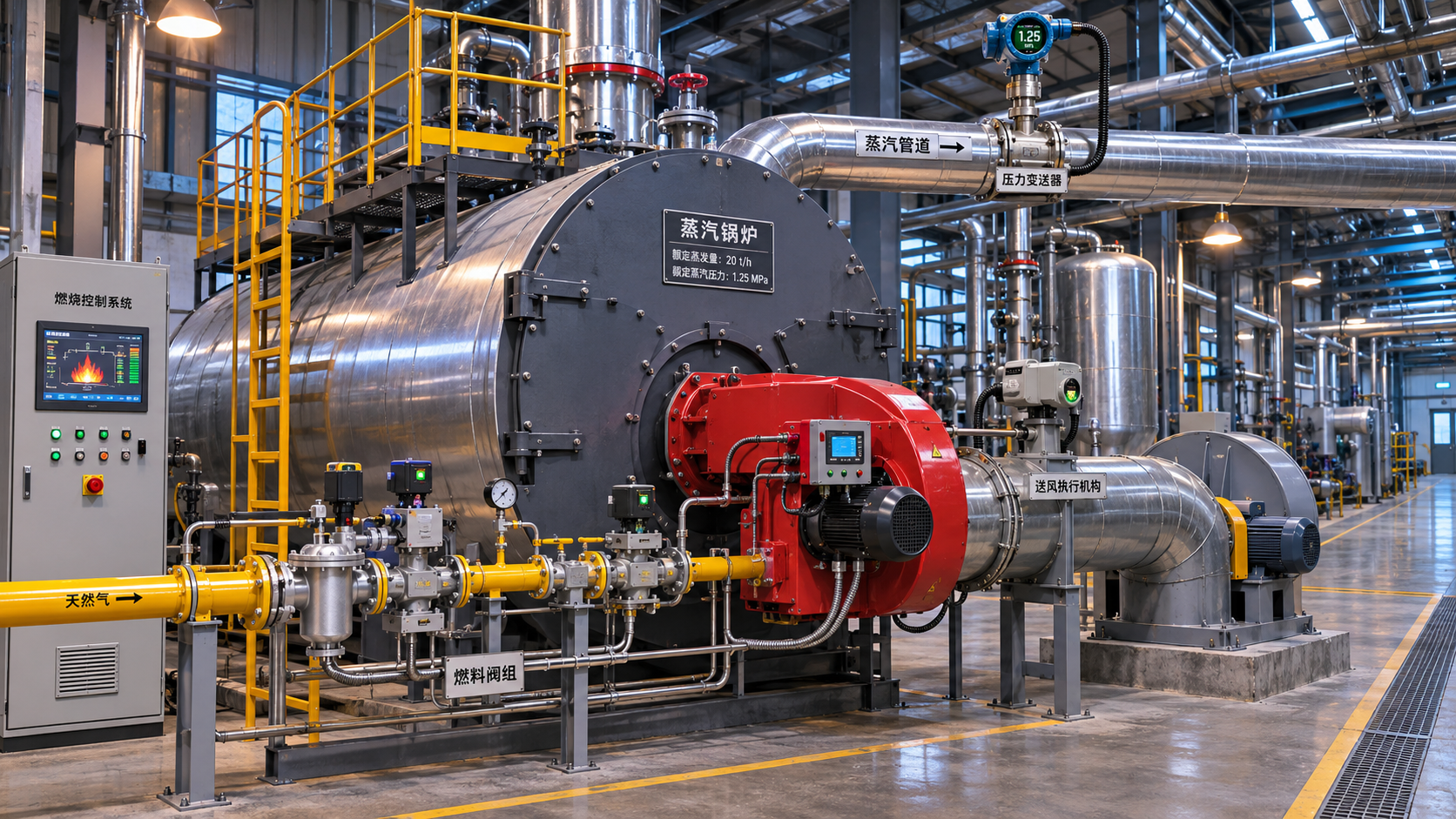
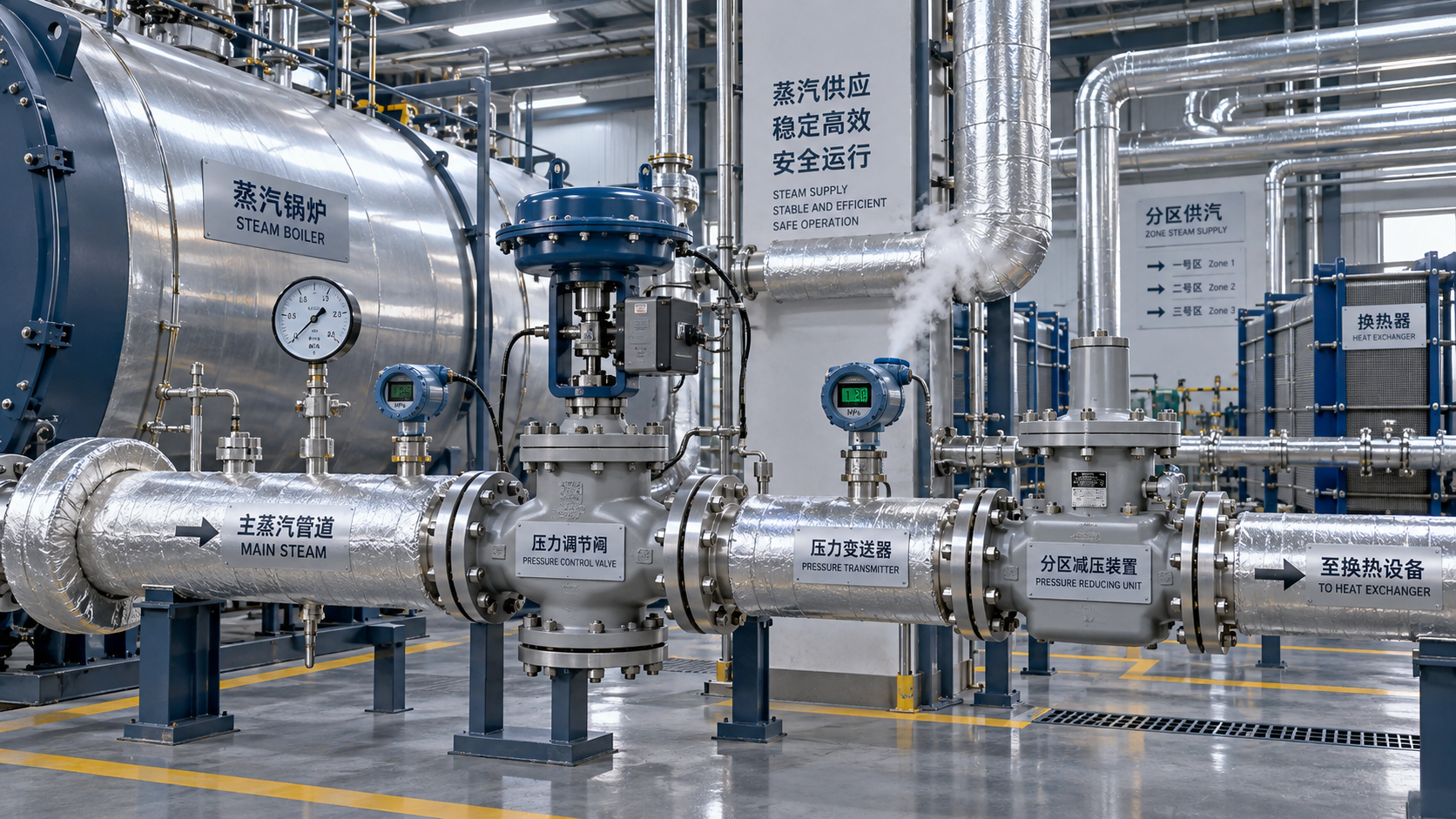
In a common pressure-based arrangement, a transmitter measures steam header or boiler pressure and sends the signal to a boiler master controller. The controller compares actual pressure with a setpoint. If demand rises and production initially falls behind, pressure drops; the controller calls for a higher firing rate. When demand falls, pressure rises and the firing demand is reduced.
The response is not instantaneous. The pressure signal must change, the controller must issue a command, actuators must move, and the furnace and water inventory must absorb the consequences. Steam pressure is therefore both a control signal and a symptom of the mismatch. A well-tuned system limits the size and duration of that mismatch without making the burner chase every minor fluctuation.
Most modulating controls use proportional-integral, or PID, logic, sometimes with derivative action. Proportional action responds to the present pressure error; integral action addresses a persistent offset. Excessive controller gain or integral action can produce oscillation, while overly conservative tuning may allow pressure to drift during a load change. Tuning should account for actuator speed, boiler response and the dynamics of the steam system, not just the controller settings.
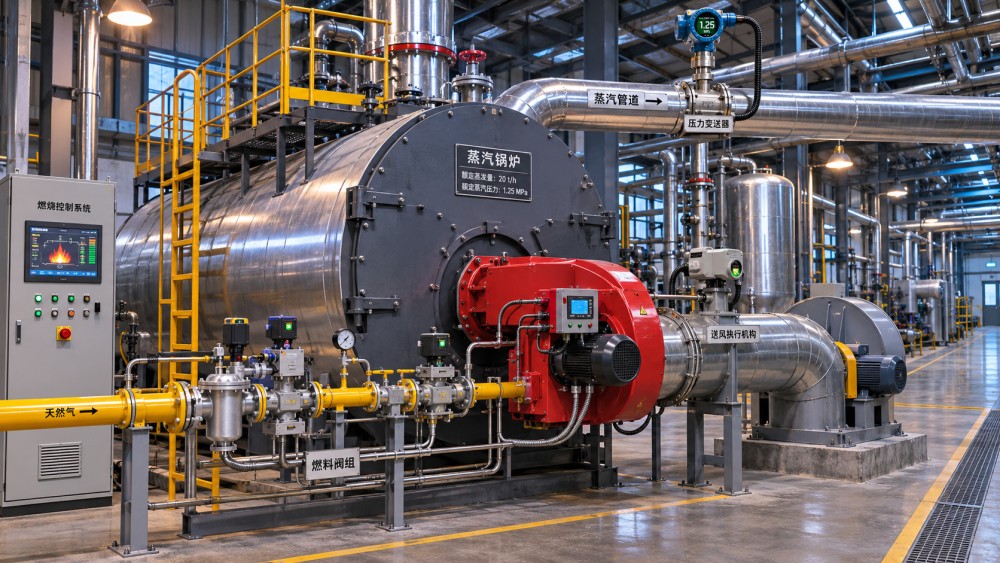
In larger or more demanding installations, steam flow can provide an additional indication of load change. A feedforward signal allows the controller to anticipate some of the required firing adjustment, while pressure feedback corrects the remaining error. This arrangement can improve response, but only when the flow measurement is reliable and the feedforward relationship is commissioned for the plant. Steam flow alone does not replace pressure feedback or the required combustion safeguards.
What changes at the burner?
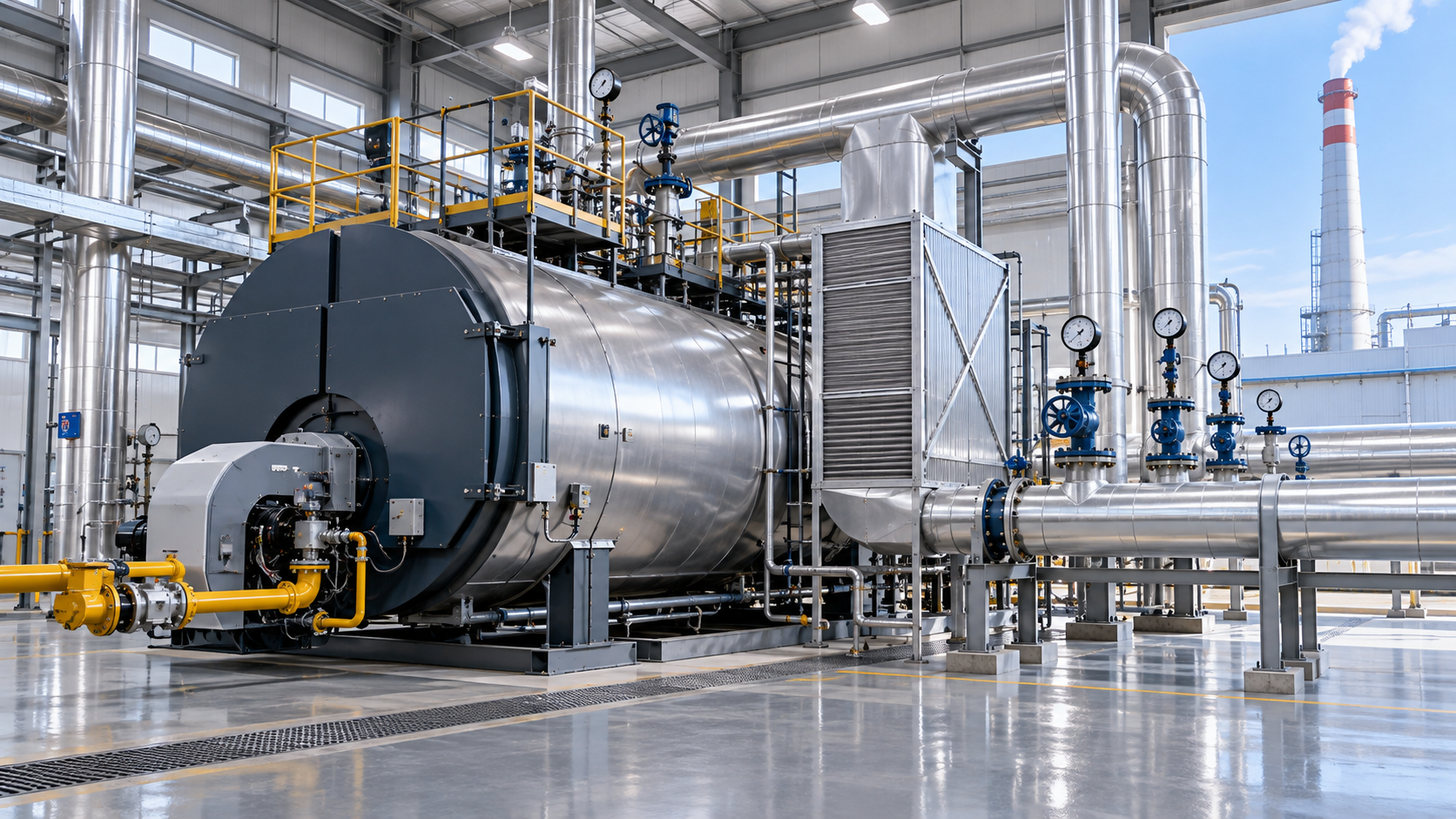
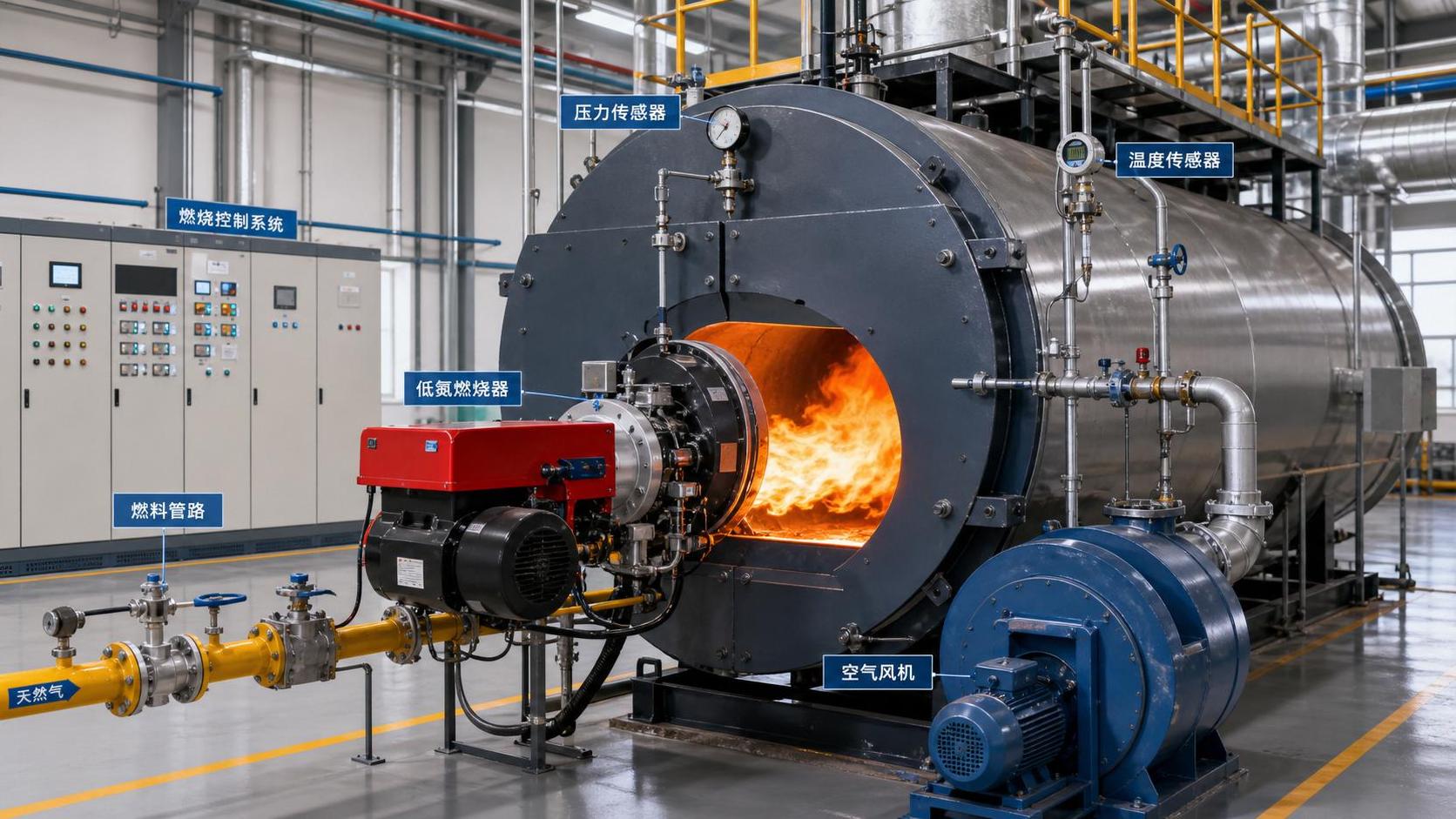
A firing-rate demand is translated into coordinated changes in fuel and combustion air. Depending on the burner, control may move a fuel valve and an air damper through a mechanical linkage, position them independently with electronic actuators, or use a more comprehensive metered combustion-control arrangement.
The distinction matters because the desired fuel-air relationship changes over the firing range. Too little air can cause incomplete combustion, carbon monoxide formation, smoke or an unstable flame. Too much air carries heat out through the stack and can reduce efficiency. The acceptable balance also depends on fuel properties, burner design, furnace conditions and emissions requirements.
Coordinating fuel and air
On an increase in firing demand, many cross-limited control schemes arrange for air flow to lead the fuel increase. On a decrease, fuel is reduced before air. This sequencing is intended to avoid a temporary fuel-rich condition during a transition. In a typical metered system, measured fuel and air flows are used in the limiting logic; a controller that merely positions actuators in sequence should not automatically be assumed to provide the same protection.
Linkage-based controls can be effective when correctly set up and maintained, but wear, backlash and changing damper characteristics can affect repeatability. Electronic parallel positioning permits independent actuator curves, although accurate position alone does not prove that the required air and fuel flows are present. Metered systems add flow measurements and control loops, bringing greater visibility and complexity. Evaluators should ask how the design detects a failed signal and what happens if actual flow does not follow the command.
Oxygen trim is a correction, not a substitute
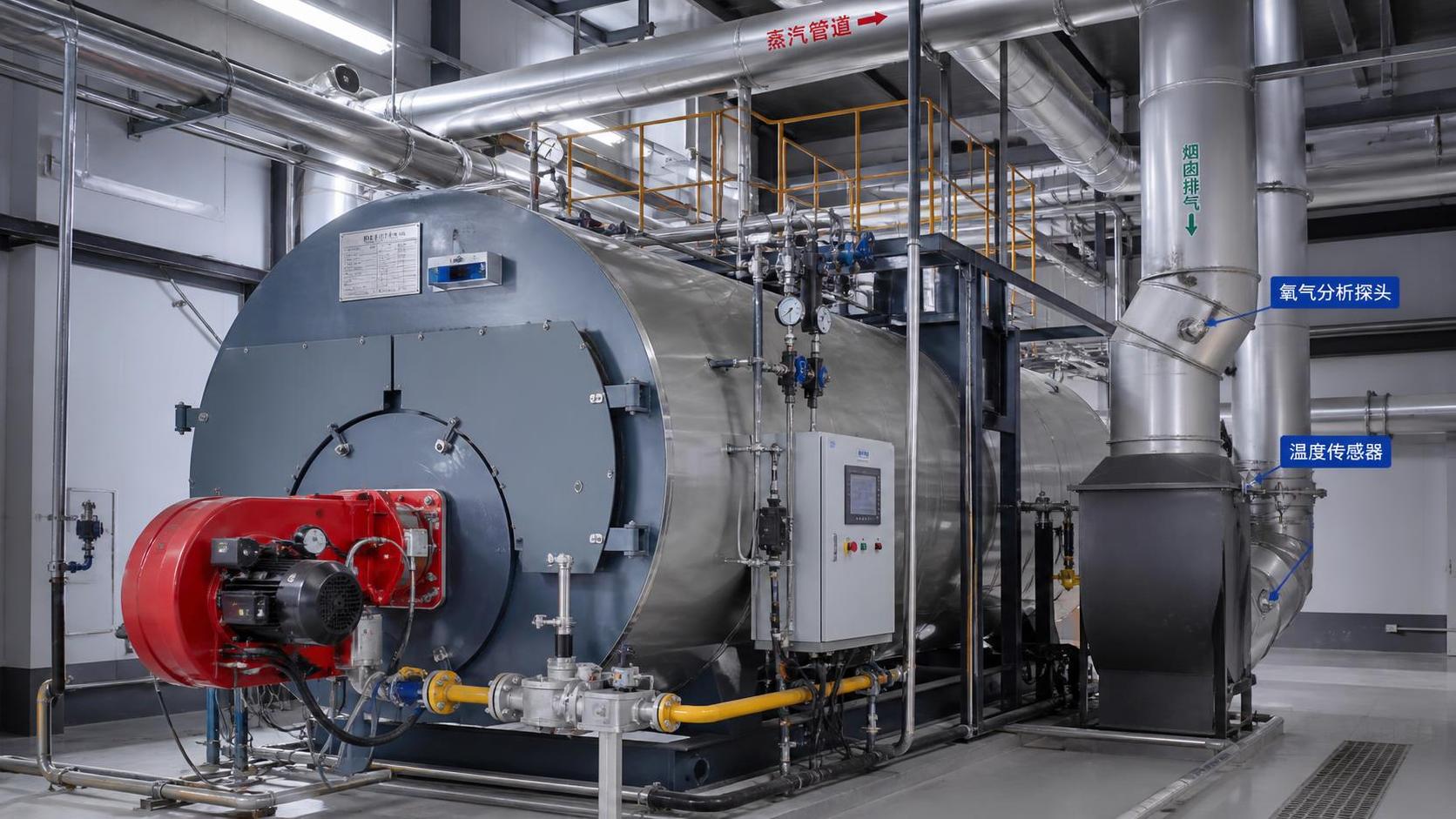
Some systems use a flue-gas oxygen analyzer to make relatively small adjustments to the air-fuel relationship. Oxygen trim can compensate for gradual changes in conditions, but it depends on a representative sample, a maintained analyzer and suitable limits. An oxygen reading by itself does not establish complete combustion; carbon monoxide monitoring and combustion testing may also be needed. Trim must not override protective limits or replace a correctly commissioned base fuel-air curve.
Modulation, staging and the limits of turndown
Burner response depends strongly on whether firing is modulating, staged or on-off. An on-off burner stops and starts to maintain pressure within a switching band. A staged burner moves between discrete firing levels. A modulating burner varies output within an approved range, which can reduce pressure swings and cycling when the load stays inside that range.
Turndown is the ratio between maximum and minimum stable firing rates under specified conditions. A wider stated range may be useful, but it is not a complete performance guarantee. At low fire, flame stability, fuel pressure, air distribution and emissions can constrain operation. The evaluator should distinguish the burner’s advertised turndown from the usable range of the installed burner, boiler, fuel train and control system.
If demand falls below minimum stable firing, the burner will generally cycle off once the applicable pressure limit or control threshold is reached. Restarting requires the prescribed start-up sequence, including any required purge and flame-establishment checks. Frequent cycling can increase purge losses and component wear, and it may signal an oversized boiler, poor load sharing or a minimum firing rate that is too high for normal demand.
At the other end of the range, a burner already at maximum output cannot correct a sustained steam deficit by control action alone. Pressure will continue to fall until demand decreases, another boiler contributes, stored energy is drawn down or a process limit is reached. Faster tuning cannot create missing capacity.
Why a stable pressure trend can hide a combustion problem
Pressure is useful, but it is not a full picture of burner performance. A boiler may maintain header pressure while operating with excessive excess air, elevated carbon monoxide or repeated actuator corrections. Conversely, a brief pressure dip after a large load step may be acceptable if recovery is controlled and process limits are respected.
For a technical review, compare time-aligned trends rather than inspecting one value in isolation:
- Steam pressure and setpoint: Look at deviation, recovery time and repeated overshoot during representative load changes.
- Firing demand and actual response: Check for output saturation, actuator lag, sticking or oscillation.
- Fuel and air measurements: Where available, verify that actual flows follow the intended relationship during both increases and decreases.
- Flue-gas oxygen and carbon monoxide: Review steady-state and transient behavior, considering analyzer response time and sampling limitations.
- Starts, stops and operating hours: Examine cycling frequency alongside the load profile and minimum firing rate.
These observations are more useful when paired with fuel pressure, draft and relevant process events. A sudden pressure dip caused by a large steam valve opening calls for a different investigation from a slow oscillation caused by a poorly tuned loop or a sticky actuator. Data resolution also matters: a trend recorded too slowly can conceal a short-lived control or combustion excursion.
Where burner control meets boiler-wide constraints
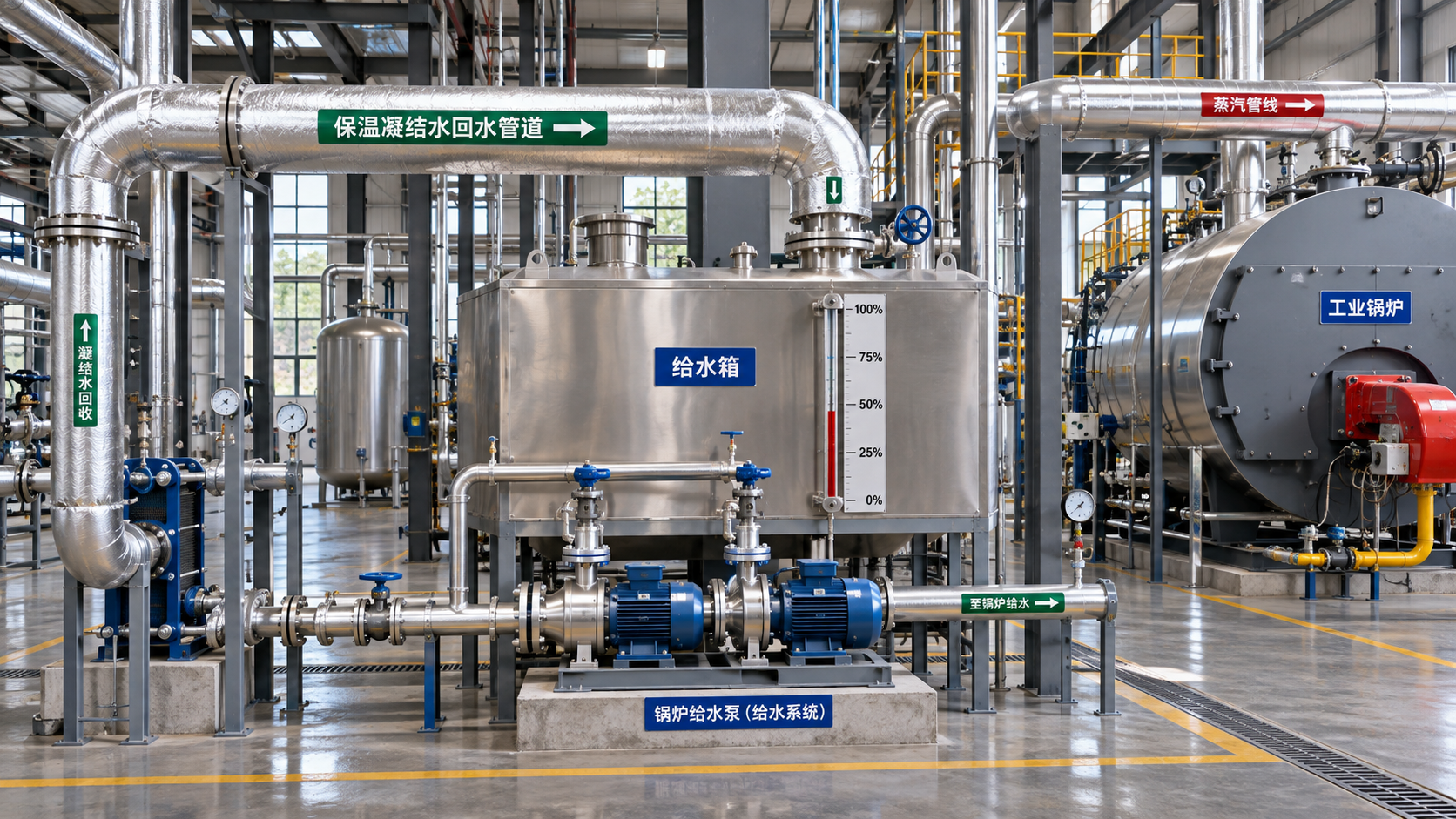
Combustion control does not operate in isolation. Feedwater control must maintain an appropriate drum water level through changing loads. A rapid increase in steaming can cause apparent water-level swell, while a reduction can cause shrink; level response should not be interpreted as a simple inventory change. Depending on boiler size and duty, single-element or multi-element level control may be used to address these dynamics.
Furnace draft and combustion-air supply also influence the response. Fan capacity, damper condition, variable-speed drive limits and changes in air inlet conditions can all affect the air available at a given command. Fuel supply pressure, valve sizing and fuel composition are equally relevant. If an actuator reaches its limit, the controller may continue demanding a correction that the equipment cannot deliver.
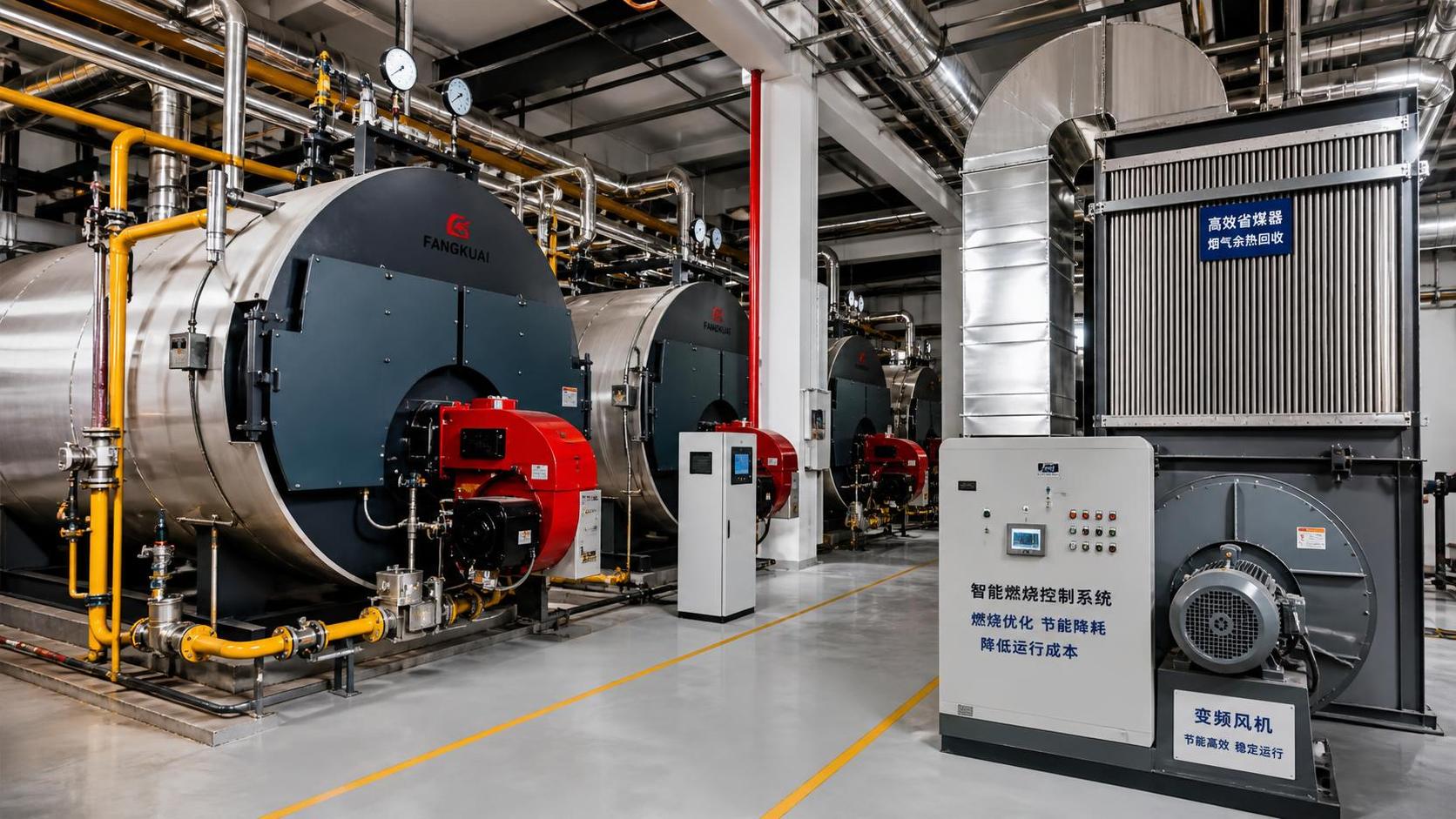
For multiple boilers feeding a common header, a plant master or sequencing system may distribute demand and decide when to bring capacity online. Individual boiler controls then manage their assigned load within their own limits. Poorly coordinated boilers can fight each other, causing unnecessary cycling or uneven loading even when each burner is properly tuned on its own.
Control is not the same as protection
The combustion control system regulates firing during normal operation. The burner management system performs safety-related sequencing and protective functions, such as checking permissives, supervising the start-up sequence and responding to loss of flame. Their exact architecture varies, but normal pressure-control logic should not be treated as a replacement for required protective functions.
Depending on the installation, protective inputs may include low water, inadequate combustion air, unsuitable fuel pressure, flame failure and high steam pressure. The required response, reset arrangements and proof of operation depend on the equipment design and applicable rules. A high-pressure operating control, for example, should not be assumed to replace an independent high-pressure limit where one is required.
Standards and regulations are jurisdiction- and application-dependent. Relevant references may include NFPA 85 for covered boiler and combustion systems, NFPA 86 for certain ovens and furnaces rather than ordinary steam boilers, EN 12952 or EN 12953 for applicable water-tube or shell boilers, and local pressure-equipment and emissions requirements. Confirm the edition, scope and authority having jurisdiction before drawing compliance conclusions. Manufacturer instructions and the approved system design remain essential to commissioning, testing and maintenance.
Questions to take into a technical evaluation
The most useful evaluation begins with the load the plant actually sees: normal and minimum steam demand, the size and frequency of load steps, acceptable pressure variation and the time available to start standby capacity. Those requirements give meaning to burner response claims.
Ask the supplier or project team to explain how firing demand is generated, how fuel and air are coordinated during transients, and which measurements prove that the commanded response occurred. Request the operating limits for each fuel, the basis of the stated turndown and the expected behavior below minimum fire. For oxygen trim or feedforward, ask about sensor failure, fallback modes and commissioning requirements.
Finally, establish how performance will be verified under safe, representative conditions. A witnessed load test and a review of trends across the operating range can reveal issues that a single full-load combustion reading will not. The goal is not the fastest possible burner movement; it is a controlled response that supports steam pressure, combustion quality and the protective boundaries of the whole boiler system.
Ready when you are. Send us a message to get started.
Related News
- How condensate recovery improves steam system thermal efficiencyAuthor :Thermal Energy Strategist

- How does boiler burner control respond to changing steam demand?Author :Thermal Energy Strategist

- How to size an industrial steam boiler for your facilityAuthor :Thermal Energy Strategist

- Do low-emission steam boilers use less fuel?Author :Thermal Energy Strategist

- When high-pressure waste heat recovery boilers make economic senseAuthor :Thermal Energy Strategist

- How steam generation efficiency shapes thermal power system designAuthor :Thermal Energy Strategist

- Boiler Optimization: Cutting Fuel Use Without Compromising Steam ReliabilityAuthor :Thermal Energy Strategist

- How to size thermal fluid systems for stable process temperaturesAuthor :Thermal Energy Strategist

- Industrial Boiler Heat Recovery: Diagnosing Lost Savings in Existing PlantsAuthor :Thermal Energy Strategist

- Boiler Heat Recovery Systems: Sizing Waste-Heat Recovery for Stable Steam LoadsAuthor :Thermal Energy Strategist

- Can Condensing Boilers Cut NOx Emissions Without Creating Corrosion Risks?Author :Thermal Energy Strategist

- Low-NOx Boilers Industry Trends: What New Rules Mean for Plant UpgradesAuthor :Thermal Energy Strategist

- A Practical Roadmap for Industrial Steam System Decarbonization ProjectsAuthor :Thermal Energy Strategist

- Industrial Steam System Vendor Comparison: Criteria Beyond Equipment PriceAuthor :Thermal Energy Strategist

- How to Choose an Industrial Steam Generator for Load Profile, Fuel, and RedundancyAuthor :Thermal Energy Strategist

- When Does a Heat Recovery Steam Generator Make Economic Sense?Author :Thermal Energy Strategist

- How pressure control prevents unstable steam supply in industrial systemsAuthor :Thermal Energy Strategist

- How excess air affects boiler efficiency in steam systemsAuthor :Thermal Energy Strategist

- When a Refinery Steam Turbine Should Prioritize Process Steam Over Maximum OutputAuthor :Thermal Energy Strategist

- Which boiler upgrades deliver the fastest efficiency cost reductionAuthor :Thermal Energy Strategist

- What to check before choosing a steam generation systems supplierAuthor :Thermal Energy Strategist

- When do industrial boiler systems cost less than electric heatAuthor :Thermal Energy Strategist

- How to Compare Boiler Systems in Latin America by Fuel Cost and ComplianceAuthor :Thermal Energy Strategist

- How to Size Low-Pressure Industrial Steam Systems for Stable Heat DemandAuthor :Thermal Energy Strategist

- Low Emissions Boilers: What to Compare Before You ChooseAuthor :Thermal Energy Strategist

- Low-NOx Boilers Cost Breakdown: Upfront Price, Fuel Savings, and PaybackAuthor :Thermal Energy Strategist

- Boiler Combustion Systems: Common Causes of Unstable Fuel PerformanceAuthor :Thermal Energy Strategist

- Hot Water Industrial Boilers: When Efficiency Gains Justify ReplacementAuthor :Thermal Energy Strategist

- What Boiler Efficiency Really Means in Daily Operation and Energy BillsAuthor :Thermal Energy Strategist

- Boiler Efficiency Testing Methods That Expose Heat Loss and Fuel WasteAuthor :Thermal Energy Strategist

- Industrial Burner Systems: Key Factors for Safe Heat OutputAuthor :Thermal Energy Strategist

- Gas-Fired Boiler Combustion Technology: Key Efficiency and Emissions Trade-OffsAuthor :Thermal Energy Strategist

- Unfired Heat Recovery Steam Generators: When Do They Pay Off?Author :Thermal Energy Strategist

- How to Evaluate Steam Generation Systems Electric for Process Heat ProjectsAuthor :Thermal Energy Strategist

- Thermal Power Systems for Industrial Heating: Common Sizing Mistakes to AvoidAuthor :Thermal Energy Strategist

- Low-NOx Condensing Boilers: How to Compare Efficiency and EmissionsAuthor :Thermal Energy Strategist
![]()