How excess air affects boiler efficiency in steam systems




Excess air has a direct and often underestimated effect on steam-system fuel use. A boiler needs some air above the theoretical combustion requirement because fuel, air, and flame temperature are never perfectly uniform across the burner and furnace. That margin protects against incomplete combustion, carbon monoxide formation, smoke, and unstable flame conditions. But every cubic meter of air admitted beyond what combustion requires must also be heated and discharged through the stack. The result is higher flue-gas loss and lower boiler efficiency.
For a technical evaluator, the practical question is not whether excess air should be eliminated. It should not. The decision is whether the measured level is appropriate for the fuel, burner, operating load, furnace condition, and emissions requirements. A boiler can lose efficiency from too much excess air, yet pushing oxygen too low can create a more serious combustion and reliability problem. The usable operating point sits between those risks.
Why excess air lowers thermal efficiency
Combustion requires oxygen. Air supplies that oxygen, but air is mostly nitrogen, which does not release useful heat during combustion. When a burner receives more air than needed, the additional nitrogen and unused oxygen enter the furnace, absorb heat, and leave with the exhaust gases. That heat is no longer available to generate steam.
The effect becomes more significant as stack temperature rises. A high excess-air rate combined with elevated flue-gas temperature is particularly expensive because the boiler is heating a larger mass of gas to a higher temperature before releasing it to the atmosphere. Conversely, a boiler with low stack temperature can still waste fuel if its oxygen level is persistently high, especially during long operating periods.
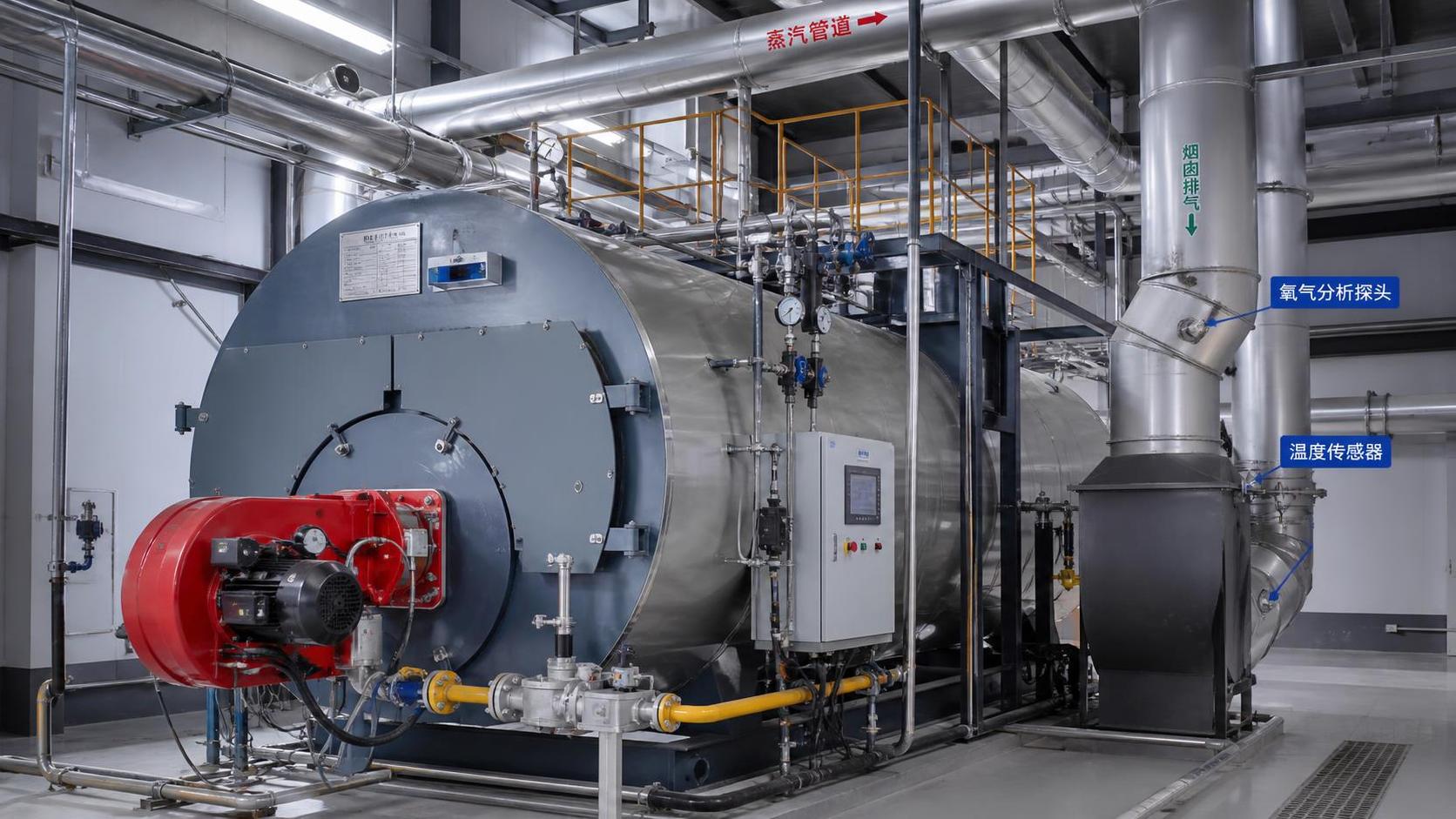
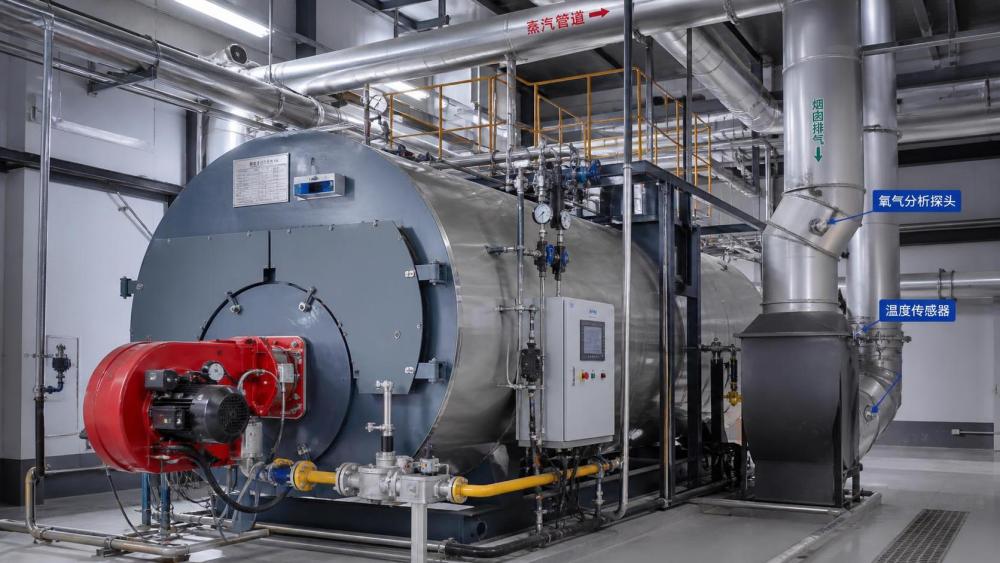
Excess air is commonly inferred from flue-gas oxygen concentration. Higher dry-basis oxygen in the stack usually indicates more combustion air than required, although the interpretation must account for air leakage downstream of the combustion zone. A stack oxygen reading is therefore useful, but it is not automatically proof that the burner itself is receiving too much air.
Boiler efficiency calculations generally reflect this relationship through dry flue-gas losses. As excess air increases, dry flue-gas mass increases. For a given fuel input and stack temperature, that raises the sensible heat lost through the stack. The loss may appear modest in a single operating snapshot, but steam boilers often run for thousands of hours. A small deviation in combustion control can become a material fuel-cost and emissions issue over an annual operating cycle.
Fuel composition changes the magnitude of the effect. Natural gas, fuel oil, coal, biomass, process off-gases, and mixed fuels have different theoretical air requirements, moisture content, ash characteristics, flame behavior, and mixing demands. A target that is workable for a clean gaseous fuel may be unsafe or unrealistic for a solid fuel with variable quality. Evaluators should avoid applying one oxygen target across every boiler type simply because it appears in a commissioning report or control-system default.
More air is not always the same as too much burner air
A high oxygen reading at the stack can originate from several conditions. Only one of them is excessive combustion air intentionally supplied by the forced-draft system. The distinction matters because each cause requires a different corrective action.
- High burner-air setting: The combustion control system, damper position, fan speed, or fuel-to-air curve is supplying more air than the firing rate requires.
- Furnace or boiler leakage: Negative-pressure sections can draw ambient air through doors, observation ports, duct joints, expansion joints, seals, or damaged casing areas.
- Air ingress downstream of the furnace: Leakage around economizers, air heaters, ducts, induced-draft fans, and flue connections can raise measured stack oxygen without improving combustion.
- Faulty measurement: A contaminated oxygen probe, poor probe location, calibration drift, wet-sample handling issues, or delayed analyzer response can misrepresent actual flue-gas conditions.
- Transient operation: Rapid load changes, burner staging, startup, shutdown, and draft disturbances can produce oxygen excursions that should not be treated as steady-state performance.
This distinction is especially important when an efficiency test leads to a recommendation to reduce fan output. If high oxygen is caused mainly by leakage after combustion, reducing burner air may drive the flame toward oxygen deficiency while the stack analyzer continues to show a deceptively acceptable reading. Carbon monoxide, unburned combustibles, furnace pressure behavior, and flame stability may deteriorate before the stack oxygen value reveals the problem.
A useful assessment therefore compares measurements taken as close as practical to the combustion process with those farther downstream. Reviewing furnace draft, damper positions, fan speed, burner registers, and oxygen trends across load points helps establish whether the air is deliberate, uncontrolled, or entering through leakage paths.
The trade-off: efficiency versus incomplete combustion
Reducing excess air improves boiler efficiency only until combustion quality begins to degrade. Below that point, the apparent fuel saving can disappear quickly. Incomplete combustion releases carbon monoxide and may leave unburned fuel components in the flue gas or ash. For liquid and gaseous fuels, poor mixing can cause localized fuel-rich zones even when average stack oxygen appears adequate. For solid fuels, the risk may show up as increased carbon in ash, unstable furnace conditions, slagging behavior, or greater particulate carryover.
Low excess air can also increase nitrogen oxides under some firing conditions because flame temperature and local oxygen availability influence NOx formation. The direction and scale of the emissions response depend on burner design, staged combustion arrangements, fuel properties, flue-gas recirculation, furnace geometry, and control logic. An evaluator should not assume that lowering oxygen will automatically reduce all emissions, or that a low-NOx burner will maintain its emissions performance at every air setting.
Combustion safety remains the governing constraint. Stable flame detection, adequate purge sequences, correct draft, reliable fuel shutoff, and burner-management-system functionality are not efficiency variables to be traded away. Any adjustment to excess-air control should remain within burner manufacturer limits, site operating procedures, permit conditions, and applicable combustion-safety requirements.
The appropriate target is therefore a controlled minimum rather than the lowest possible oxygen reading. It should leave sufficient margin for fuel-quality variation, changes in ambient-air temperature, burner wear, load swings, and instrument uncertainty. A boiler operating with a narrow theoretical margin can look efficient during a brief test and become unreliable during normal production demand.
What technical evaluators should measure
Stack oxygen alone is not enough to judge boiler performance. It should be reviewed with carbon monoxide, stack temperature, firing rate, steam output, feedwater temperature, fuel characteristics, and operating load. The relationship between these variables tells a more reliable story than any one value.
A load-based test is more informative than a single full-load check. Many boilers spend substantial time below rated capacity, where air-fuel control can be less accurate. Mechanical linkages may have nonlinear behavior, damper characteristics can change near low openings, and burner staging may produce step changes in oxygen. A boiler that performs well at high fire can carry excessive air for long periods at low or mid-load.
Trend data also matters. A stable average oxygen value can hide frequent cycling between high oxygen and near-deficient conditions. Short-duration carbon monoxide peaks, fan hunting, or recurring furnace-pressure changes indicate that the control loop may require attention even if daily averages seem acceptable.
Control architecture determines how far optimization can go
The method used to match fuel and air has a strong influence on attainable efficiency. In simple systems, a mechanical linkage connects fuel and air actuators. These systems can be reliable, but calibration can drift as linkages wear, actuators develop backlash, dampers foul, or fuel supply conditions change. Periodic combustion tuning is essential because the original setup does not remain accurate indefinitely.
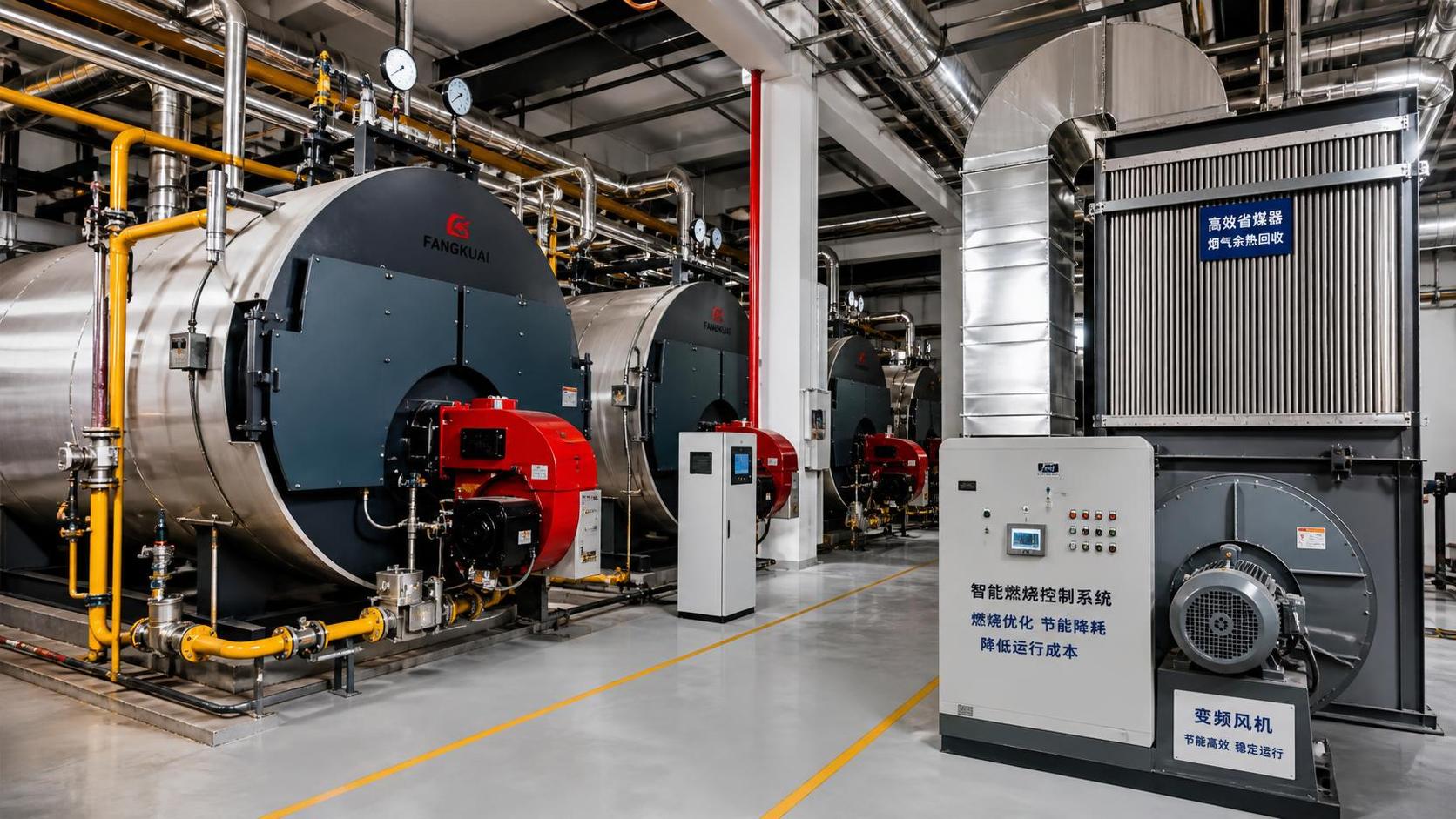
Parallel positioning uses separate actuators for fuel and air, typically coordinated through programmed curves. It can provide better repeatability across load ranges than a mechanical linkage, provided the system has been properly characterized and maintained. Oxygen trim adds flue-gas feedback to correct for deviations from the baseline fuel-air relationship. This is often valuable where ambient conditions, fuel quality, or boiler load vary, but it is not a substitute for sound burner setup.
For applications with demanding load changes or multiple burners, cross-limited combustion control provides an additional safeguard. During load increases, it introduces air before fuel rises; during load decreases, it reduces fuel before air falls. This sequencing reduces the chance of a fuel-rich excursion caused by actuator mismatch or response delay. It may temporarily operate with more air during transitions, which is appropriate because the priority at that moment is stable and safe combustion rather than a theoretical steady-state efficiency maximum.
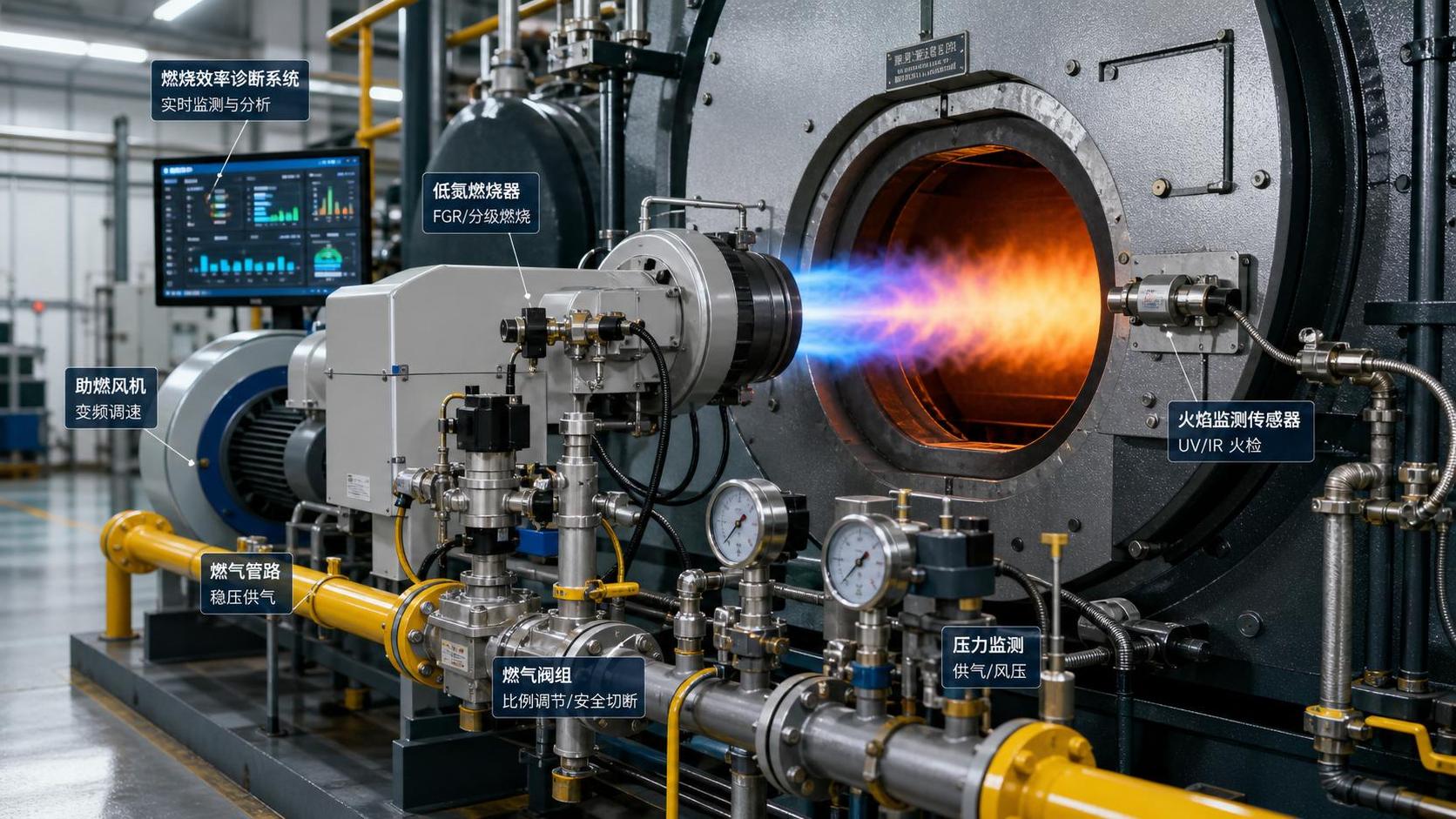
Analyzer maintenance is part of the control architecture, not a peripheral task. Zirconia probes and extractive analyzers can be affected by contamination, temperature exposure, calibration errors, sample-line problems, and slow response. An oxygen-trim loop acting on biased data can steadily move a boiler away from its intended operating point. Functional checks, calibration practices, response verification, and appropriate analyzer location should be included in any optimization plan.
A practical sequence for evaluating an excessive-air problem
The first step is to establish a representative baseline. Select stable operating periods, capture fuel use and steam output, record flue-gas oxygen, carbon monoxide, stack temperature, draft, and control positions, and separate data by boiler load. Startup, shutdown, sootblowing, fuel switching, and unusual process demand should be identified rather than blended into the same baseline.
Next, inspect for leakage before changing combustion settings. Doors, access panels, burner tiles, duct connections, expansion joints, economizer casings, and induced-draft sections deserve particular attention in negative-pressure systems. Leakage repairs can reduce stack oxygen and fan power without narrowing the burner’s combustion safety margin.
Once the measurement system and physical condition are credible, tune the fuel-air relationship through controlled load points. Oxygen should be reduced in small increments while carbon monoxide, flame behavior, furnace pressure, emissions response, and steam-generation stability are monitored. The target should be documented as a curve by load and fuel condition, not expressed only as one stack oxygen number.
Finally, verify the improvement using a consistent efficiency method. Comparing fuel consumed per unit of useful steam under comparable operating conditions is often more meaningful than comparing isolated oxygen readings. A favorable result should persist across the load range the boiler actually serves, with no deterioration in emissions compliance, reliability, or combustion safety.
Where the largest errors occur
Excess-air optimization is often treated as a burner adjustment, but the biggest performance error may sit elsewhere in the steam system. A heavily fouled fireside surface raises stack temperature; poor heat transfer then magnifies the cost of every unit of excess air. An economizer bypass, damaged insulation, incorrect feedwater-temperature assumptions, or excessive blowdown can also mask the benefit of combustion improvements.
That does not make air control less important. It changes the order of analysis. When stack temperature is unusually high, an evaluator should investigate soot, scale, heat-transfer surfaces, gas bypassing, and economizer performance alongside oxygen. When oxygen is high but carbon monoxide is low and combustion appears stable, leakage testing may offer a better return than aggressively retuning the burner.
For steam-system decisions, excess air is best treated as a measurable loss mechanism and a control-quality indicator. A boiler that consistently carries more air than its operating condition requires wastes stack heat and fuel. A boiler tuned too close to oxygen deficiency may sacrifice safety, emissions performance, and availability. The durable objective is a verified load-based combustion curve, credible flue-gas measurement, and a boiler envelope that maintains efficient steam generation without relying on an artificially narrow operating margin.
Ready when you are. Send us a message to get started.
Related News
- When high-pressure waste heat recovery boilers make economic senseAuthor :Thermal Energy Strategist

- How steam generation efficiency shapes thermal power system designAuthor :Thermal Energy Strategist

- Boiler Optimization: Cutting Fuel Use Without Compromising Steam ReliabilityAuthor :Thermal Energy Strategist

- How to size thermal fluid systems for stable process temperaturesAuthor :Thermal Energy Strategist

- Industrial Boiler Heat Recovery: Diagnosing Lost Savings in Existing PlantsAuthor :Thermal Energy Strategist

- Boiler Heat Recovery Systems: Sizing Waste-Heat Recovery for Stable Steam LoadsAuthor :Thermal Energy Strategist

- Can Condensing Boilers Cut NOx Emissions Without Creating Corrosion Risks?Author :Thermal Energy Strategist

- Low-NOx Boilers Industry Trends: What New Rules Mean for Plant UpgradesAuthor :Thermal Energy Strategist

- A Practical Roadmap for Industrial Steam System Decarbonization ProjectsAuthor :Thermal Energy Strategist

- Industrial Steam System Vendor Comparison: Criteria Beyond Equipment PriceAuthor :Thermal Energy Strategist

- How to Choose an Industrial Steam Generator for Load Profile, Fuel, and RedundancyAuthor :Thermal Energy Strategist

- When Does a Heat Recovery Steam Generator Make Economic Sense?Author :Thermal Energy Strategist

- How pressure control prevents unstable steam supply in industrial systemsAuthor :Thermal Energy Strategist

- How excess air affects boiler efficiency in steam systemsAuthor :Thermal Energy Strategist

- When a Refinery Steam Turbine Should Prioritize Process Steam Over Maximum OutputAuthor :Thermal Energy Strategist

- Which boiler upgrades deliver the fastest efficiency cost reductionAuthor :Thermal Energy Strategist

- What to check before choosing a steam generation systems supplierAuthor :Thermal Energy Strategist

- When do industrial boiler systems cost less than electric heatAuthor :Thermal Energy Strategist

- How to Compare Boiler Systems in Latin America by Fuel Cost and ComplianceAuthor :Thermal Energy Strategist

- How to Size Low-Pressure Industrial Steam Systems for Stable Heat DemandAuthor :Thermal Energy Strategist

- Low Emissions Boilers: What to Compare Before You ChooseAuthor :Thermal Energy Strategist

- Low-NOx Boilers Cost Breakdown: Upfront Price, Fuel Savings, and PaybackAuthor :Thermal Energy Strategist

- Boiler Combustion Systems: Common Causes of Unstable Fuel PerformanceAuthor :Thermal Energy Strategist

- Hot Water Industrial Boilers: When Efficiency Gains Justify ReplacementAuthor :Thermal Energy Strategist

- What Boiler Efficiency Really Means in Daily Operation and Energy BillsAuthor :Thermal Energy Strategist

- Boiler Efficiency Testing Methods That Expose Heat Loss and Fuel WasteAuthor :Thermal Energy Strategist

- Industrial Burner Systems: Key Factors for Safe Heat OutputAuthor :Thermal Energy Strategist

- Gas-Fired Boiler Combustion Technology: Key Efficiency and Emissions Trade-OffsAuthor :Thermal Energy Strategist

- Unfired Heat Recovery Steam Generators: When Do They Pay Off?Author :Thermal Energy Strategist

- How to Evaluate Steam Generation Systems Electric for Process Heat ProjectsAuthor :Thermal Energy Strategist

- Thermal Power Systems for Industrial Heating: Common Sizing Mistakes to AvoidAuthor :Thermal Energy Strategist

- Low-NOx Condensing Boilers: How to Compare Efficiency and EmissionsAuthor :Thermal Energy Strategist
![]()
- Low Emissions Boilers for Food Processing: Key Compliance and Fuel Cost FactorsAuthor :Thermal Energy Strategist

- Steam System Efficiency Calculation: Key Inputs That Change the ResultAuthor :Thermal Energy Strategist

- How to Evaluate a Steam Boiler Components Exporter Before OrderingAuthor :Thermal Energy Strategist

- Burner Systems Troubleshooting: Common Efficiency Loss CausesAuthor :Thermal Energy Strategist