Can Condensing Boilers Cut NOx Emissions Without Creating Corrosion Risks?




Yes—condensing boilers can cut NOx emissions without creating unacceptable corrosion risk, but only when combustion control, heat-exchanger design, flue routing, and condensate handling are treated as one system. The failure mode is usually not “low NOx” by itself. Problems arise when a boiler is selected or commissioned around emissions performance alone, while acidic condensate, low return-water temperatures, drain materials, or unstable burner operation are left unresolved.
A typical evaluation scenario starts with a project team seeking lower stack emissions and higher seasonal efficiency from the same plant room. The boiler is expected to operate with cooler flue gases so that latent heat can be recovered. That operating condition is central to condensing efficiency, but it also produces liquid condensate containing dissolved carbon dioxide and, depending on fuel and combustion conditions, nitrogen- and sulfur-related compounds. If this liquid remains where it should not—inside an unsuitable heat exchanger, flue component, trap, or drain connection—corrosion can become a lifecycle issue rather than a maintenance detail.
A sound condensing boiler low nox emissions strategy therefore does not force a trade-off between clean combustion and durability. It requires confirmation that the combustion system reduces NOx consistently, while every wetted component downstream of the flame is suitable for the expected condensate chemistry and temperature profile.
Why low NOx and condensation interact
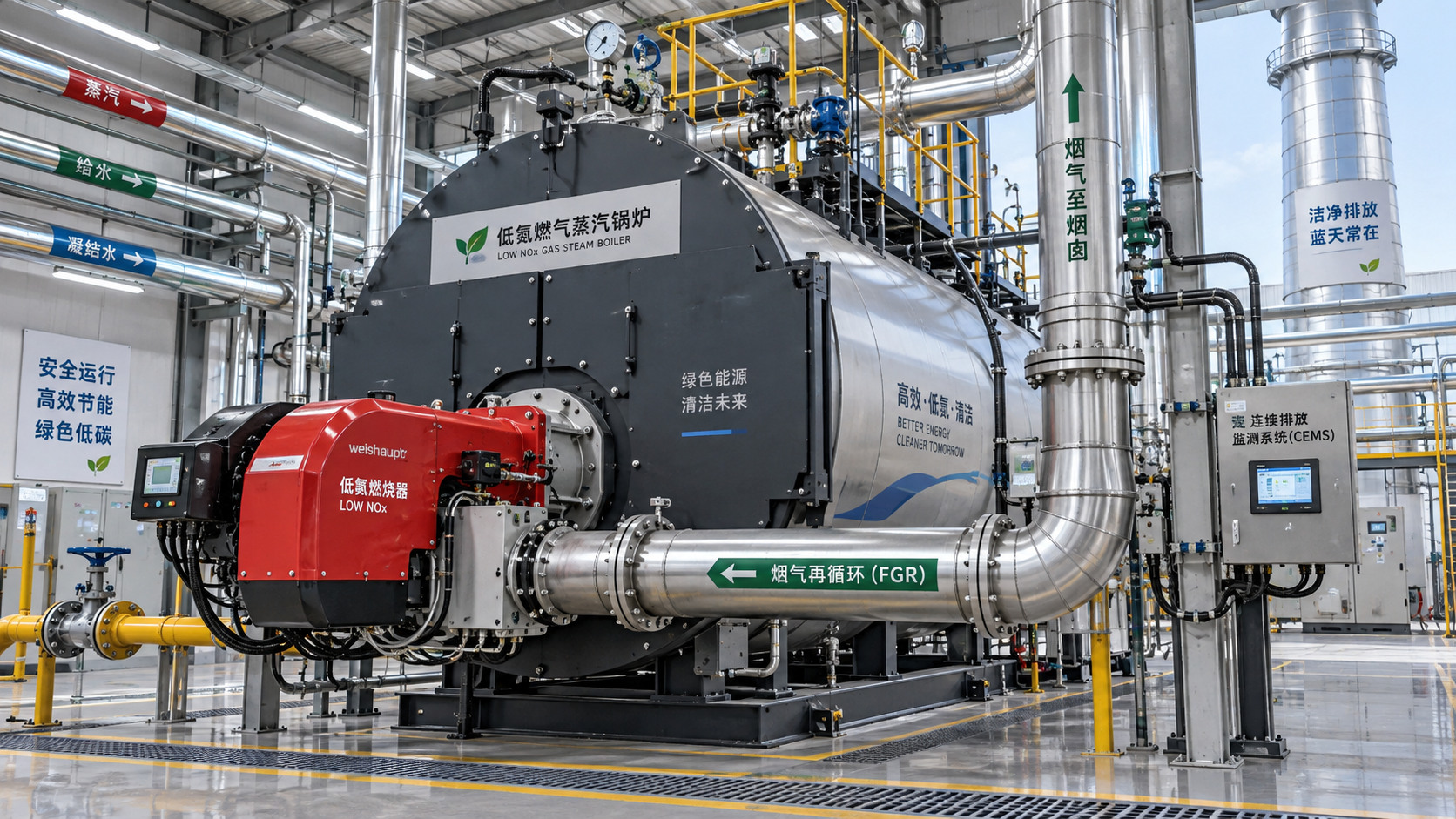
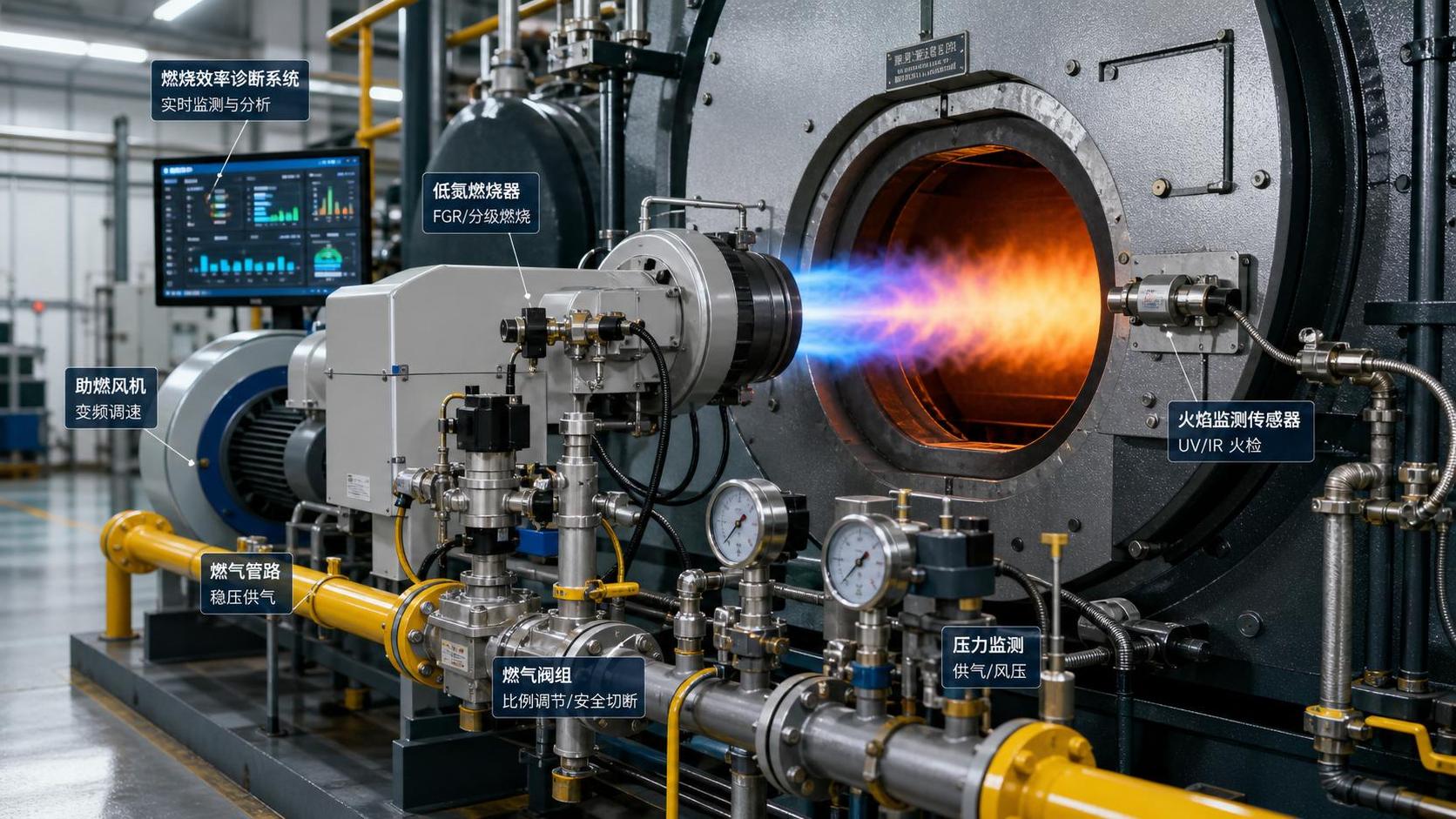
NOx formation in gas-fired boilers is strongly influenced by flame temperature, oxygen availability, residence time, mixing quality, and burner geometry. Low-NOx designs commonly use staged combustion, premixing, flue-gas recirculation, surface combustion, or other methods that moderate peak flame temperature and reduce localized oxygen-rich zones. These approaches can substantially improve emissions performance, but they may also make the burner more sensitive to fuel quality, air balance, pressure variation, and commissioning accuracy.
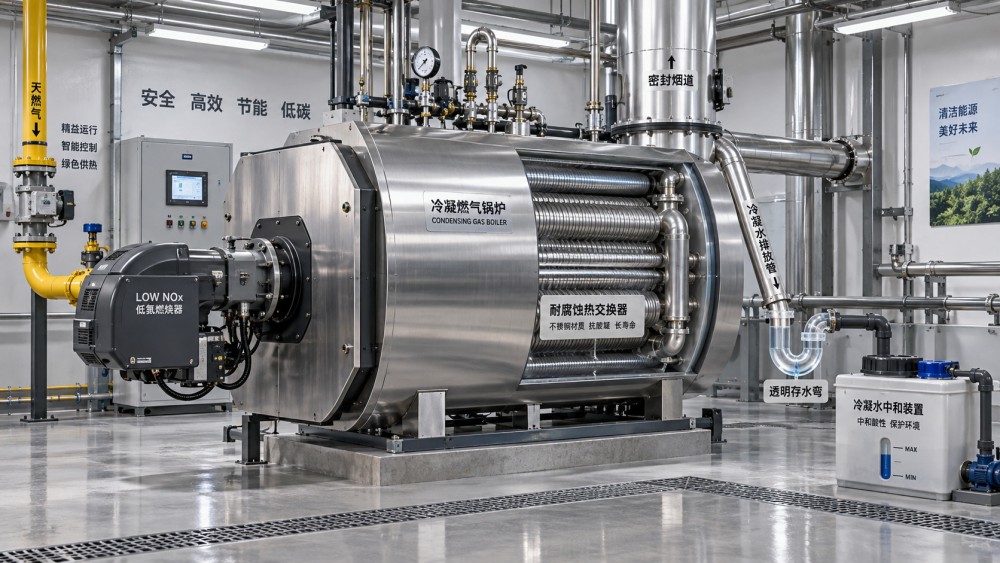
Condensing operation occurs when flue gas is cooled below its water-vapor dew point. Water vapor then becomes liquid and releases latent heat to the boiler heat exchanger. This is desirable from an efficiency perspective, yet the liquid is not neutral. Carbon dioxide dissolved in water forms carbonic acid. Nitrogen oxides can contribute to additional acidity, and fuels containing sulfur create a more demanding condensate environment. Even where sulfur levels are low, repeated wet-dry cycling and deposits can intensify localized attack.
The practical question is not whether condensate exists; a properly operating condensing boiler is designed to produce it. The question is whether the equipment directs it rapidly through compatible surfaces and out of the system without pooling, backflow, blockage, or exposure to materials that cannot tolerate the environment.
The corrosion risks that deserve separate evaluation
“Corrosion” is often used as a single category, but several mechanisms may be active in a condensing boiler installation. Distinguishing them helps prevent a vague assessment from becoming an incorrect specification.
Heat-exchanger attack
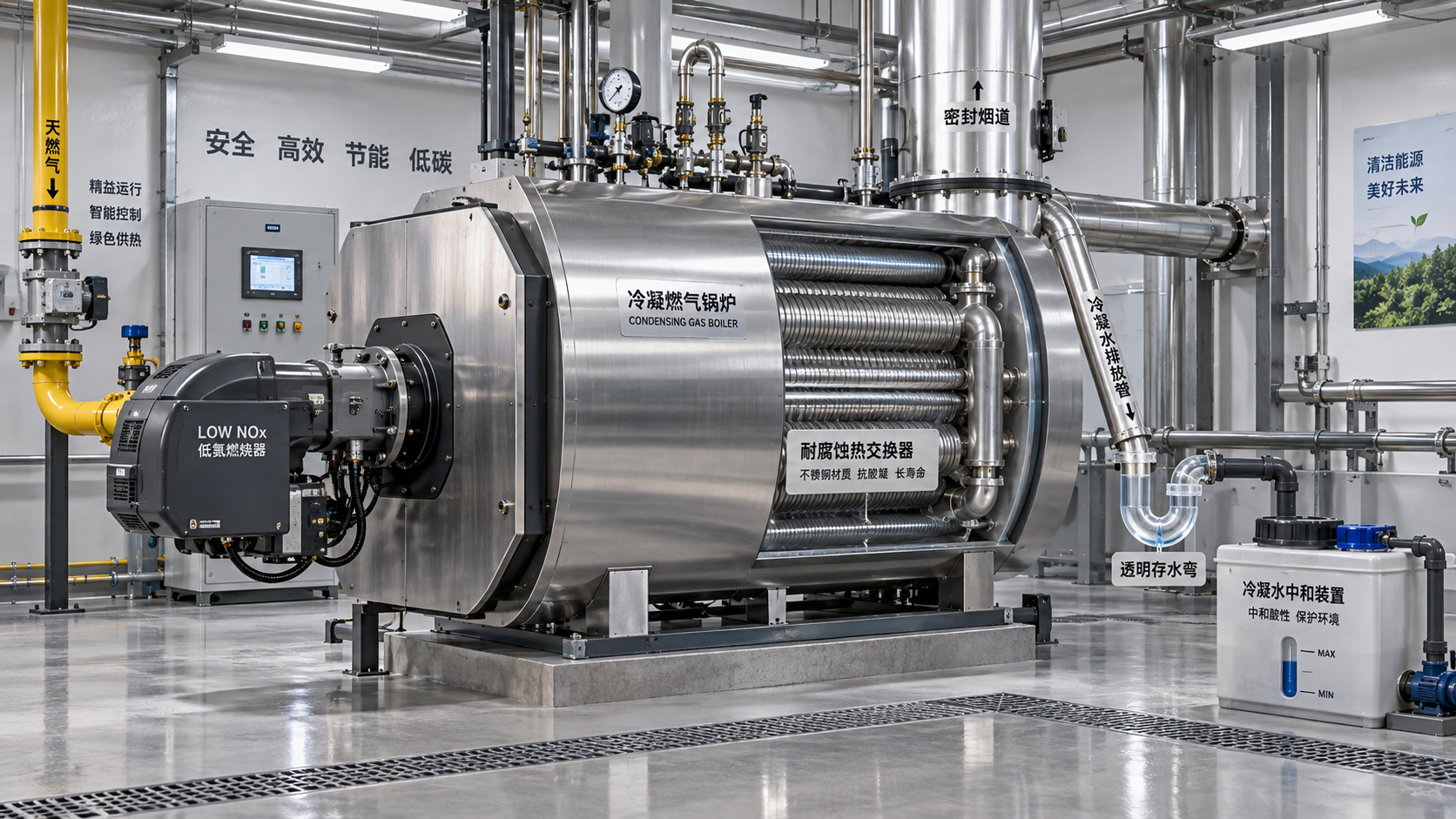
The heat exchanger sees the most sustained combination of heat, condensate, combustion residues, and flow turbulence. Stainless steel and aluminum-silicon alloy heat exchangers are both widely used in condensing applications, but their operating boundaries differ. Material choice must be evaluated together with water chemistry, cleaning practices, allowable condensate exposure, fuel type, and the manufacturer’s stated system requirements.
Stainless steel can provide good resistance in acidic condensate service when the alloy grade, weld quality, and geometry are appropriate. However, chloride contamination from system water, cleaning chemicals, or unsuitable fill water can increase the risk of pitting or crevice corrosion. Aluminum alloys can perform effectively in purpose-designed boiler heat exchangers, but they are generally more dependent on controlled water chemistry and compatible treatment products. A material cannot be judged only by its name; the full boiler design and permitted maintenance regime matter.
Flue-system deterioration
A non-condensing flue may have been selected on the assumption that exhaust gases stay hot and dry. Once a high-efficiency boiler operates in condensing mode, that assumption may no longer hold. Horizontal runs, long common headers, poor slope, uninsulated sections, and cold external terminations can all collect condensate. In those locations, corrosion risk affects flue integrity as well as the boiler itself.
Flue materials should be approved for wet, condensing service and installed with the required gradient toward a controlled condensate collection point. Joint seals also require attention. Acid-resistant pipe is of limited value if gaskets harden, joints leak, or condensate drains back toward the appliance. Shared flue arrangements require particularly careful design because load changes can alter pressure, temperature, and condensate flow across multiple boilers.
Condensate drainage and downstream pipework
Drainage is sometimes treated as a minor installation task, yet it determines whether acidic liquid leaves the appliance safely. The drain line needs an appropriate trap arrangement, suitable materials, adequate slope, freeze protection where required, and access for inspection. A blocked trap or incorrectly configured drain can cause condensate to back up into the boiler or flue collector, creating operating faults and prolonged exposure of internal components.
Where local discharge rules or site drainage conditions require it, condensate neutralization may be necessary before disposal. Neutralization equipment should be sized for realistic firing patterns and maintained because media can become exhausted. Installing a neutralizer without planning inspection and replenishment merely moves the failure point downstream.
Do not judge emissions at one firing point
Low-NOx performance should be assessed across the boiler’s normal modulation range, not only at a preferred laboratory-style load. A burner may behave cleanly and stably at high fire but become less controlled at low fire, during ignition, or after rapid changes in demand. Those periods can affect NOx, carbon monoxide, excess oxygen, flame stability, and condensate formation.
For a technical review, the relevant questions include:
- What NOx performance is expected at minimum, mid-range, and maximum firing rates?
- Does the burner maintain stable combustion across expected gas-pressure variation?
- How does the control system respond to changing supply-air temperature or restricted combustion-air paths?
- Are combustion settings protected against unauthorized adjustment after commissioning?
- Can the boiler cascade maintain adequate turndown without repeated cycling?
Repeated short cycling does not automatically cause corrosion, but it can create unfavorable thermal transitions, increase ignition events, and reduce the time spent in steady, efficient operation. A boiler plant that is oversized for the load may still meet an emissions figure during a brief test while delivering poor seasonal behavior in service.
Return-water temperature is part of the materials decision
Condensing boilers are intended to operate with return-water temperatures low enough to support condensation for a meaningful portion of the duty cycle. However, a system conversion can produce mixed results. An older distribution network may have high design temperatures, variable flow, fouling, bypasses, or uncontrolled mixing valves. The boiler then spends less time condensing than expected, while still being exposed to start-stop operation and complex hydraulic conditions.
The evaluation should begin with the actual load profile and heating circuit temperatures rather than the boiler nameplate alone. Review design and operating supply/return temperatures, minimum flow requirements, pump control, hydraulic separation, and any circuits that may return unusually cold water. Cold return water is normally acceptable for a condensing boiler designed for it; the concern is not low temperature in isolation. The concern is whether the boiler, headers, controls, and drainage system were all designed around that condition.
Combustion quality affects corrosion more than expected
A low-NOx burner is not a “fit and forget” component. Poor combustion adjustment can change the composition and quantity of flue-gas constituents reaching the condensing surfaces. Excessively rich combustion may raise carbon monoxide and soot-related deposition risk. Excess air can reduce efficiency and alter flue-gas temperature behavior. Burner contamination, blocked air inlets, fan degradation, or changing gas composition can move the system away from its intended operating point.
Deposits are important because they retain moisture and create local chemical concentration. A heat exchanger may be manufactured from a compatible alloy yet still suffer if debris, combustion residues, or scale are allowed to accumulate in areas that should drain freely. Inspection access is therefore a design criterion, not simply a service preference. The maintenance team needs a practical way to inspect the burner, condensate collector, trap, accessible heat-exchanger surfaces, and flue connection without dismantling unrelated plant components.
Material selection should extend beyond the boiler casing
Durability depends on the complete condensate path. It is not enough to specify a corrosion-resistant heat exchanger while connecting it to incompatible drain fittings or an existing flue that was never intended for wet service. During specification or retrofit review, map the path from combustion chamber to final disposal:
- Identify the heat-exchanger material and the permitted system-water chemistry.
- Confirm that the internal condensate collector and trap are included, correctly sized, and accessible.
- Verify flue material compatibility with condensing operation, including terminals, supports, seals, and common headers.
- Review drain-pipe materials, fall, diameter, freeze exposure, and connection to the building drainage system.
- Determine whether a neutralization stage is required by the site’s discharge conditions or governing requirements.
- Document which inspection points will reveal blockage, leakage, or abnormal deposits before damage progresses.
This approach also avoids a recurring retrofit mistake: retaining legacy components because they appear mechanically sound. A flue section can be intact yet unsuitable for continuous wet exposure. Similarly, existing drains may accept water but not acidic condensate, or they may lack a route that prevents vapor leakage through an improperly trapped connection.
Commissioning should verify the whole operating envelope
Commissioning is where the emissions objective and corrosion-control measures become testable. The boiler should be checked under realistic firing conditions, with combustion readings taken in accordance with the appliance requirements and local procedures. The task is not merely to obtain a passing value at one point. It is to establish stable combustion, correct air-gas ratio control, reliable ignition, acceptable modulation, and proper condensate removal.
Before handover, confirm that condensate appears where expected and drains without standing in the collector or flue. Check that traps are primed where required, drainage is not under strain or reverse fall, and flue joints remain dry externally. Review control sequences that could create undesirable cycling, especially in multi-boiler arrangements where one unit may repeatedly start and stop while others carry the base load.
Water-side commissioning deserves equal attention. System debris, incompatible inhibitor products, untreated make-up water, and oxygen ingress can undermine a heat exchanger regardless of combustion performance. Cleaning and treatment procedures should follow the boiler manufacturer’s material requirements rather than a generic plant-room routine.
When the risk is higher than normal
Additional engineering review is appropriate when the installation includes long external flues, shared headers, unusual fuel composition, high-chloride water conditions, frequent low-load operation, poor access for maintenance, or a conversion from a conventional boiler plant with unknown drainage and flue history. These conditions do not prevent use of a condensing low-NOx boiler, but they reduce the margin for assumptions.
The most reliable decision is to specify emissions performance and corrosion resistance as linked acceptance criteria. Require evidence that the burner can maintain low-NOx combustion across the intended operating range, then verify that heat-exchanger materials, water chemistry limits, flue components, condensate routing, and service procedures match that operating mode. When those elements are aligned, lower NOx and long-term condensing operation are compatible goals rather than competing ones.
Related News
- How to size thermal fluid systems for stable process temperaturesAuthor :Thermal Energy Strategist

- Can Condensing Boilers Cut NOx Emissions Without Creating Corrosion Risks?Author :Thermal Energy Strategist

- Low-NOx Boilers Industry Trends: What New Rules Mean for Plant UpgradesAuthor :Thermal Energy Strategist

- A Practical Roadmap for Industrial Steam System Decarbonization ProjectsAuthor :Thermal Energy Strategist

- Industrial Steam System Vendor Comparison: Criteria Beyond Equipment PriceAuthor :Thermal Energy Strategist

- How to Choose an Industrial Steam Generator for Load Profile, Fuel, and RedundancyAuthor :Thermal Energy Strategist

- When Does a Heat Recovery Steam Generator Make Economic Sense?Author :Thermal Energy Strategist

- How pressure control prevents unstable steam supply in industrial systemsAuthor :Thermal Energy Strategist

- How excess air affects boiler efficiency in steam systemsAuthor :Thermal Energy Strategist

- When a Refinery Steam Turbine Should Prioritize Process Steam Over Maximum OutputAuthor :Thermal Energy Strategist

- Which boiler upgrades deliver the fastest efficiency cost reductionAuthor :Thermal Energy Strategist

- What to check before choosing a steam generation systems supplierAuthor :Thermal Energy Strategist

- When do industrial boiler systems cost less than electric heatAuthor :Thermal Energy Strategist

- How to Compare Boiler Systems in Latin America by Fuel Cost and ComplianceAuthor :Thermal Energy Strategist

- How to Size Low-Pressure Industrial Steam Systems for Stable Heat DemandAuthor :Thermal Energy Strategist

- Low Emissions Boilers: What to Compare Before You ChooseAuthor :Thermal Energy Strategist

- Low-NOx Boilers Cost Breakdown: Upfront Price, Fuel Savings, and PaybackAuthor :Thermal Energy Strategist

- Boiler Combustion Systems: Common Causes of Unstable Fuel PerformanceAuthor :Thermal Energy Strategist

- Hot Water Industrial Boilers: When Efficiency Gains Justify ReplacementAuthor :Thermal Energy Strategist

- What Boiler Efficiency Really Means in Daily Operation and Energy BillsAuthor :Thermal Energy Strategist

- Boiler Efficiency Testing Methods That Expose Heat Loss and Fuel WasteAuthor :Thermal Energy Strategist

- Industrial Burner Systems: Key Factors for Safe Heat OutputAuthor :Thermal Energy Strategist

- Gas-Fired Boiler Combustion Technology: Key Efficiency and Emissions Trade-OffsAuthor :Thermal Energy Strategist

- Unfired Heat Recovery Steam Generators: When Do They Pay Off?Author :Thermal Energy Strategist

- How to Evaluate Steam Generation Systems Electric for Process Heat ProjectsAuthor :Thermal Energy Strategist

- Thermal Power Systems for Industrial Heating: Common Sizing Mistakes to AvoidAuthor :Thermal Energy Strategist

- Low-NOx Condensing Boilers: How to Compare Efficiency and EmissionsAuthor :Thermal Energy Strategist
![]()
- Low Emissions Boilers for Food Processing: Key Compliance and Fuel Cost FactorsAuthor :Thermal Energy Strategist

- Steam System Efficiency Calculation: Key Inputs That Change the ResultAuthor :Thermal Energy Strategist

- How to Evaluate a Steam Boiler Components Exporter Before OrderingAuthor :Thermal Energy Strategist

- Burner Systems Troubleshooting: Common Efficiency Loss CausesAuthor :Thermal Energy Strategist

- EU PED Q2 Rules Require Digital Compliance TagsAuthor :Thermal Energy Strategist

- Thermal Power Systems: Key Efficiency Risks in Daily OperationAuthor :Thermal Energy Strategist

- Low-NOx Combustion Boilers: Key Efficiency and Compliance ChecksAuthor :Thermal Energy Strategist

- Low-NOx Combustion Boilers: Key Specs That Affect Emissions and Fuel UseAuthor :Thermal Energy Strategist

- Low-NOx Combustion Boilers: Key Compliance RisksAuthor :Thermal Energy Strategist