When do smart thermal systems with sensors reduce chiller energy use?




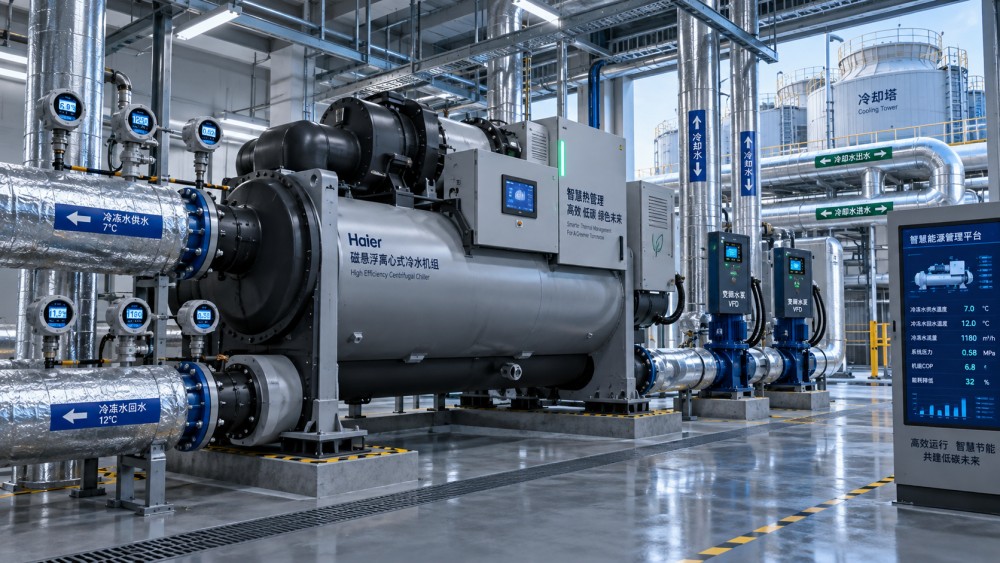
Smart thermal systems with sensors reduce chiller energy use when the sensor data changes how the plant actually operates. Adding temperature probes to a fixed control sequence rarely delivers meaningful savings on its own. The benefit appears when reliable measurements of load, flow, temperature difference, pressure, and outdoor conditions allow the control system to avoid unnecessary cooling, excessive pumping, poor staging, and unstable operation.
In practical terms, a sensor-enabled system is most effective when a chiller plant spends much of its time away from peak design load. That is common in facilities with changing production schedules, variable occupancy, batch processes, seasonal weather, partial cleanroom loads, or multiple cooling zones with different temperature requirements. Under those conditions, static setpoints and fixed-speed equipment often maintain more cooling capacity than the process needs.
The question is therefore not whether a building or industrial site has “smart” controls. It is whether the controls can distinguish real cooling demand from misleading signals, then make safe adjustments without compromising process temperature, equipment reliability, or humidity control.
Where sensor-based control creates a real energy opportunity
Chillers consume more energy when they are forced to produce colder water, reject heat at higher temperatures, run at low efficiency during part-load operation, or work against excessive system resistance. Sensors can expose each of these conditions, but only if the measurements are connected to suitable control actions.
A common opportunity is overcooling. A plant may supply chilled water at a conservative fixed temperature even when downstream coils, heat exchangers, or process equipment could meet demand with warmer water. Raising chilled-water supply temperature can reduce compressor lift, which generally reduces the work required from the chiller. This adjustment must be constrained by the most temperature-sensitive load, humidity requirement, or production process. A sensor network makes the decision more defensible because it can observe whether critical return temperatures, zone conditions, or process temperatures remain within acceptable limits.
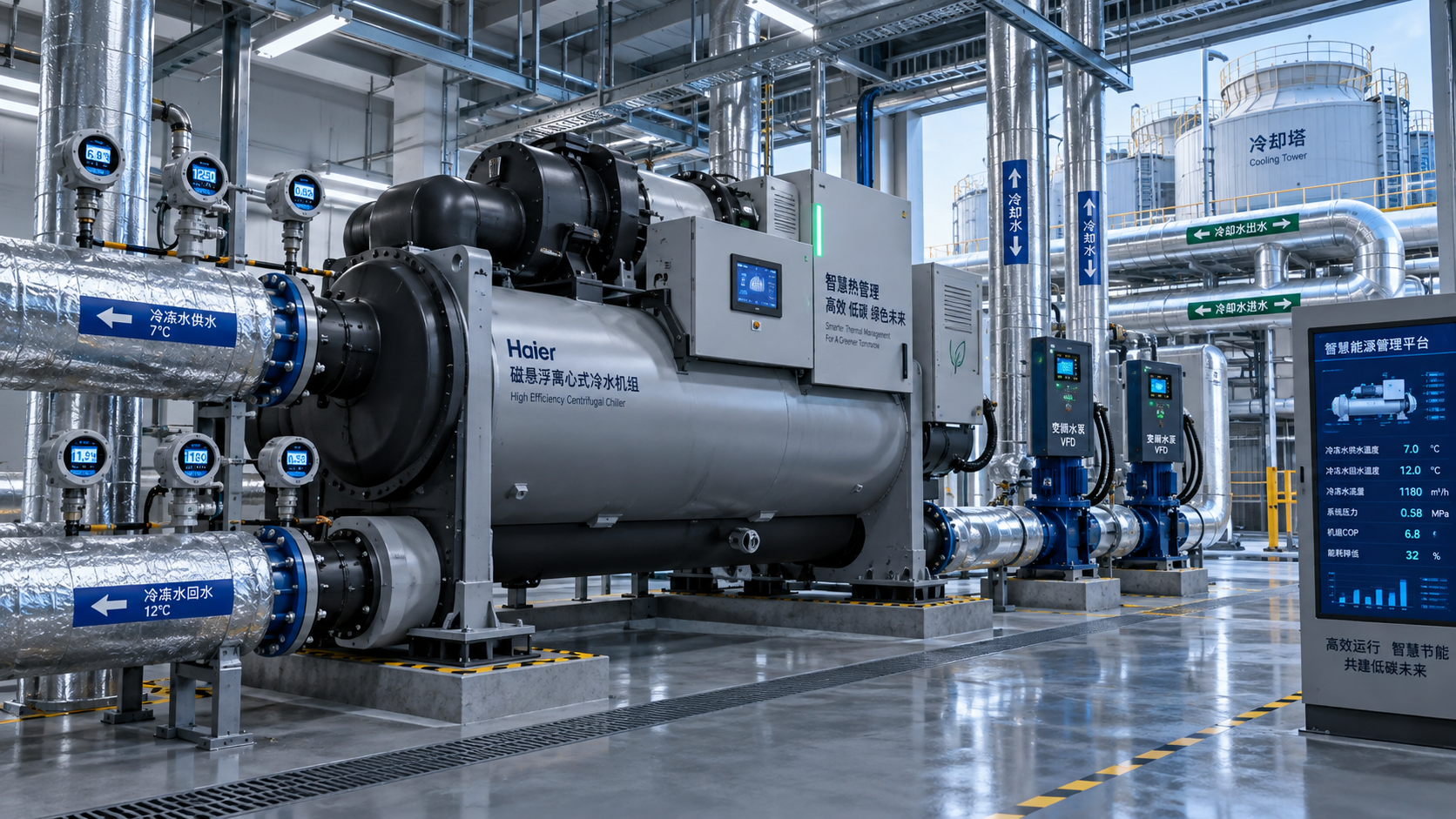
Another opportunity is low delta-T operation. When chilled-water return temperature is lower than expected, the system moves a large volume of water while carrying relatively little heat per unit of flow. This can cause extra pumping energy and may force additional chillers to operate earlier than necessary. Sensors at supply and return headers, combined with flow measurement, help identify whether the problem comes from bypass flow, leaking control valves, oversized coils, incorrect valve sequencing, or terminal units receiving more water than they need.
Smart thermal systems with sensors are also valuable where heat rejection conditions change significantly. Condenser-water temperature, cooling-tower performance, ambient wet-bulb conditions, and fouling indicators can guide the balance between chiller compressor energy, tower fan energy, and condenser pumping energy. The best operating point is not always the coldest possible condenser water. If the tower must use high fan power to lower condenser-water temperature slightly, the total plant energy may rise rather than fall.
The measurements that matter more than a large sensor count
More data does not automatically produce better control. A useful design begins with a clear operating decision, then identifies the measurements needed to make that decision safely. For most chilled-water systems, the following inputs have more value than a long list of loosely connected sensors.
Flow measurement deserves particular attention. Temperature readings alone can suggest that load has changed, but they cannot always separate a true load change from altered water flow. Likewise, a differential-pressure sensor may support pump speed control, yet it should be located and interpreted around the hydraulically critical portion of the system. A poorly selected sensor location can make a variable-speed pump respond to local pressure changes while distant coils still receive insufficient flow.
Power meters provide the necessary reality check. A control sequence may reduce chiller kW while increasing pumping or cooling-tower energy enough to erase the gain. Plant optimization should consider the combined energy of compressors, pumps, tower fans, free-cooling equipment, and any relevant secondary loops.
Part-load conditions are usually the decisive factor
Most chillers are selected to meet a maximum anticipated load, not the load seen during every operating hour. A sensor-based control strategy has the most room to improve efficiency when the plant regularly operates at partial load and can choose among multiple operating states: one chiller versus two, higher versus lower water temperature, slower versus faster pumping, or mechanical cooling versus a favorable outdoor cooling source.
For a plant with multiple chillers, the controls need to decide when to stage equipment on or off. The wrong sequence can leave several machines lightly loaded, operate a less suitable machine first, or create frequent starts and stops. A better sequence uses live load, equipment status, entering-water conditions, and measured energy to select an operating combination that meets demand with stable capacity margin.
This does not mean the system should always run the minimum number of chillers. One machine operating near a constraint may use more energy, reduce redundancy, or create unstable leaving-water temperature. In some conditions, operating two units at moderate load can be preferable. The controller needs operating maps or tested performance logic that reflects the installed equipment, not a generic assumption that fewer running machines always means lower energy.
Three applications where the approach is often justified
Variable process cooling
Manufacturing and processing sites often have cooling demand that follows production lines, batch cycles, washdown periods, or equipment availability. A fixed chilled-water setpoint may be appropriate for one sensitive process but unnecessarily low for the rest of the plant. With sensors at major process branches and at critical equipment, controls can maintain the strictest requirement while allowing less critical loads to operate at a more efficient condition.
The design challenge is separating process-critical loads from convenience loads. A system that averages all temperatures together can hide a local problem until it becomes a quality or uptime issue. Priority logic, independent alarms, and minimum flow requirements should be defined before automated reset sequences are enabled.
Large facilities with diverse cooling zones
Hospitals, laboratories, data-intensive spaces, commercial campuses, and mixed-use facilities may have simultaneous cooling requirements that change by area and time of day. Zone-level sensors can identify when the chilled-water plant is supporting only a small portion of the original design load. They can also reveal whether a small number of poorly controlled air-handling units are keeping the entire plant at an unnecessarily low setpoint.
Humidity-sensitive spaces require added caution. Raising chilled-water temperature can reduce coil dehumidification capability. The optimization logic should therefore account for humidity or dew-point limits where they govern performance, rather than treating dry-bulb temperature as the only success measure.
Plants with cooling towers or waterside economizers
Where outdoor conditions periodically support efficient heat rejection or indirect free cooling, sensor quality and control coordination become especially important. The system must know when the available approach temperature is sufficient, whether heat exchangers can carry the required load, and whether the auxiliary fan and pump energy remains justified.
These applications benefit from measuring conditions across the complete heat-transfer path: outdoor condition, tower water temperatures, heat-exchanger approach, chilled-water demand, and equipment power. Switching too early can create inadequate cooling or unstable transitions. Switching too late leaves an available efficiency opportunity unused.
Sensor accuracy is necessary, but sensor trustworthiness is the larger issue
Control decisions are only as good as the signals behind them. A temperature sensor with drift, a blocked pressure impulse line, an incorrectly scaled flow meter, or a failed communication point can lead to false optimization. The result may be wasted energy, unstable control, or an unnecessary process alarm.
For this reason, a strong implementation includes plausibility checks. Supply temperature should be compared with expected equipment status. Flow readings should be checked against pump speed, valve position, and thermal load. A sudden jump in a sensor value should not immediately drive an aggressive plant reset. Control systems should identify unreasonable values, hold a conservative operating mode when a critical signal is unavailable, and alert maintenance staff to the failed point.
Sensor placement also changes the quality of the conclusion. Measuring only at the chiller plant may show that total load has fallen, but it may not explain whether the reduction is caused by lower demand, bypass flow, or a control valve issue at a distant branch. Measurements should be placed at the points where decisions are made and where system constraints originate.
Control integration determines whether the project remains a dashboard
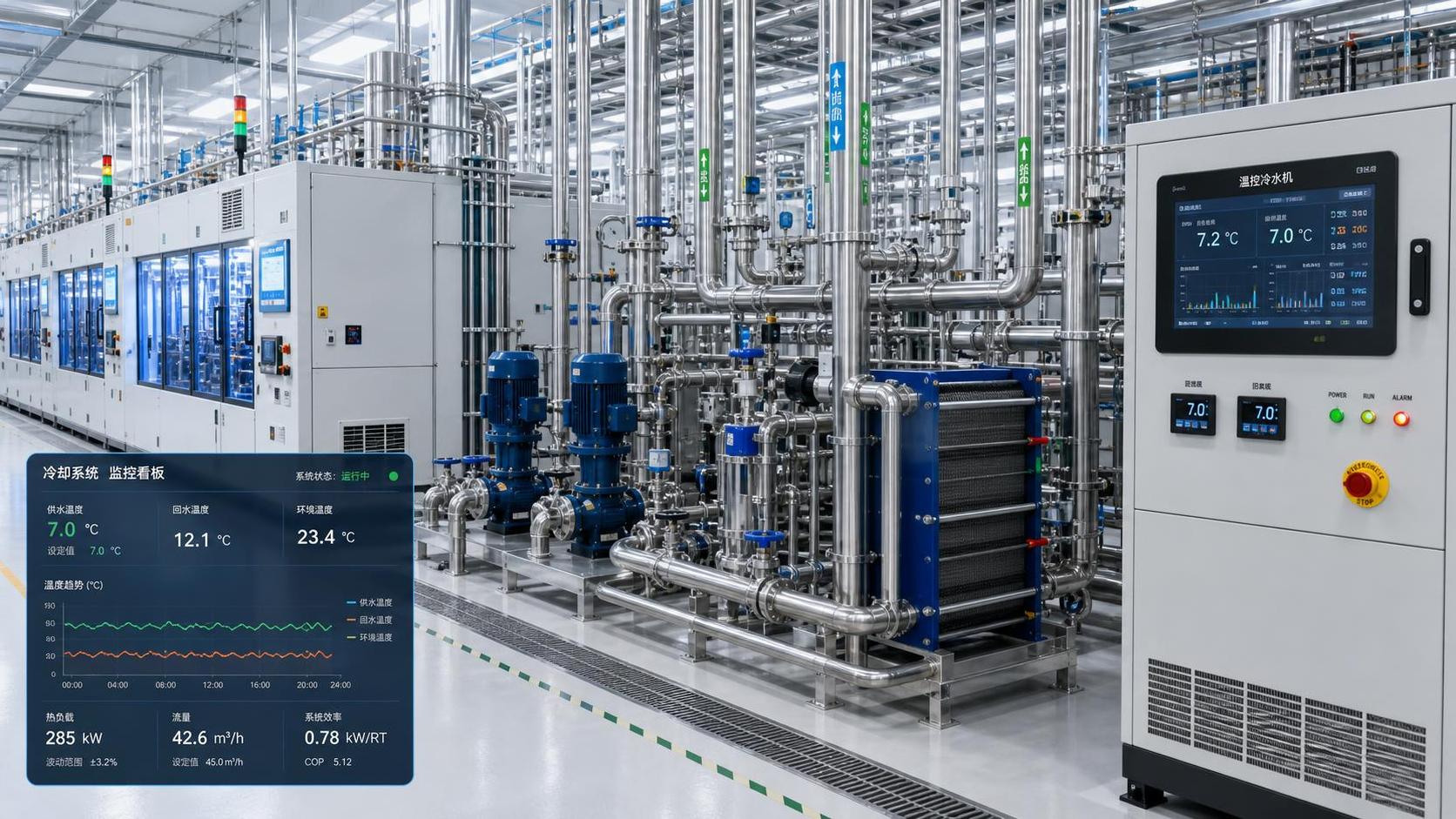
Many thermal monitoring projects stop at visualization. Dashboards can be useful for finding trends, but chiller energy falls only when operators or automation act on those trends. The implementation should define which decisions will be automated, which will remain operator-approved, and what conditions prevent a change.
A practical sequence often starts with limited, low-risk actions: optimizing pump differential-pressure setpoints, correcting obvious scheduling conflicts, identifying persistent low delta-T, or adjusting cooling-tower fan staging. Once the data quality and system response are understood, the controls can expand toward chilled-water reset, chiller staging, condenser-water optimization, and demand-based sequencing.
Integration with the existing building management system, industrial control system, or chiller controls should preserve local safeties and manufacturer operating limits. Optimization logic belongs above those protections, not in place of them. A controller should never trade equipment protection or process stability for a modest energy improvement.
Common reasons sensor projects fail to reduce chiller energy
- The project measures symptoms but cannot change operation. Temperature trends alone do not reduce energy when schedules, setpoints, and equipment staging remain fixed.
- Control boundaries are too narrow. Optimizing compressor energy while ignoring pumps and tower fans can raise total plant consumption.
- Setpoints are reset without protecting critical loads. A warmer chilled-water target may be efficient until humidity control, process cooling, or a remote coil becomes limiting.
- Existing hydraulic faults are treated as a software problem. Bypass valves, stuck valves, fouled strainers, poor balancing, and inadequate pipe configuration may need physical correction before advanced controls can work.
- Performance is judged from a short or unusual operating period. Comparison should account for weather, production level, operating hours, and changes in the served load.
How to evaluate a sensor-enabled thermal solution
Begin with the operating problem, not the platform label. Identify whether the main concern is excess chilled-water flow, low delta-T, unstable staging, high condenser-water temperature, unexplained overnight load, poor tower coordination, or inconsistent process temperatures. That diagnosis determines the sensor package and the control functions worth funding.
Then map the system from load to heat rejection. Document chillers, pumps, towers, heat exchangers, loops, control valves, critical loads, existing meters, and control ownership. This reveals whether the intended optimization can be implemented through existing controls or requires additional instrumentation and integration work.
Before broad automation, establish a representative operating baseline. The baseline should include plant energy, operating state, temperatures, flows, weather-sensitive conditions where relevant, and the thermal demand being served. The purpose is not to create a headline savings claim. It is to verify that later changes improve the complete system while maintaining the required output.
Finally, require transparent logic. A useful system should show why it is requesting a setpoint change, which sensor inputs support the decision, what operating limits apply, and how the plant behaves when data is missing. Black-box recommendations are difficult to validate, difficult to maintain, and harder to trust in facilities with critical thermal loads.
For teams tracking developments across industrial cooling, heat exchange, and compression systems, GTC-Matrix provides a useful lens for connecting equipment behavior with the wider efficiency questions that shape thermal-system decisions. The most valuable intelligence is not a generic promise of smarter cooling; it is the ability to identify where thermodynamic conditions, controls, and equipment operation no longer align.
Sensor-enabled chiller optimization is justified when the site has variable demand, controllable equipment, trustworthy measurements, and a clear path from data to operating action. If any of those elements is missing, install the missing foundation first. A modest control improvement built on reliable system knowledge is more useful than a complex analytics layer applied to unstable hydraulics or unclear process requirements.
Related News
- When do smart thermal systems with sensors reduce chiller energy use?Author :Cryogenic Systems Expert

- How to size energy efficient industrial cooling for a process loadAuthor :Cryogenic Systems Expert

- How to specify high-precision temperature control in EuropeAuthor :Cryogenic Systems Expert

- How cooling system design affects cleanroom contamination controlAuthor :Cryogenic Systems Expert

- When does industrial cooling heat recovery pay back in energy savings?Author :Cryogenic Systems Expert

- How to size an industrial cooling system for peak process loadsAuthor :Cryogenic Systems Expert

- When are aluminum electronics cooling solutions suitable for high-density designs?Author :Cryogenic Systems Expert

- A thermal management guide for preventing chiller capacity lossAuthor :Cryogenic Systems Expert

- When does aluminum make sense for electronics cooling solutions?Author :Cryogenic Systems Expert

- EU Battery Carbon Footprint Labels Become Mandatory on Aug 18 for Battery-Integrated Cooling and Energy Storage ExportsAuthor :Cryogenic Systems Expert

- China-UAE Direct Sea Route Cuts Lead Times for Industrial Cooling and Compression ExportsAuthor :Cryogenic Systems Expert

- EPA Rule Takes Effect for R-410A Equipment ImportsAuthor :Cryogenic Systems Expert

- EN 378-1:2026 Tightens EU Export ChecksAuthor :Cryogenic Systems Expert

- How to Compare Semiconductor Cooling Solutions by Heat Load and Uptime RiskAuthor :Cryogenic Systems Expert

- EU Label Deadline Hits China Chiller ExportsAuthor :Cryogenic Systems Expert

- How Smart Thermal Systems Improve Industrial Cooling EfficiencyAuthor :Cryogenic Systems Expert

- How to Choose Process Cooling Equipment for Stable Temperature ControlAuthor :Cryogenic Systems Expert

- EU Finalizes 2026 HFC Quota Cut for R-134a ChillersAuthor :Cryogenic Systems Expert

- EU Tightens HFC-134a Quotas for Industrial ChillersAuthor :Cryogenic Systems Expert

- REACH SVHC Update Pressures HFC-134a Chiller Supply ChainsAuthor :Cryogenic Systems Expert

- EU PFAS Coolant Ban Reshapes Chiller ExportsAuthor :Cryogenic Systems Expert

- EU REACH Restricts PFAS Cooling Media ImportsAuthor :Cryogenic Systems Expert

- EU Ecodesign Rule Takes Effect for Industrial ChillersAuthor :Cryogenic Systems Expert

- EU REACH Rule Takes Effect for PFAS in Industrial Cooling ExportsAuthor :Cryogenic Systems Expert

- Industrial Cooling for Plastic Processing: How to Size for Stable Cycle TimesAuthor :Cryogenic Systems Expert

- EU F-Gas Update Bars R404A/R507 in Commercial CoolingAuthor :Cryogenic Systems Expert

- DOE Raises Chiller Efficiency Standard From October 2026Author :Cryogenic Systems Expert

- India Mandates BIS Energy Certification for Industrial ChillersAuthor :Cryogenic Systems Expert

- Energy-Efficient Heat Exchange for Process Cooling: Cost vs PaybackAuthor :Cryogenic Systems Expert

- EPA R-134a Import Ban Takes Effect on July 13, 2026Author :Cryogenic Systems Expert

- India BIS Rule Takes Effect for Industrial ChillersAuthor :Cryogenic Systems Expert

- EPA Cuts R134a Import Quotas 20% From July 10Author :Cryogenic Systems Expert

- How to Compare Energy-Efficient Cooling Systems for Factory Expansion ProjectsAuthor :Cryogenic Systems Expert

- Chiller Price Index Rises 11.3% in Q2Author :Cryogenic Systems Expert

- Saudi SASO Tightens Chiller Import Compliance From July 10Author :Cryogenic Systems Expert

- Dubai Opens Fast-Track Chiller TendersAuthor :Cryogenic Systems Expert