



When does industrial cooling heat recovery pay back in energy savings?




When Does Industrial Cooling Heat Recovery Pay Back in Energy Savings?
Industrial cooling heat recovery can turn a major operating cost into a measurable efficiency opportunity—but the investment is not automatically attractive simply because a plant rejects a large amount of heat. The central commercial question is whether recovered heat can reliably displace a more expensive source of useful heat, often enough, at a temperature that the receiving process can use.
For decision-makers, the payback calculation sits at the intersection of cooling load profiles, heat demand, operating schedules, local fuel and electricity prices, integration complexity, and available capital. A facility may reject substantial heat through chillers, condenser water loops, refrigeration systems, or compressor aftercoolers. Yet if the heat is available at night while process demand occurs during the day, or if the recovered temperature is too low for the intended use, the apparent opportunity can disappear quickly.
The strongest projects are usually not the ones with the largest cooling systems. They are the ones where a stable source of rejected heat and a stable demand for low- or medium-temperature heat overlap for much of the year. That distinction matters when assessing industrial cooling heat recovery as a capital project rather than an engineering concept.
Payback Starts With the Match Between Heat Source and Heat Sink
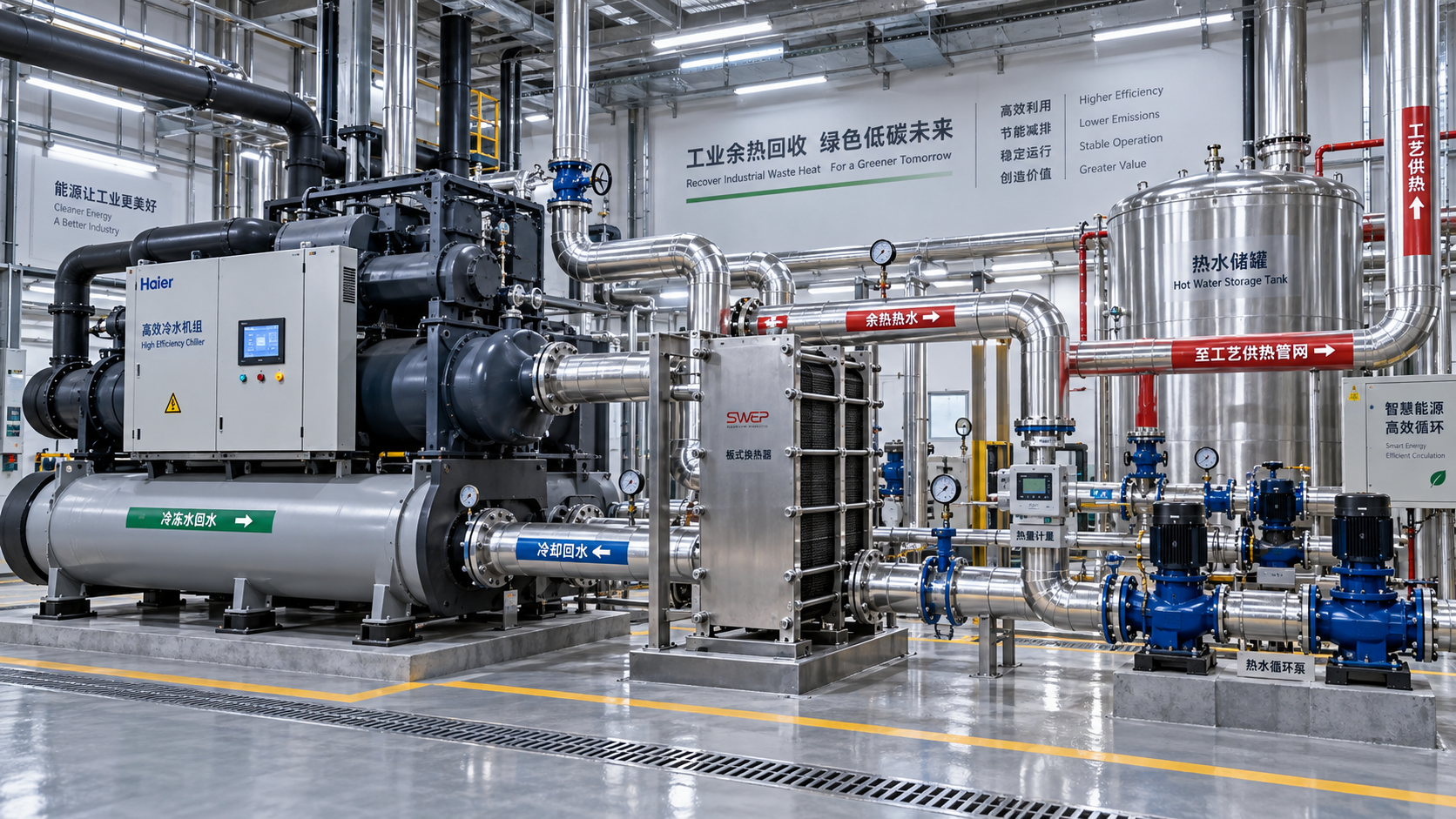
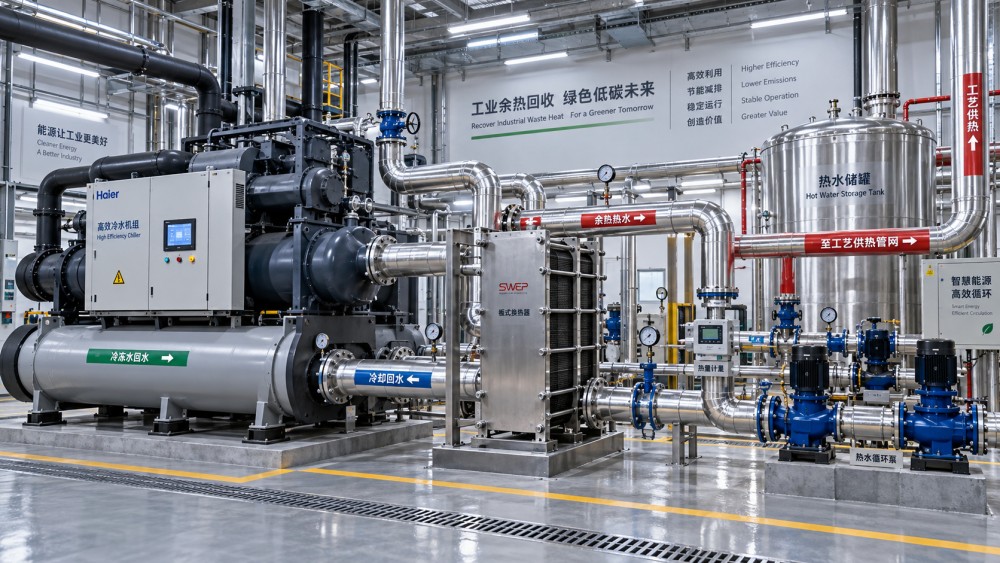
Cooling equipment does not “create” free heat. It moves heat from one place to another, and the recoverable stream must be captured, transferred, controlled, and used. In refrigeration and chilled-water systems, rejected condenser heat can often support domestic hot water, washdown, preheating, space heating, boiler feedwater preheat, or low-temperature process duties. In compressed-air systems, aftercooler heat may be useful for space heating, drying applications, or water preheating. The practical value depends on temperature, cleanliness requirements, continuity, and proximity.
A sound feasibility study maps both sides of the equation at interval level, not only as annual totals. Monthly data is helpful; hourly or sub-hourly data is better where loads fluctuate sharply. Plant teams should compare:
- the cooling or refrigeration load and the temperature of the rejected heat;
- the demand profile of the proposed heat user;
- the current energy source being displaced, such as gas, steam, electricity, or purchased heat;
- the required supply and return temperatures at the receiving process; and
- the distance, pipework route, operating risk, and control changes required to connect them.
The most favorable condition is simultaneous demand: the cooling system is rejecting heat at the same time that another part of the site needs heat. If a facility must add a large thermal store to bridge timing differences, the project may still work, but the capital cost, space requirement, and losses must be included. If there is no meaningful coincidence at all, heat recovery may reduce peak boiler operation on a limited number of hours without delivering the annual savings assumed in an early concept.
Temperature is equally decisive. Heat rejected near ambient temperature has limited direct use. Raising it with a heat pump can broaden the applications, but it also introduces electricity consumption and changes the economics. By contrast, a process that can accept warm water directly may require relatively simple heat-exchanger integration. The target should not be the highest possible recovered temperature; it should be the lowest useful temperature that displaces a real cost.
A Practical Financial Model: Avoid Counting Theoretical Heat as Savings
The financial model should be built from useful delivered energy, not from the total heat rejected by equipment. A basic annual savings estimate can be expressed as:
Annual net savings = avoided cost of the displaced heat − additional electricity − maintenance and operating costs.
Avoided cost must reflect the efficiency of the existing heating system. If recovered heat replaces heat from a boiler, the calculation should consider the fuel cost and the boiler’s real operating efficiency, rather than treating each unit of recovered heat as equal to a unit of fuel purchased. If it displaces electric resistance heating, the avoided energy cost can be different again. Where heat recovery requires a booster heat pump, its seasonal or project-specific operating performance must be estimated conservatively from actual source and delivery temperatures.
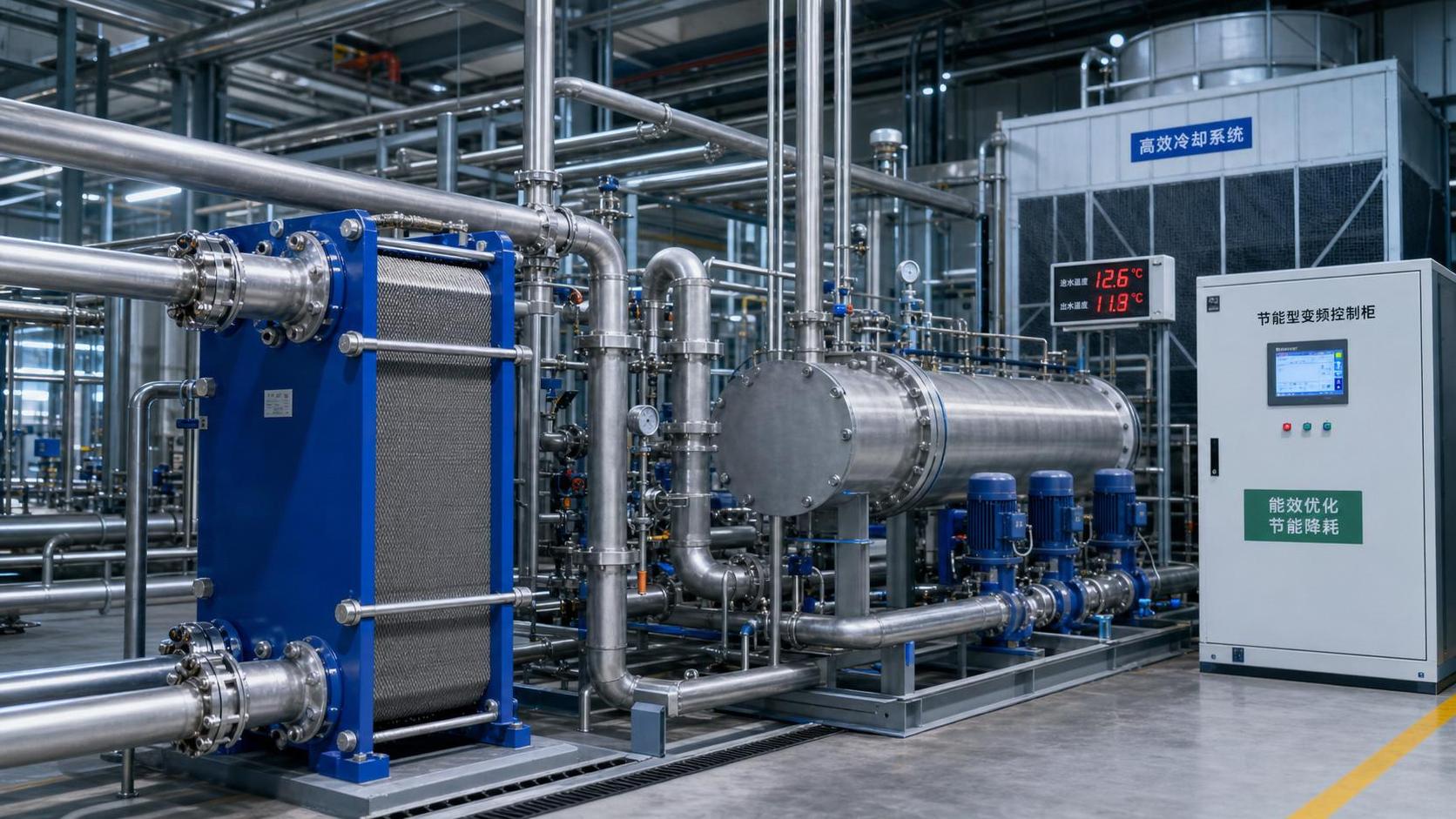
The capital side is often underestimated in preliminary business cases. Equipment cost is only one component. A credible budget includes plate or shell-and-tube heat exchangers, pumps, valves, piping, insulation, water treatment where required, electrical works, instrumentation, controls integration, commissioning, civil modifications, shutdown planning, and contingency for site conditions. In hygienic, pharmaceutical, food, semiconductor, or other tightly controlled environments, separation requirements and validation expectations may affect both design and cost.
Simple payback remains a useful screening tool:
Simple payback = total installed project cost ÷ annual net savings.
It should not be the only approval metric. A project with a reasonable simple payback may still face exposure to production downtime, volatile utility tariffs, future maintenance obligations, or a planned process change that reduces heat demand. Net present value, internal return requirements, carbon-cost assumptions, depreciation treatment, incentives where verifiable, and financing conditions may all influence the final decision. Still, simple payback is valuable because it forces an early discipline: state clearly what energy is actually being replaced, for how many operating hours, and at what net cost.
Where the Economics Tend to Be Strongest
Industrial cooling heat recovery commonly warrants detailed evaluation where cooling is continuous and hot-water demand is predictable. Cold-chain facilities, food and beverage production, chemical processing, data-intensive operations, plastics processing, district-scale campuses, and some pharmaceutical plants may have suitable conditions. The underlying pattern is more important than the sector label: extended cooling operation, a nearby and recurring heat demand, and a high-cost conventional heating source.
Sites with year-round refrigeration loads can be especially interesting because rejection is not limited to a short summer season. Plants with cleaning cycles, washdown, preheating steps, or large hot-water consumption may offer a dependable sink for recovered heat. Facilities already operating multiple utility systems can also find opportunities in the gaps between them—for example, using recovered heat to preheat water before a boiler or to reduce the load on a central hot-water loop rather than attempting to replace high-temperature steam entirely.
The converse is also true. A warehouse with seasonal cooling demand and limited hot-water use may have little opportunity despite a large chiller. A site with a high-temperature thermal process should be cautious about assuming low-grade condenser heat will make a major contribution. Such projects may require heat-pump upgrading, and that changes both the technical scope and the risk profile.
Integration Risks That Can Extend Payback
Many heat recovery projects underperform not because the core thermodynamics were wrong, but because integration was treated as secondary. Cooling systems have a primary duty: protecting production, product quality, and equipment reliability. Any recovery scheme must preserve that duty under changing ambient conditions, varying process loads, maintenance events, and partial plant operation. The heat-recovery circuit needs bypass logic, clear control priorities, isolation capability, and defined failure modes.
Fouling and water quality deserve early attention. Heat exchangers can lose performance when process water, cooling water, or secondary circuits are poorly managed. Pump energy can also erode savings if pipe routes are long or hydraulic design is weak. Procurement specifications should therefore require suppliers to state design temperatures, pressure drops, expected control approach, materials compatibility, access for maintenance, and performance assumptions at part load—not only nominal capacity.
Another frequent error is ignoring refrigeration-system implications. Raising condensing temperatures or imposing unsuitable control conditions can affect chiller or refrigeration efficiency. The project must evaluate the combined system result: recovered useful heat minus any change in cooling energy and auxiliary consumption. A heat recovery package that looks efficient in isolation may be less compelling once compressor power, pumps, and cooling tower operation are included.
Questions Procurement Teams Should Put Into the Tender
A tender based solely on estimated recovered kilowatts invites incomparable offers. The better approach is to define the duty, boundaries, and measurement method. Suppliers should be asked to identify which inputs they have used and which remain assumptions. This makes commercial comparison more transparent and reduces disputes after commissioning.
- What source temperatures and flow rates have been assumed across the operating range?
- What usable heat output is guaranteed at the required delivery temperature?
- What additional electrical load is expected from pumps, compressors, or heat pumps?
- How does the design respond when the heat sink is unavailable?
- Which equipment, controls, pipework, commissioning work, and shutdown activities are excluded?
- How will delivered thermal energy and electrical consumption be metered and verified?
- What maintenance tasks, cleaning intervals, spare parts, and water-quality conditions are required?
Metering is not an administrative detail. Without separate measurement of recovered heat, auxiliary electricity, and the displaced heating load where practical, a site cannot distinguish between a seasonal change in demand and actual project performance. Measurement also gives finance and operations teams a common basis for reviewing savings after startup.
Why Energy Price Volatility Changes the Decision
Heat recovery economics are sensitive to the spread between the cost of the energy being displaced and the energy required to recover or upgrade heat. This means a project should not be assessed using one utility price taken from a single invoice. Decision-makers benefit from scenario analysis: a base case, a lower avoided-fuel-cost case, and a higher electricity-cost case. If the project only works under one optimistic price assumption, its resilience is limited.
Carbon reporting and decarbonization targets can strengthen the strategic case, but they should not replace an operational business case. Emissions outcomes depend on the displaced fuel, local electricity factors, equipment performance, and the boundary used for reporting. Regulatory treatment, refrigerant requirements, and available support mechanisms also vary by market and can change. These items need confirmation against current local rules and project documentation before they are placed into an investment model.
At GTC-Matrix, the thermal question is viewed as part of a wider industrial energy system. Cooling, compressed air, vacuum processes, heat exchangers, and combustion equipment are often assessed separately even though their load patterns and control decisions interact. The platform’s Strategic Intelligence Center follows these links through the perspectives of thermodynamics analysts, pneumatic power engineers, and industrial economists—particularly where oil-free compression, microchannel heat exchangers, low-NOx boiler developments, refrigerant transitions, and energy-cost movements alter the assumptions behind a project.
The Decision Threshold Is Operational, Not Just Financial
Industrial cooling heat recovery pays back when useful heat can be delivered consistently enough to displace a measurable and sufficiently costly heating duty, while the installed system remains simple enough to operate without compromising cooling reliability. That is a more demanding test than identifying waste heat on a plant diagram, but it is the test that protects capital.
Before approving a concept, establish a measured baseline, map the source and sink by operating period, test conservative energy-price scenarios, define all integration costs, and agree on post-installation verification. Where those steps show durable overlap, heat recovery can move from an appealing efficiency idea to a defensible energy investment. Thermal Driving Industry, Intelligence Connecting Power.
Related News
- When does industrial cooling heat recovery pay back in energy savings?Author :Cryogenic Systems Expert

- How to size an industrial cooling system for peak process loadsAuthor :Cryogenic Systems Expert

- When are aluminum electronics cooling solutions suitable for high-density designs?Author :Cryogenic Systems Expert

- A thermal management guide for preventing chiller capacity lossAuthor :Cryogenic Systems Expert

- When does aluminum make sense for electronics cooling solutions?Author :Cryogenic Systems Expert

- EU Battery Carbon Footprint Labels Become Mandatory on Aug 18 for Battery-Integrated Cooling and Energy Storage ExportsAuthor :Cryogenic Systems Expert

- China-UAE Direct Sea Route Cuts Lead Times for Industrial Cooling and Compression ExportsAuthor :Cryogenic Systems Expert

- EPA Rule Takes Effect for R-410A Equipment ImportsAuthor :Cryogenic Systems Expert

- EN 378-1:2026 Tightens EU Export ChecksAuthor :Cryogenic Systems Expert

- How to Compare Semiconductor Cooling Solutions by Heat Load and Uptime RiskAuthor :Cryogenic Systems Expert

- EU Label Deadline Hits China Chiller ExportsAuthor :Cryogenic Systems Expert

- How Smart Thermal Systems Improve Industrial Cooling EfficiencyAuthor :Cryogenic Systems Expert

- How to Choose Process Cooling Equipment for Stable Temperature ControlAuthor :Cryogenic Systems Expert

- EU Finalizes 2026 HFC Quota Cut for R-134a ChillersAuthor :Cryogenic Systems Expert

- EU Tightens HFC-134a Quotas for Industrial ChillersAuthor :Cryogenic Systems Expert

- REACH SVHC Update Pressures HFC-134a Chiller Supply ChainsAuthor :Cryogenic Systems Expert

- EU PFAS Coolant Ban Reshapes Chiller ExportsAuthor :Cryogenic Systems Expert

- EU REACH Restricts PFAS Cooling Media ImportsAuthor :Cryogenic Systems Expert

- EU Ecodesign Rule Takes Effect for Industrial ChillersAuthor :Cryogenic Systems Expert

- EU REACH Rule Takes Effect for PFAS in Industrial Cooling ExportsAuthor :Cryogenic Systems Expert

- Industrial Cooling for Plastic Processing: How to Size for Stable Cycle TimesAuthor :Cryogenic Systems Expert

- EU F-Gas Update Bars R404A/R507 in Commercial CoolingAuthor :Cryogenic Systems Expert

- DOE Raises Chiller Efficiency Standard From October 2026Author :Cryogenic Systems Expert

- India Mandates BIS Energy Certification for Industrial ChillersAuthor :Cryogenic Systems Expert

- Energy-Efficient Heat Exchange for Process Cooling: Cost vs PaybackAuthor :Cryogenic Systems Expert

- EPA R-134a Import Ban Takes Effect on July 13, 2026Author :Cryogenic Systems Expert

- India BIS Rule Takes Effect for Industrial ChillersAuthor :Cryogenic Systems Expert

- EPA Cuts R134a Import Quotas 20% From July 10Author :Cryogenic Systems Expert

- How to Compare Energy-Efficient Cooling Systems for Factory Expansion ProjectsAuthor :Cryogenic Systems Expert

- Chiller Price Index Rises 11.3% in Q2Author :Cryogenic Systems Expert

- Saudi SASO Tightens Chiller Import Compliance From July 10Author :Cryogenic Systems Expert

- Dubai Opens Fast-Track Chiller TendersAuthor :Cryogenic Systems Expert

- Japan Raises Chiller COP Floor to 6.2 From Sept. 1Author :Cryogenic Systems Expert
![]()
- Compact Thermal Management in Smart Devices: Common Failure RisksAuthor :Cryogenic Systems Expert

- Thermal Management for Batteries: Cooling Methods ComparedAuthor :Cryogenic Systems Expert

- How Compact Thermal Design Extends Smart Device UptimeAuthor :Cryogenic Systems Expert