How cooling system design affects cleanroom contamination control




How Cooling System Design Affects Cleanroom Contamination Control
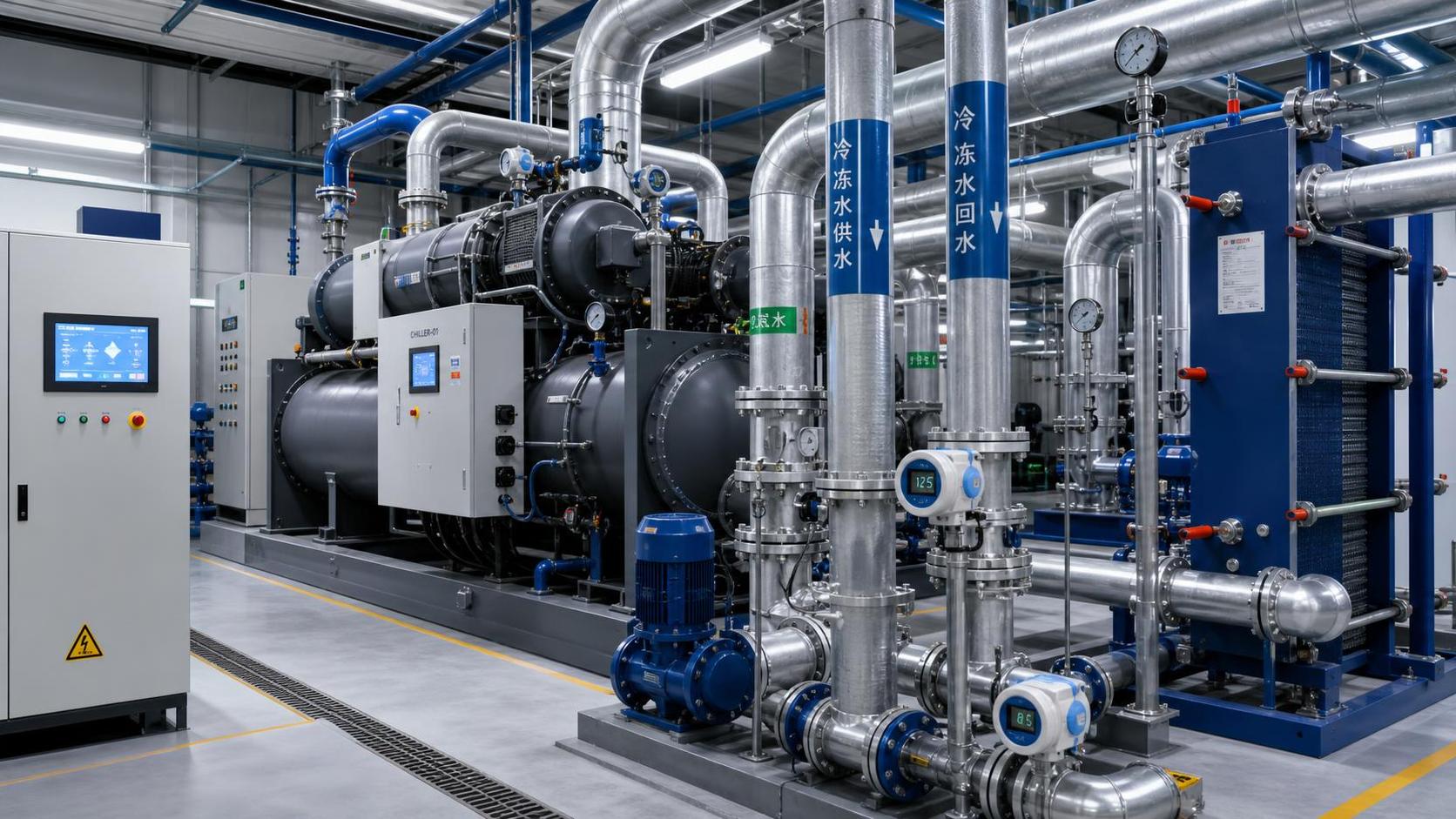
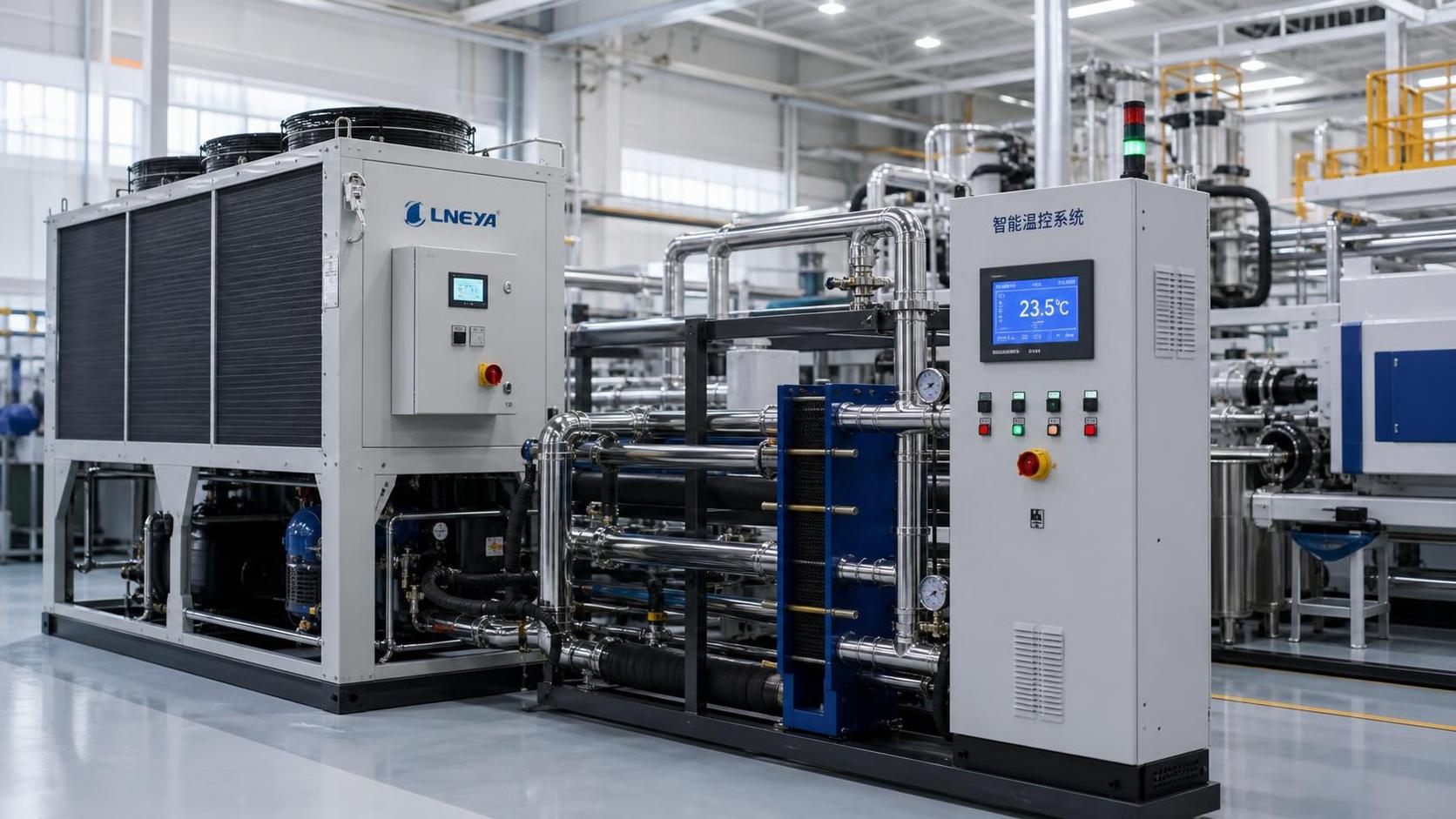
For technical evaluators, cleanroom cooling contamination control is not simply a matter of maintaining temperature. Cooling design shapes airflow, humidity, filtration performance, condensate handling, and particle movement.
The central judgment is straightforward: a cooling system can meet a thermal load while still weakening contamination control. Evaluation must therefore connect HVAC performance with process risk.
Pharmaceutical, semiconductor, biotechnology, and food facilities require more than comfortable operating conditions. They need stable environmental control that protects products, processes, operators, and compliance outcomes.
Technical teams should assess cooling equipment as part of the cleanroom contamination-control strategy, rather than as an isolated utility package selected only by capacity and efficiency.
This article explains where cooling design affects cleanroom performance, which risks deserve priority, and how evaluators can compare solutions with greater confidence.
Start With the Contamination-Control Objective
Before reviewing equipment specifications, evaluators should define what contamination must be controlled: viable organisms, nonviable particles, moisture, chemical vapors, or cross-contamination between process zones.
Each contaminant behaves differently. Particles follow airflow, microorganisms may travel on particles or droplets, and moisture supports microbial growth when surfaces remain wet or poorly drained.
Cooling system design affects these hazards because it changes air volume, supply-air temperature, coil moisture, pressure relationships, and the reliability of filtration support systems.
A design review should begin with the cleanroom classification, process sensitivity, occupancy pattern, heat load profile, cleaning regime, and applicable regulatory or customer requirements.
For example, a semiconductor process may prioritize particle concentration and electrostatic control, while aseptic pharmaceutical production requires strict airflow protection and microbiological risk management.
Food-production cleanrooms often require strong humidity control, washable surfaces, and dependable drainage because condensation can threaten both hygiene and product shelf life.
Clear contamination objectives prevent a common procurement error: choosing high-efficiency cooling equipment that cannot maintain the environmental stability required during variable production conditions.
Airflow Design Determines Where Contaminants Travel
Airflow is the primary transport mechanism for airborne contamination. Cooling systems influence it through supply-air volume, diffuser arrangement, return-air placement, and temperature-driven buoyancy effects.
When supply air is too cold, it may fall rapidly from diffusers and create local drafts. When it is too warm, upward movement can disturb intended airflow paths.
In unidirectional cleanrooms, cooling must support uniform downward or horizontal airflow. Uneven discharge temperatures can create turbulence that carries particles toward critical process areas.
Non-unidirectional cleanrooms require carefully planned mixing. The objective is to dilute contamination effectively without creating stagnant pockets behind equipment, beneath workstations, or near exterior walls.
Technical evaluators should request computational fluid dynamics studies or smoke-visualization evidence when airflow patterns are critical to product protection, especially around open processing operations.
Air velocity alone does not prove cleanroom performance. A system may deliver the required airflow rate while producing recirculation zones, short-circuiting supply air directly to returns.
Cooling coil control also matters because changing coil output alters supply-air density. Seasonal operation, reduced occupancy, and partial-load production can all change established airflow behavior.
Humidity Control Is a Major Contamination Variable
Temperature is often the visible setpoint, but relative humidity is frequently the more important contamination-control variable. Excess moisture increases microbial risk and creates condensation hazards.
High humidity can support mold growth in building materials, ductwork, insulation, and poorly maintained air-handling components. It may also compromise packaging, powders, and sensitive electronic products.
Low humidity creates different risks. Electrostatic discharge can damage semiconductor devices, attract particles to surfaces, and interfere with precise handling of lightweight process materials.
Cleanroom cooling systems remove sensible heat and latent moisture together, but the balance changes constantly. Equipment selection must reflect the actual sensible-to-latent heat ratio.
An oversized cooling coil may cycle too frequently, producing unstable dehumidification. An undersized coil may hold temperature but fail to remove moisture during humid outdoor conditions.
Dedicated outdoor air systems can improve cleanroom humidity stability by treating ventilation air separately. This reduces the burden on recirculating air handlers and improves control flexibility.
Evaluators should examine humidity performance at summer peak, low-load operation, startup, door-opening events, and process changes rather than relying only on nominal design-condition calculations.
Cooling Coils Can Become Contamination Sources
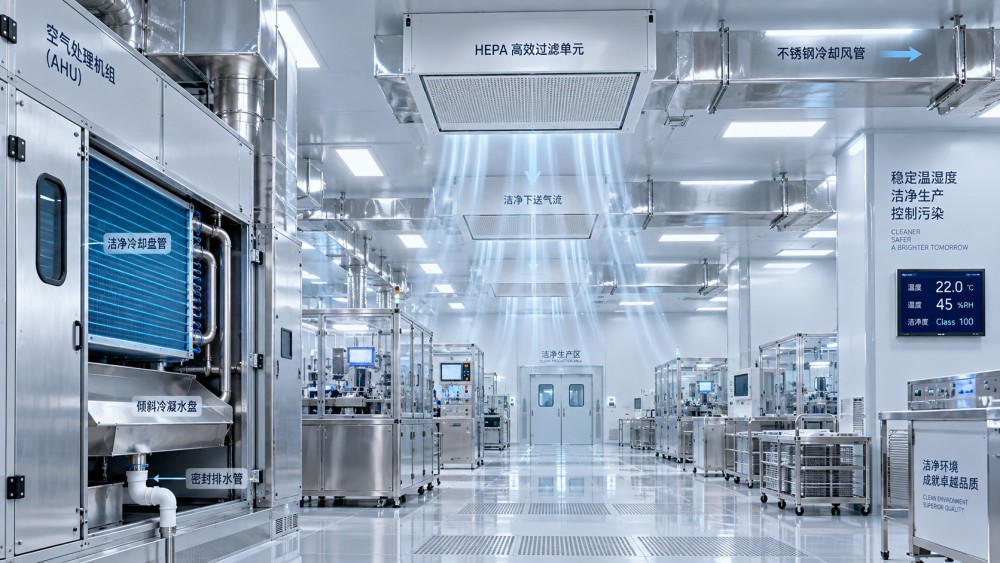
Cooling coils intentionally create cold surfaces where moisture condenses. Without appropriate materials, drainage, access, and maintenance, these areas can become reservoirs for microbial growth.
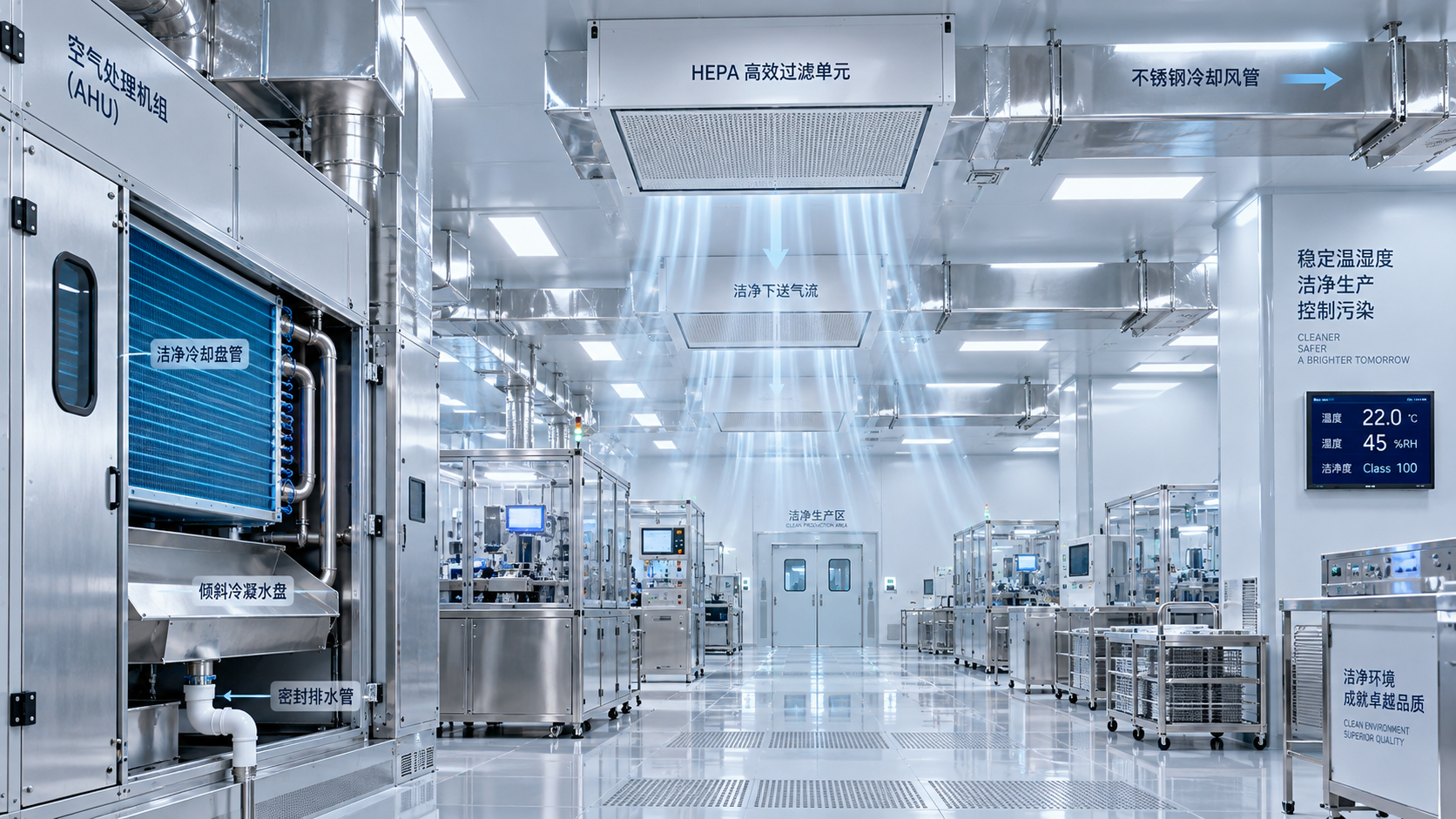
Condensate pans should drain completely under normal operating conditions. Standing water, inadequate pan slope, blocked traps, and poor pipe routing increase contamination and odor risks.
Drainage design must also prevent air bypass through traps. Incorrectly sized or unprimed traps can disrupt pressure control and introduce unfiltered air into conditioned spaces.
Coil face velocity deserves attention because excessive velocity can entrain droplets downstream. Moisture carryover may wet insulation, duct interiors, filters, or downstream components.
Materials should resist corrosion, tolerate approved cleaning agents, and avoid shedding particles. Smooth, accessible surfaces support inspection and reduce the likelihood of hidden contamination accumulation.
Maintenance access is an engineering issue, not merely an operational preference. If coils, pans, filters, and drain lines cannot be safely inspected, contamination risks remain unverified.
Technical specifications should require documented cleaning procedures, access-clearance dimensions, drain-pan design details, and commissioning checks for condensate removal under realistic operating conditions.
Filtration Performance Depends on Thermal System Stability
HEPA or ULPA filtration is essential in many cleanrooms, but filtration performance depends on the surrounding air-handling system operating within its intended pressure, flow, and moisture conditions.
Cooling systems influence fan demand and pressure drop because coil loading changes airflow resistance. Dirty coils can reduce delivered air volume and weaken room air-change performance.
Variable-air-volume strategies require particular care in cleanrooms. Energy savings are valuable, but reduced airflow can alter pressure cascades, recovery times, and particle dilution capability.
Where airflow may be reset, controls should maintain minimum air-change rates and directional airflow requirements. These limits must be based on contamination risk, not convenience.
Filter loading also affects thermal performance. Increased pressure drop can reduce airflow if fans lack static-pressure reserve, while fan-speed changes can disturb validated room conditions.
Evaluators should confirm that fan arrays, variable-speed drives, and control sequences can maintain airflow during expected filter loading, coil fouling, and partial equipment outages.
Air filtration should be assessed as a coordinated system involving prefilters, cooling coils, fans, final filters, room terminals, sensors, and maintenance practices.
Pressure Cascades Need Cooling and Control Coordination
Pressure differentials prevent contamination from migrating between rooms. Cooling system design affects these cascades through supply volumes, return volumes, exhaust rates, and door-opening recovery behavior.
A cleanroom can lose directional airflow when cooling controls reduce supply airflow without proportionally adjusting exhaust or return paths. This is especially risky in adjacent classified spaces.
Pressure control should not rely solely on manual damper positions. Automated monitoring and responsive control are needed where room conditions change with occupancy or process equipment operation.
Room pressure sensors must be placed and calibrated thoughtfully. Poor sensor location can produce misleading readings because pressure varies near doors, supply diffusers, and local exhaust points.
Technical evaluators should review normal, standby, alarm, and failure modes. A cooling-system fault may affect pressure control before temperature alarms indicate a meaningful problem.
For high-risk applications, consider redundancy in critical fans, chilled-water pumps, controls, and power supply. The appropriate resilience level should follow process consequences and recovery capability.
Commissioning should verify pressure recovery after door openings, filter changes, equipment startups, and mode transitions. Static pressure readings alone do not prove robust contamination containment.
Control Sequences Matter as Much as Equipment Capacity
Cleanroom cooling contamination control depends heavily on automation logic. Well-selected equipment can still perform poorly when sensors, setpoints, sequences, or alarms are not properly coordinated.
Temperature and humidity sensors should be accurate, calibrated, and located away from abnormal local influences. A sensor near a diffuser may not represent occupied-zone conditions.
Control sequences should avoid simultaneous cooling and reheating that wastes energy without improving stability. However, reheat may remain necessary for precise humidity control in sensitive environments.
Demand-controlled ventilation requires caution in cleanrooms. Reducing outdoor air based only on carbon dioxide can overlook contamination, pressurization, and process exhaust requirements.
Trend data is valuable for technical evaluation. Temperature, humidity, differential pressure, fan speed, valve position, and alarms can reveal instability before a contamination excursion occurs.
Alarm design should distinguish minor deviations from urgent process risks. Frequent nuisance alarms encourage operators to ignore alerts, while delayed alarms can allow conditions to deteriorate unnoticed.
Cybersecurity and system access should also be reviewed. Unauthorized setpoint changes or poorly managed remote access can undermine validated environmental-control performance and operational traceability.
Energy Efficiency Must Not Compromise Cleanliness
Cleanrooms are energy-intensive because they require high air-change rates, strict temperature control, dehumidification, filtration, and often continuous operation. Efficiency improvements are therefore commercially important.
However, energy projects should be evaluated against contamination-control limits first. Reduced airflow, higher supply temperatures, or widened humidity bands may create unacceptable process or compliance risks.
High-efficiency chillers, oil-free compressors, optimized pumping, heat recovery, and variable-speed fans can reduce energy use without reducing cleanliness when properly integrated and validated.
Airside economization may offer savings in suitable climates, but it introduces outdoor-air quality considerations. Filtration capacity, moisture control, and contamination exposure must be assessed carefully.
Heat recovery systems require special scrutiny where exhaust air may contain hazardous, potent, odorous, or biologically active materials. Leakage risks must be understood and controlled.
Part-load efficiency is especially relevant because many facilities rarely operate at full design load. Stable control across low-load conditions is often more valuable than peak efficiency alone.
Evaluators should compare lifecycle outcomes: energy consumption, maintenance requirements, downtime exposure, replacement intervals, validation effort, and the cost of a potential contamination event.
Use a Structured Technical Evaluation Framework
A disciplined evaluation process helps teams compare cooling options beyond brochure claims. Start by documenting the cleanroom environmental requirements and the critical process failure modes.
Then assess whether the proposed system maintains temperature, humidity, airflow, pressure, and filtration performance across credible operating scenarios, including abnormal but foreseeable conditions.
Request calculations for peak and partial loads, psychrometric analysis, fan static-pressure margins, coil selection, condensate management, and redundancy assumptions where applicable.
Review material selections, cleanability, access provisions, filter-change procedures, drain design, insulation protection, and the separation of clean and potentially contaminated maintenance activities.
Ask suppliers how controls manage startup, shutdown, power recovery, sensor failure, valve failure, fan failure, and loss of chilled-water capacity. These answers expose practical design maturity.
Commissioning requirements should include airflow balancing, filter integrity testing, pressure mapping, temperature and humidity mapping, condensate verification, and alarm-function testing.
For regulated environments, establish clear documentation expectations early. Design records, test reports, maintenance instructions, calibration evidence, and change-control procedures support long-term compliance confidence.
Conclusion: Evaluate Cooling as a Cleanroom Risk-Control System
Cooling system design affects cleanroom contamination control because thermal equipment directly shapes airflow, moisture behavior, filtration support, pressure relationships, and microbial growth opportunities.
Technical evaluators should avoid treating cooling capacity as the primary decision criterion. The stronger approach is to assess contamination consequences across normal, partial-load, maintenance, and failure conditions.
A reliable solution combines stable thermal control, effective humidity management, cleanable components, complete condensate drainage, resilient airflow control, and verifiable pressure performance.
Energy efficiency remains important, but it should be pursued through integrated design and validated controls. Savings are meaningful only when product quality and contamination protection remain intact.
By applying this framework, organizations can select cooling systems that support cleaner operations, more predictable compliance, lower lifecycle risk, and stronger long-term process performance.
Related News
- How cooling system design affects cleanroom contamination controlAuthor :Cryogenic Systems Expert

- When does industrial cooling heat recovery pay back in energy savings?Author :Cryogenic Systems Expert

- How to size an industrial cooling system for peak process loadsAuthor :Cryogenic Systems Expert

- When are aluminum electronics cooling solutions suitable for high-density designs?Author :Cryogenic Systems Expert

- A thermal management guide for preventing chiller capacity lossAuthor :Cryogenic Systems Expert

- When does aluminum make sense for electronics cooling solutions?Author :Cryogenic Systems Expert

- EU Battery Carbon Footprint Labels Become Mandatory on Aug 18 for Battery-Integrated Cooling and Energy Storage ExportsAuthor :Cryogenic Systems Expert

- China-UAE Direct Sea Route Cuts Lead Times for Industrial Cooling and Compression ExportsAuthor :Cryogenic Systems Expert

- EPA Rule Takes Effect for R-410A Equipment ImportsAuthor :Cryogenic Systems Expert

- EN 378-1:2026 Tightens EU Export ChecksAuthor :Cryogenic Systems Expert

- How to Compare Semiconductor Cooling Solutions by Heat Load and Uptime RiskAuthor :Cryogenic Systems Expert

- EU Label Deadline Hits China Chiller ExportsAuthor :Cryogenic Systems Expert

- How Smart Thermal Systems Improve Industrial Cooling EfficiencyAuthor :Cryogenic Systems Expert

- How to Choose Process Cooling Equipment for Stable Temperature ControlAuthor :Cryogenic Systems Expert

- EU Finalizes 2026 HFC Quota Cut for R-134a ChillersAuthor :Cryogenic Systems Expert

- EU Tightens HFC-134a Quotas for Industrial ChillersAuthor :Cryogenic Systems Expert

- REACH SVHC Update Pressures HFC-134a Chiller Supply ChainsAuthor :Cryogenic Systems Expert

- EU PFAS Coolant Ban Reshapes Chiller ExportsAuthor :Cryogenic Systems Expert

- EU REACH Restricts PFAS Cooling Media ImportsAuthor :Cryogenic Systems Expert

- EU Ecodesign Rule Takes Effect for Industrial ChillersAuthor :Cryogenic Systems Expert

- EU REACH Rule Takes Effect for PFAS in Industrial Cooling ExportsAuthor :Cryogenic Systems Expert

- Industrial Cooling for Plastic Processing: How to Size for Stable Cycle TimesAuthor :Cryogenic Systems Expert

- EU F-Gas Update Bars R404A/R507 in Commercial CoolingAuthor :Cryogenic Systems Expert

- DOE Raises Chiller Efficiency Standard From October 2026Author :Cryogenic Systems Expert

- India Mandates BIS Energy Certification for Industrial ChillersAuthor :Cryogenic Systems Expert

- Energy-Efficient Heat Exchange for Process Cooling: Cost vs PaybackAuthor :Cryogenic Systems Expert

- EPA R-134a Import Ban Takes Effect on July 13, 2026Author :Cryogenic Systems Expert

- India BIS Rule Takes Effect for Industrial ChillersAuthor :Cryogenic Systems Expert

- EPA Cuts R134a Import Quotas 20% From July 10Author :Cryogenic Systems Expert

- How to Compare Energy-Efficient Cooling Systems for Factory Expansion ProjectsAuthor :Cryogenic Systems Expert

- Chiller Price Index Rises 11.3% in Q2Author :Cryogenic Systems Expert

- Saudi SASO Tightens Chiller Import Compliance From July 10Author :Cryogenic Systems Expert

- Dubai Opens Fast-Track Chiller TendersAuthor :Cryogenic Systems Expert

- Japan Raises Chiller COP Floor to 6.2 From Sept. 1Author :Cryogenic Systems Expert
![]()
- Compact Thermal Management in Smart Devices: Common Failure RisksAuthor :Cryogenic Systems Expert

- Thermal Management for Batteries: Cooling Methods ComparedAuthor :Cryogenic Systems Expert