How to specify high-precision temperature control in Europe




Start with the controlled process, not the temperature range
For high-precision temperature control in Europe, a setpoint range and a stated accuracy figure are not enough to form a reliable specification. The first question is whether the supplier can hold the process within its allowable thermal window under the disturbances that occur in production: changing load, variable flow, ambient shifts, equipment cycling, cleaning sequences, or a change of product batch.
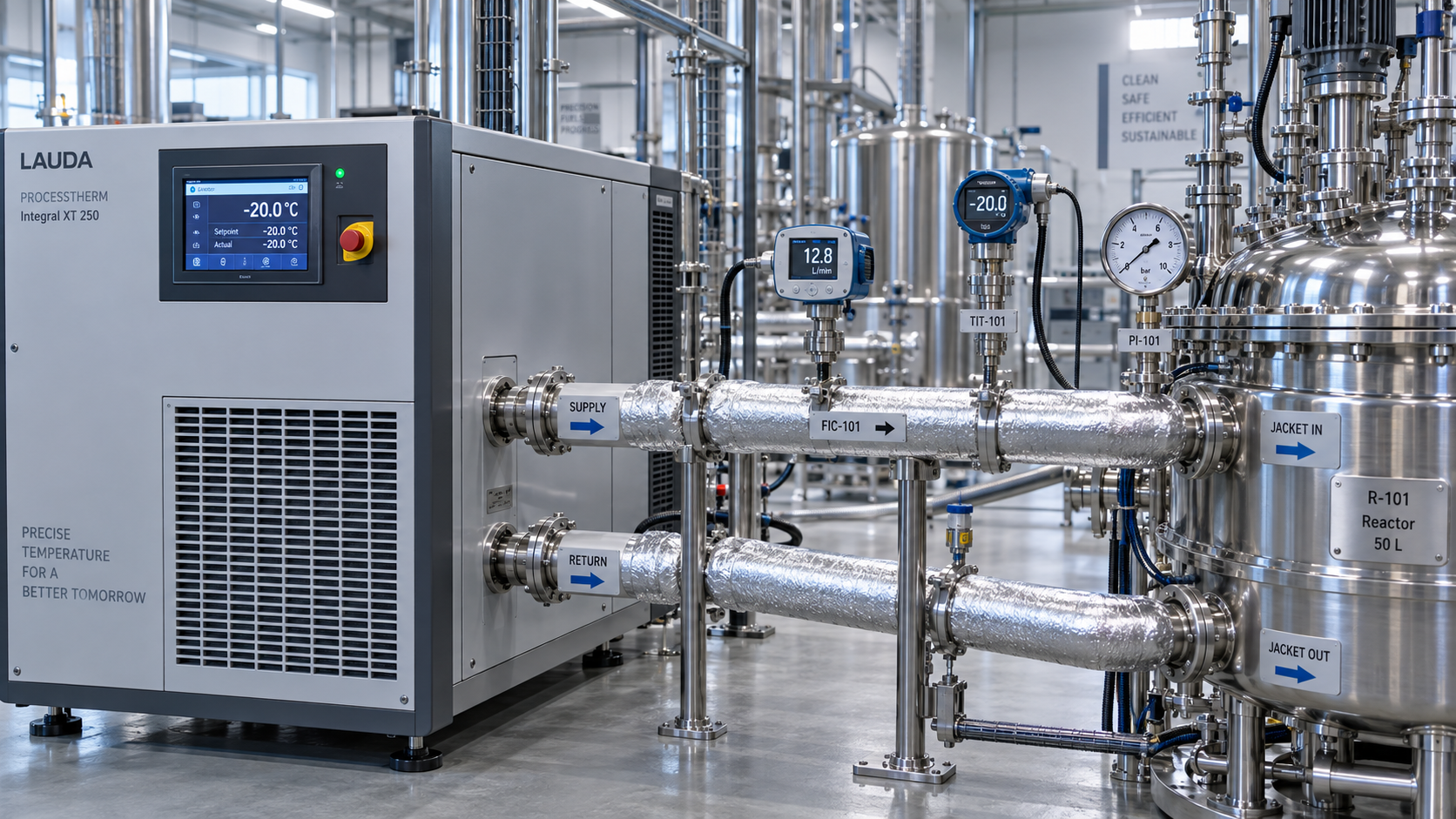
A unit that holds a supply fluid at 20.0°C in a lightly loaded factory acceptance test may behave very differently when connected to a reactor jacket, test chamber, laser system, coating head, mould tool, or analytical instrument. The temperature that matters may be fluid supply, fluid return, product surface, chamber air, a critical component, or the process material itself. These points can differ materially, particularly where heat-transfer resistance, long pipe runs, low flow, or intermittent production cycles are involved.
Technical evaluators should therefore write the temperature requirement as a process condition rather than a catalogue request. A useful specification identifies the controlled point, target setpoint, allowable deviation, required recovery behaviour, load profile, fluid medium, flow conditions, and the way performance will be verified. This avoids a common procurement failure: buying a machine with an impressive nominal stability value that was measured at an irrelevant sensor location or under unrealistically steady conditions.
For many European industrial projects, the most defensible approach is to distinguish three separate requirements:
- Setpoint accuracy: how closely the displayed or commanded value represents the actual measured temperature after calibration.
- Stability: the short-term variation at the defined measuring point while the system is operating at a stable load.
- Uniformity: the maximum temperature difference across the process area, tool, chamber, bath, or multiple points of use.
These are often presented as though they were interchangeable. They are not. A circulating chiller can have tight supply-temperature stability while the connected process has poor uniformity. A chamber can control its air sensor accurately while a loaded product reaches temperature slowly or develops gradients. A specification that does not separate these terms leaves room for a technically compliant but operationally unsuitable proposal.
Define precision under real disturbances
The requested precision should be tied to what can genuinely be controlled. A requirement of ±0.1°C may be appropriate for a sensitive metrology loop, semiconductor support process, pharmaceutical test system, or tightly controlled material treatment step. It becomes less meaningful if the sensor itself has a comparable uncertainty, the process load changes abruptly, or the piping arrangement introduces a larger temperature loss than the allowed tolerance.
Ask bidders to state the conditions behind every performance claim. At minimum, those conditions should cover ambient temperature, fluid type and concentration, supply temperature, flow rate, thermal load, load-step size, operating duration, sensor position, measurement resolution, and the calculation method used for stability. A figure expressed as “±0.1°C” without a time interval, load condition, and sensor location cannot be compared fairly with another offer.
Response performance deserves equal attention. In a process with cyclic heat release, the controller must reject disturbances fast enough to prevent unacceptable drift, but it must also avoid overshoot and persistent hunting. Aggressive tuning can make a trend chart look responsive while repeatedly pushing a sensitive process beyond its permitted limits. Slow control can be acceptable for a high-mass thermal system, but not for a test sequence that depends on fast and repeatable transitions.
Rather than requesting a vague “fast response,” define relevant test cases. These may include a step increase in heat load, start-up from ambient, recovery after a production pause, a change in return-fluid temperature, loss and restoration of flow, or switching between two setpoints. The unit should be evaluated over the operating envelope, not only at its most favourable design point.
Heat load is rarely constant
Cooling and heating capacity should be specified as a curve or matrix, not as a single maximum number. Capacity changes with supply temperature, ambient conditions, refrigerant circuit design, fluid mixture, altitude, condenser condition, and the selected operating mode. In applications where the temperature-control unit must both heat and cool, the transition behaviour matters as much as peak capacity.
A credible thermal-load profile includes steady-state load, expected peak load, rate of change, and any internally generated heat from pumps, drives, agitation, or auxiliary equipment. It should also state whether load is continuous, batch-based, pulsed, or seasonal. Oversizing may seem conservative, but it can create poor part-load operation, excess cycling, higher capital cost, and control instability if the equipment is not designed to modulate effectively at low demand.
Specify the hydraulic circuit as carefully as the refrigeration circuit
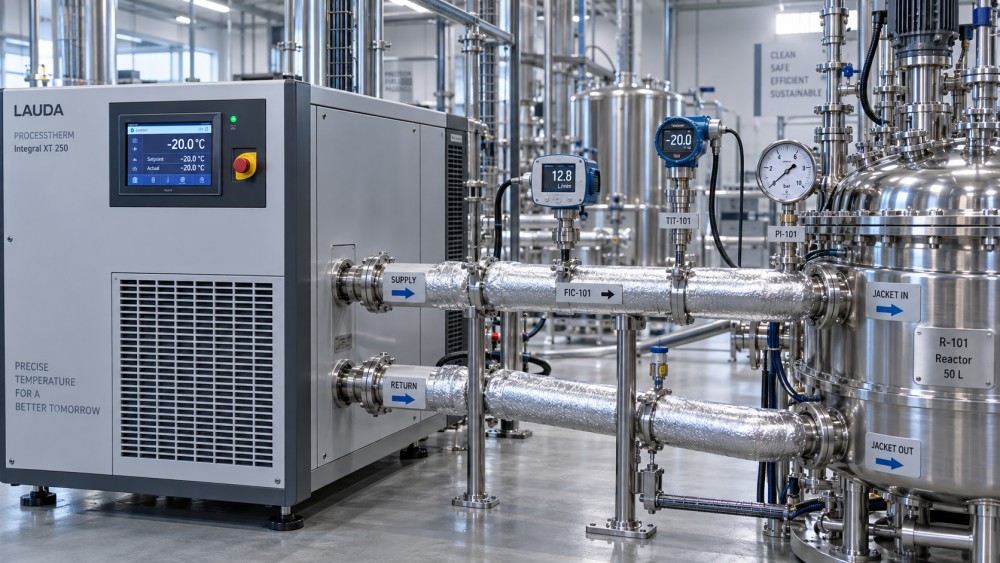
Many precision problems originate outside the refrigeration system. Pump selection, pressure control, fluid volume, bypass arrangements, filtration, pipe insulation, valve authority, and sensor placement all affect the delivered result. A stable internal reservoir does not guarantee stable temperature at a remote tool.
For liquid-based systems, the specification should establish required flow, minimum and maximum pressure, allowable pressure drop, fluid chemistry, temperature range, and the process-side volume. If glycol or another additive is required for freeze protection, material compatibility and the effect on viscosity, pump duty, and heat-transfer performance should be considered. A fluid choice that protects the system in a cold location can reduce capacity and alter control response.
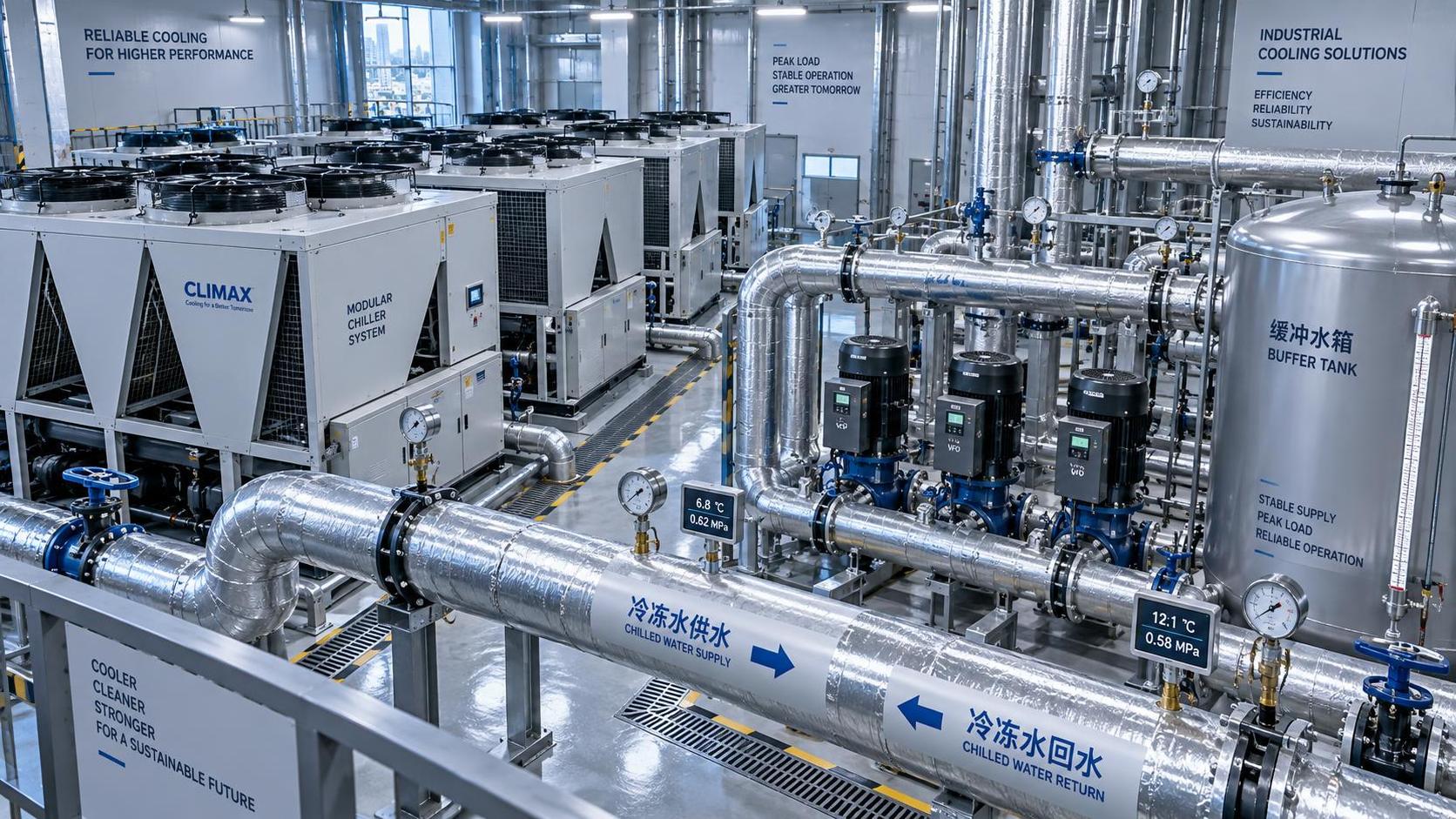
Where one central unit serves several loads, do not assume that a common supply temperature will provide identical process temperatures. Different branches can see unequal flows, heat gains, return temperatures, and valve positions. Decoupled loops, local mixing, secondary pumps, buffer volume, or point-of-use temperature control may be needed. The appropriate architecture depends on whether the priority is distribution efficiency, independent setpoints, isolation of contamination risk, rapid response, or uniformity across multiple users.
European compliance is part of the technical specification
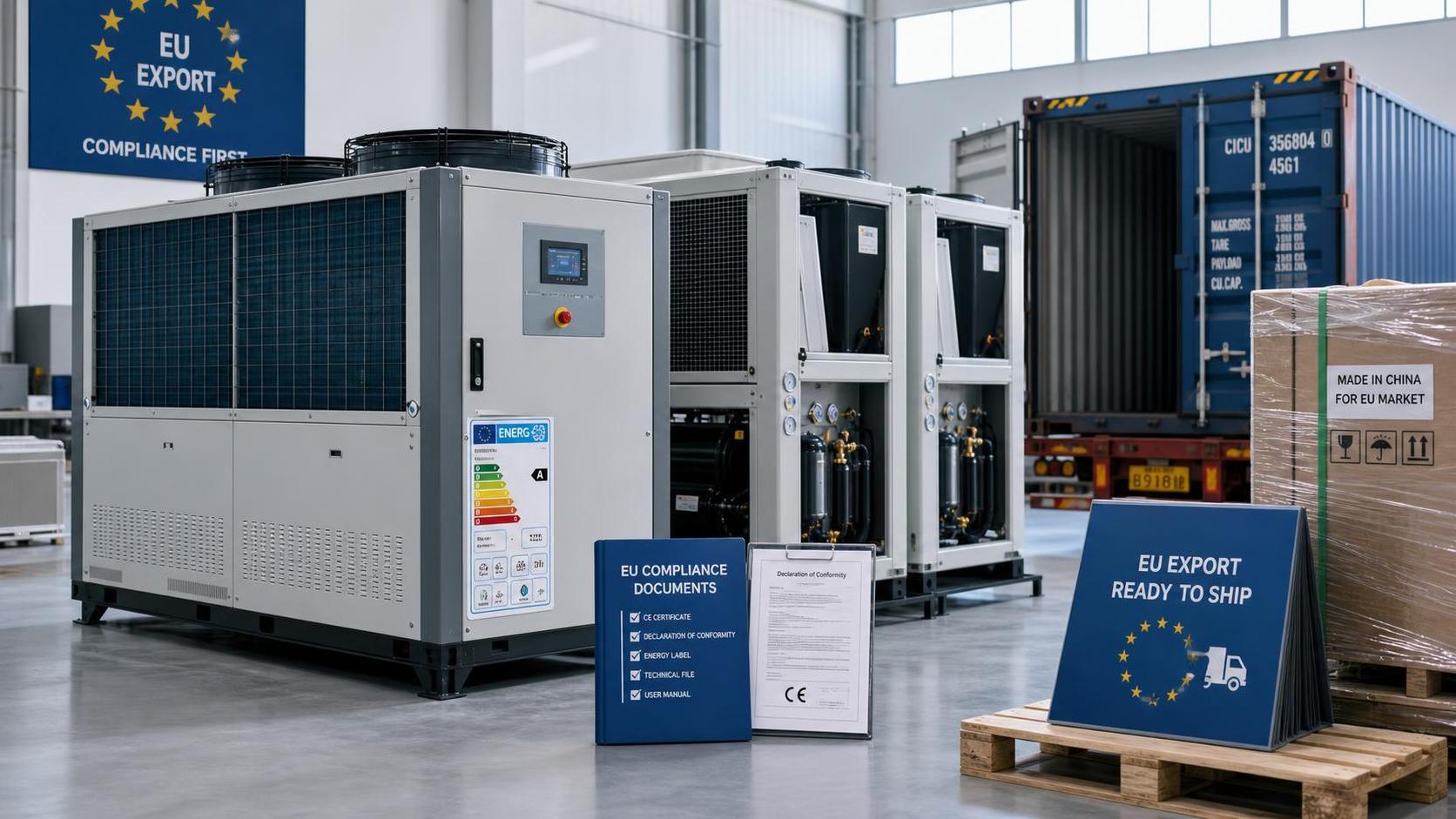
In Europe, compliance should be considered early because it can influence equipment architecture, refrigerant choice, documentation, service strategy, and site installation requirements. A request for CE marking alone is too broad to be useful. The manufacturer’s conformity assessment must reflect the equipment actually supplied and the regulatory obligations that apply to it, which may include electrical safety, electromagnetic compatibility, machinery-related requirements, pressure equipment, and refrigerant-containing assemblies.
For a packaged temperature-control system, evaluators should request the declaration of conformity, applicable legislation and standards, operating instructions, safety information, electrical documentation, and information required for correct installation and maintenance. Where the scope includes a pressurised circuit, verify how the pressure-bearing parts and the complete assembly have been assessed. The relevant responsibilities can differ depending on whether equipment is supplied as a self-contained unit, integrated into a production line, or assembled on site with other pressure equipment.
Refrigerant selection should be treated as a lifecycle decision rather than a simple environmental label. The European F-gas framework affects the availability and permitted use of certain fluorinated greenhouse gases, while national implementation, servicing capability, and the specific application can shape the practical outcome. Specify that the supplier identifies the refrigerant, its safety classification, likely service requirements, containment provisions, leak detection where applicable, and the basis on which the proposed configuration is suitable for the intended installation.
Low-global-warming-potential refrigerants can be a sound direction, but their adoption may introduce flammability, pressure, ventilation, charge-limit, or equipment-room considerations. A technically sound offer addresses those conditions directly. Replacing one refrigerant with another without revisiting system design, site risk assessment, and maintenance competence is not a precision-control strategy.
Control integration and data integrity determine whether performance can be proven
High-precision temperature control usually belongs to a wider control environment. The thermal unit may need to exchange setpoints, status, alarms, operating modes, flow values, pressure data, and temperature trends with a PLC, SCADA platform, building management system, laboratory system, or manufacturing execution environment. The necessary protocol should be identified before the purchase order, together with ownership of the control logic and the permitted remote commands.
There is an important distinction between monitoring a unit and controlling a process through it. If a central system writes the setpoint, define limits, priority rules, communication-loss behaviour, local override permissions, and alarm escalation. If remote control can affect product quality or equipment safety, the fail-safe state should be explicit rather than inferred from a standard controller configuration.
For regulated or quality-critical applications, temperature records need more than a screen trend. Establish the required timestamp accuracy, sampling interval, retained data, event logging, user access controls, calibration status, export format, and audit expectations. The required level of documentation varies by sector, but the principle is consistent: a claimed control band is of limited value when the measurement chain cannot demonstrate it.
Calibration cannot be delegated to a display value
Specify the measurement chain from the reference instrument to the process sensor. This includes sensor type, tolerance, installation method, transmitter accuracy, controller resolution, calibration interval, and the treatment of offsets. A high-resolution display can imply precision that the sensor, mounting arrangement, or calibration method does not support.
Where the process tolerance is narrow, acceptance testing should use suitably calibrated reference equipment and a pre-agreed method. Define where measurements are taken, how long the system must stabilise, how disturbances are introduced, which values are recorded, and the pass/fail rule. Factory testing can establish basic equipment performance, while site acceptance confirms the delivered result with actual pipework, utilities, controls, and process load.
Evaluate energy performance at the operating profile
Energy consumption should be assessed at the temperatures and load distribution expected in service. A unit that performs efficiently at full cooling load may operate most of the year at part load, elevated ambient temperatures, or a setpoint that changes the compressor lift substantially. Similarly, an apparently economical central system can lose its advantage through pumping energy, distribution losses, or excessive simultaneous heating and cooling.
Request electrical demand and heat-rejection information across representative operating points. Include pumps, fans, heaters, controls, and any integral auxiliary equipment rather than considering compressor power in isolation. For water-cooled systems, site water use, treatment requirements, and available condenser-water conditions can be as important as electrical input. For air-cooled systems, placement, recirculation risk, noise constraints, and seasonal ambient variation require attention.
The most useful comparison is often an annual operating scenario built around actual hours at each load and temperature condition. It will not eliminate uncertainty, but it exposes proposals that rely on a single optimistic efficiency point. It also makes the trade-off visible between a lower purchase price and the operating cost, maintenance burden, refrigerant exposure, and production risk that follow from the chosen design.
A specification that supports a defensible decision
A strong request for quotation for high-precision temperature control in Europe leaves little ambiguity about the duty. It describes the controlled process point, temperature band, uniformity requirement where relevant, load profile, fluid circuit, ambient envelope, utilities, integration needs, compliance obligations, documentation, and acceptance method. It also asks suppliers to declare exclusions and assumptions, especially those relating to external hydraulics, site installation, process-side control, and refrigerant safety measures.
That level of definition does not make every proposal identical. It makes differences visible. One supplier may offer a highly stable packaged loop that suits a compact and repeatable load. Another may show that the required process performance depends on remote sensing, a secondary circuit, larger buffer volume, or local control at each tool. For an evaluator, that distinction is more valuable than comparing nominal capacity, a headline accuracy figure, or the initial purchase price alone.
Related News
- How to size energy efficient industrial cooling for a process loadAuthor :Cryogenic Systems Expert

- How to specify high-precision temperature control in EuropeAuthor :Cryogenic Systems Expert

- How cooling system design affects cleanroom contamination controlAuthor :Cryogenic Systems Expert

- When does industrial cooling heat recovery pay back in energy savings?Author :Cryogenic Systems Expert

- How to size an industrial cooling system for peak process loadsAuthor :Cryogenic Systems Expert

- When are aluminum electronics cooling solutions suitable for high-density designs?Author :Cryogenic Systems Expert

- A thermal management guide for preventing chiller capacity lossAuthor :Cryogenic Systems Expert

- When does aluminum make sense for electronics cooling solutions?Author :Cryogenic Systems Expert

- EU Battery Carbon Footprint Labels Become Mandatory on Aug 18 for Battery-Integrated Cooling and Energy Storage ExportsAuthor :Cryogenic Systems Expert

- China-UAE Direct Sea Route Cuts Lead Times for Industrial Cooling and Compression ExportsAuthor :Cryogenic Systems Expert

- EPA Rule Takes Effect for R-410A Equipment ImportsAuthor :Cryogenic Systems Expert

- EN 378-1:2026 Tightens EU Export ChecksAuthor :Cryogenic Systems Expert

- How to Compare Semiconductor Cooling Solutions by Heat Load and Uptime RiskAuthor :Cryogenic Systems Expert

- EU Label Deadline Hits China Chiller ExportsAuthor :Cryogenic Systems Expert

- How Smart Thermal Systems Improve Industrial Cooling EfficiencyAuthor :Cryogenic Systems Expert

- How to Choose Process Cooling Equipment for Stable Temperature ControlAuthor :Cryogenic Systems Expert

- EU Finalizes 2026 HFC Quota Cut for R-134a ChillersAuthor :Cryogenic Systems Expert

- EU Tightens HFC-134a Quotas for Industrial ChillersAuthor :Cryogenic Systems Expert

- REACH SVHC Update Pressures HFC-134a Chiller Supply ChainsAuthor :Cryogenic Systems Expert

- EU PFAS Coolant Ban Reshapes Chiller ExportsAuthor :Cryogenic Systems Expert

- EU REACH Restricts PFAS Cooling Media ImportsAuthor :Cryogenic Systems Expert

- EU Ecodesign Rule Takes Effect for Industrial ChillersAuthor :Cryogenic Systems Expert

- EU REACH Rule Takes Effect for PFAS in Industrial Cooling ExportsAuthor :Cryogenic Systems Expert

- Industrial Cooling for Plastic Processing: How to Size for Stable Cycle TimesAuthor :Cryogenic Systems Expert

- EU F-Gas Update Bars R404A/R507 in Commercial CoolingAuthor :Cryogenic Systems Expert

- DOE Raises Chiller Efficiency Standard From October 2026Author :Cryogenic Systems Expert

- India Mandates BIS Energy Certification for Industrial ChillersAuthor :Cryogenic Systems Expert

- Energy-Efficient Heat Exchange for Process Cooling: Cost vs PaybackAuthor :Cryogenic Systems Expert

- EPA R-134a Import Ban Takes Effect on July 13, 2026Author :Cryogenic Systems Expert

- India BIS Rule Takes Effect for Industrial ChillersAuthor :Cryogenic Systems Expert

- EPA Cuts R134a Import Quotas 20% From July 10Author :Cryogenic Systems Expert

- How to Compare Energy-Efficient Cooling Systems for Factory Expansion ProjectsAuthor :Cryogenic Systems Expert

- Chiller Price Index Rises 11.3% in Q2Author :Cryogenic Systems Expert

- Saudi SASO Tightens Chiller Import Compliance From July 10Author :Cryogenic Systems Expert

- Dubai Opens Fast-Track Chiller TendersAuthor :Cryogenic Systems Expert

- Japan Raises Chiller COP Floor to 6.2 From Sept. 1Author :Cryogenic Systems Expert
![]()