When does aluminum make sense for electronics cooling solutions?




The question is not whether aluminum can cool electronics, but whether it can cool this design
Aluminum is usually the default starting point in electronics cooling because it is widely available, comparatively light, easy to machine or extrude, and materially less expensive than copper in many supply conditions. That default is often sensible. It is not, however, a complete material-selection decision.
For a technical evaluator, the useful question is more specific: can an aluminum-based thermal path keep the relevant components below their allowable temperature limits across the full duty cycle, manufacturing variation, installation environment, and expected service life? If the answer is yes, aluminum may deliver the best balance of thermal performance, mass, cost, and production scalability. If the answer is no, replacing it with copper is only one possible response. The real answer may instead involve a larger fin area, a different airflow path, a vapor chamber, a heat pipe, a liquid-cooling loop, a revised component layout, or lower thermal resistance elsewhere in the stack.
That distinction matters because electronics cooling solutions are increasingly constrained by more than peak chip power. Enclosures are shrinking, power densities are rising, ambient temperatures are less predictable, and energy use from fans or pumps has become a system-level concern. In industrial controls, telecom equipment, energy storage, automotive electronics, data infrastructure, medical devices, and power conversion systems, a material decision that looks minor in a bill of materials can affect reliability margins, qualification effort, manufacturing yield, and service cost.
Where aluminum has a strong technical case
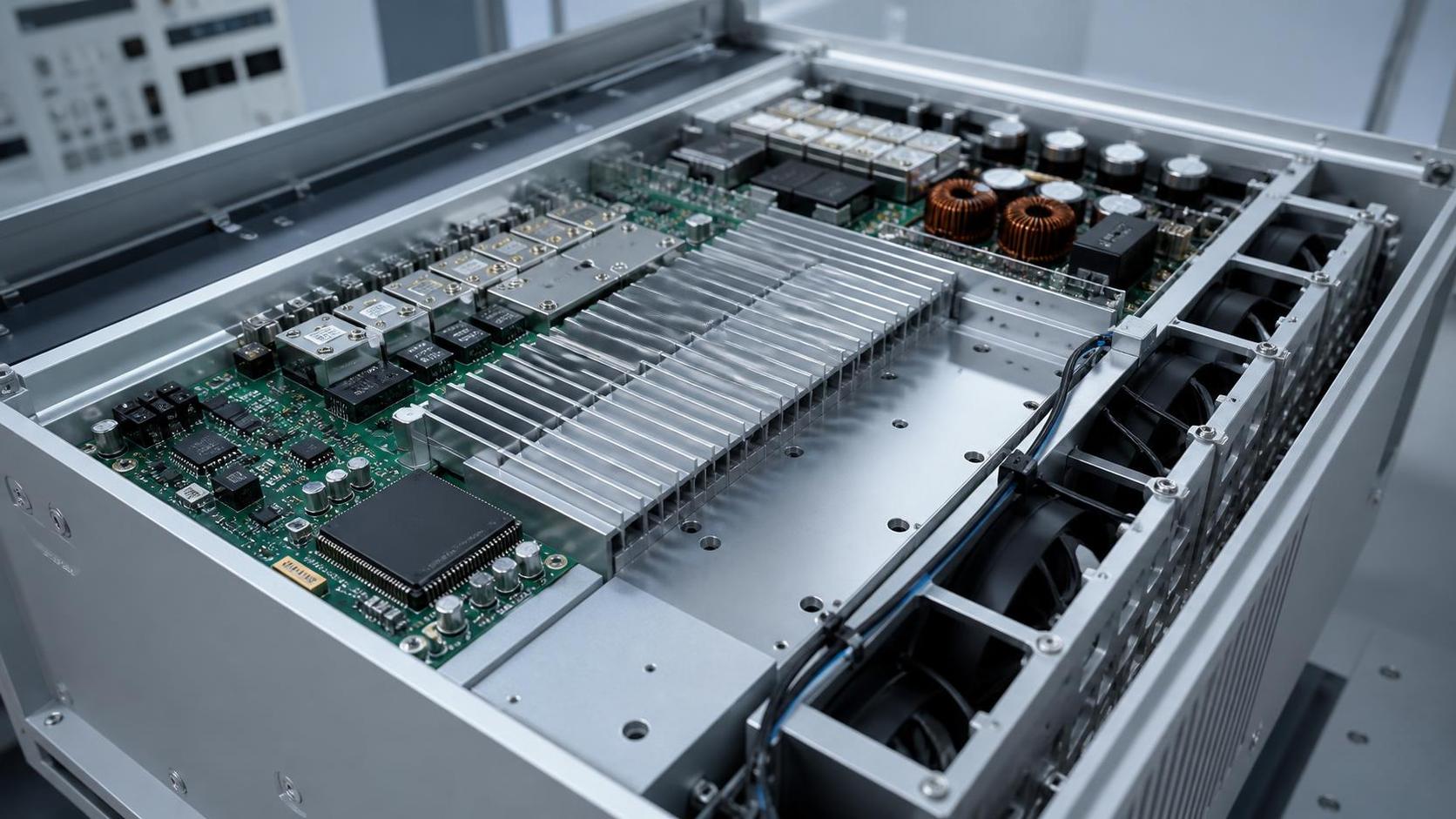
Aluminum is most compelling when heat must be spread and rejected over a relatively large surface area, particularly where airflow is available. Its thermal conductivity is lower than that of pure copper, but the practical cooling result is not determined by conductivity alone. Geometry, contact resistance, fin efficiency, air velocity, surface treatment, and enclosure behavior frequently dominate the final thermal outcome.
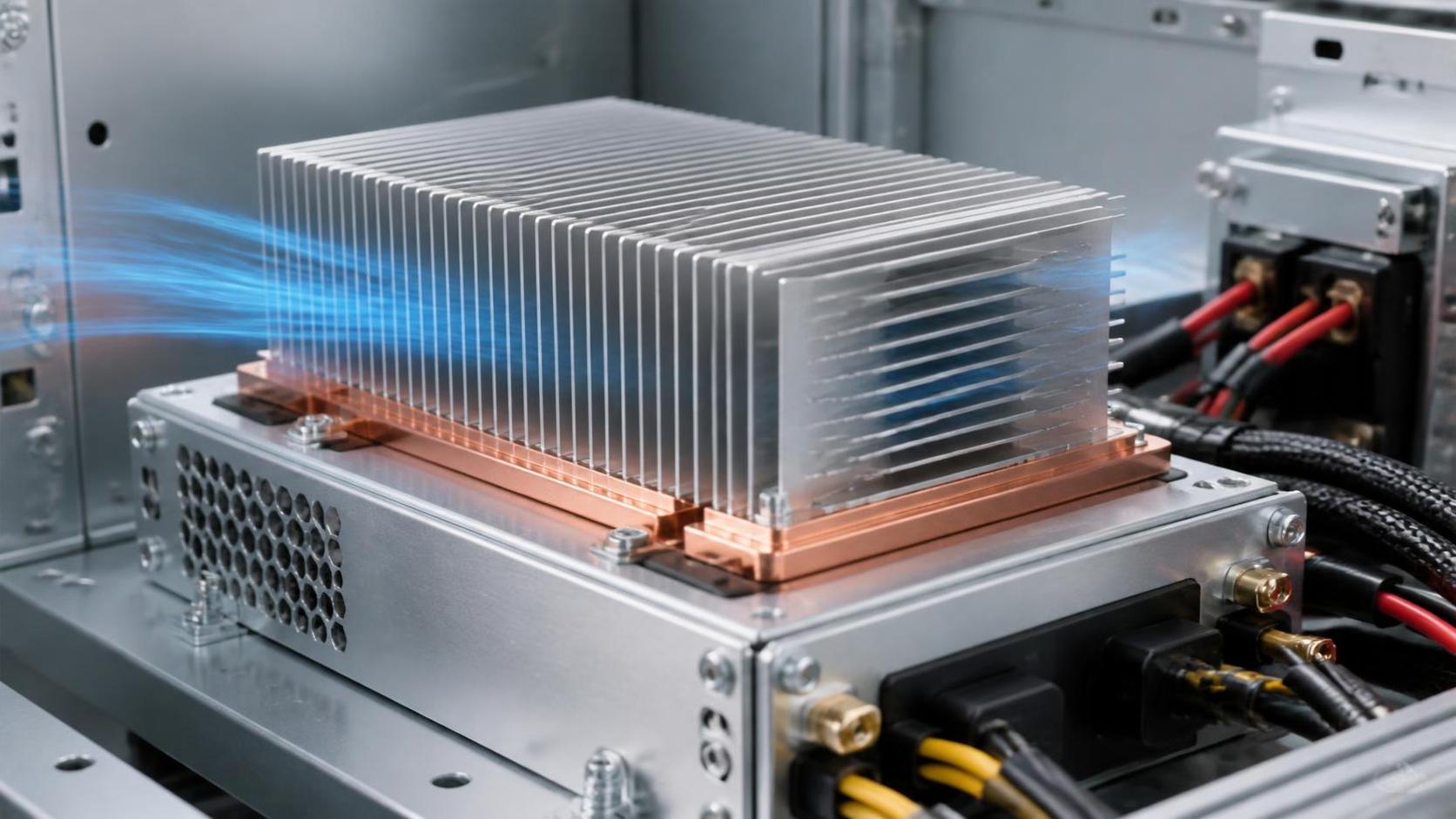
In forced-air heat sinks, for example, an optimized aluminum extrusion or die-cast structure can provide enough fin area and airflow access that moving to copper brings only a modest reduction in component temperature. If that improvement does not unlock additional power capacity, longer life, reduced fan demand, or a more compact enclosure, the added material cost and mass may be difficult to justify.
Aluminum also has advantages that become more visible at production scale:
- It supports cost-effective extrusion for repeatable, high-volume finned profiles.
- It is substantially lighter than copper, which matters in mobile, rack-mounted, aerospace-adjacent, transport, and manually installed equipment.
- It can be machined, stamped, die-cast, bonded, or fabricated through established supply chains.
- Its corrosion behavior is often manageable with appropriate alloy selection, finishing, and enclosure design.
- Its material availability and recyclability can support broader lifecycle and procurement objectives, although local supply conditions should still be assessed.
Common examples include LED luminaires, industrial motor drives, PLC cabinets, power supplies, communications radios, battery management systems, consumer adapters, and moderately loaded computing or networking equipment. In these applications, aluminum often provides a practical route to thermal control without adding disproportionate weight or manufacturing complexity.
The material is especially attractive when the heat source is not extremely concentrated. A power module distributing heat through a reasonably broad baseplate is a different problem from a compact processor or RF transistor releasing a high thermal load through a very small footprint. Aluminum handles the former well in many cases. The latter may expose its limitations quickly.
Thermal conductivity is important, but it is not the entire resistance chain
Copper is commonly cited as the superior thermal material because it conducts heat much more effectively than aluminum. As a broad material property, that is true. But a cooling assembly is a chain, not a single material value. Heat travels from semiconductor junction to package, package to thermal interface material, interface to heat spreader or cold plate, then through the heat sink and finally into air or coolant. The largest thermal bottleneck may be a thin interface layer, a flatness issue, insufficient mounting pressure, a restricted airflow channel, or recirculation of hot exhaust air.
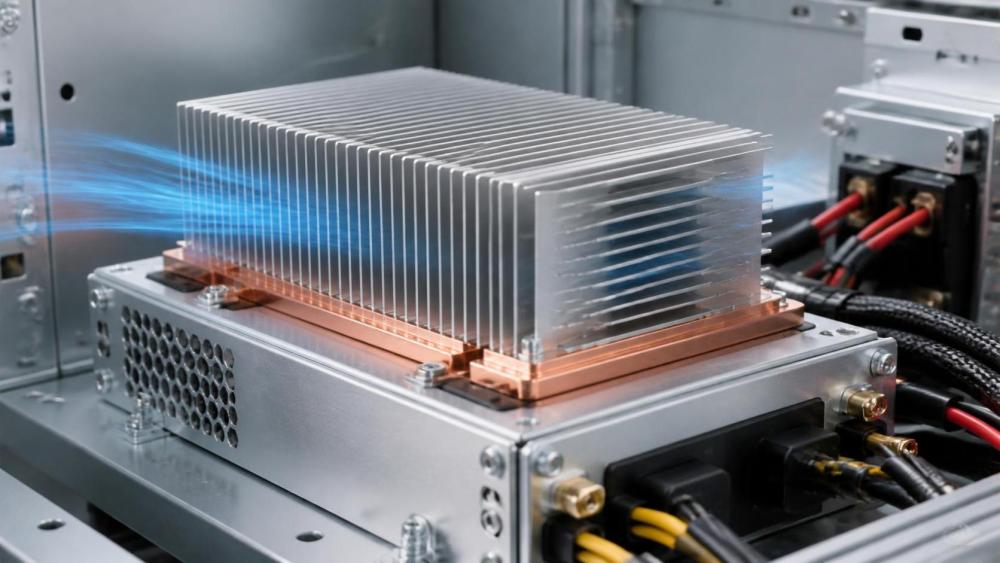
An aluminum heat sink with a well-controlled interface and efficient airflow can therefore outperform a poorly integrated copper solution. Conversely, a copper baseplate beneath aluminum fins can be justified where the first few millimeters of heat spreading are the critical constraint, while aluminum remains the more economical material for the larger air-side structure.
Technical teams should resist the simplified claim that copper is always “better” and aluminum is always “cheaper.” The correct comparison is at assembly and system level. A heavier copper solution can increase handling difficulty, impose mechanical loads on a PCB, require more robust mounts, and add cost without solving an airflow or interface problem. An aluminum solution can appear economical but become inadequate when concentrated heat flux produces unacceptable temperature gradients close to the source.
The decision turns on heat density, not just total watts
A 100 W thermal load is not a sufficient basis for selecting a heat sink material. The source area, allowable junction temperature, duty profile, surrounding heat sources, and cooling method all change the decision. A broad inverter module dissipating 100 W may be comfortably cooled by an aluminum extrusion in forced air. A compact processor dissipating the same power over a small die area may require a copper spreader, vapor chamber, heat pipe, or liquid cold plate before the heat can be transferred efficiently to the larger rejection surface.
For practical screening, evaluators should separate three questions:
- Can the heat enter the cooling structure? This is governed by package design, interface material, mounting pressure, contact flatness, and local spreading resistance.
- Can the cooling structure distribute the heat? This depends on material conductivity, base thickness, source footprint, heat sink geometry, and the distance between the source and active cooling area.
- Can the system reject heat to its environment? This depends on airflow, coolant flow, inlet temperature, fouling, enclosure sealing, altitude, acoustic constraints, and external ambient conditions.
Aluminum becomes less suitable as a single-material answer when the middle question is severe: high power in a small footprint, multiple hot spots on one baseplate, long lateral heat-spreading distances, or tight local temperature uniformity requirements. In those cases, a hybrid architecture is often more rational than an all-copper assembly. Copper inserts, copper baseplates, heat pipes, or vapor chambers can address local spreading while aluminum manages bulk fin area and structural mass.
Air cooling favors aluminum, until enclosure physics starts to dominate
Most aluminum heat sinks are used in air-cooled systems, but “air-cooled” is not one operating condition. A heat sink tested in open laboratory airflow can behave very differently inside a sealed industrial enclosure, a dusty outdoor cabinet, a high-altitude installation, or a rack where neighboring equipment is exhausting warm air into the same intake path.
When evaluating an aluminum design, ask whether the claimed performance is based on the actual installation state. Fan curves should be assessed against total system impedance, not free-air flow. Airflow direction must match fin orientation. Cable bundles, filters, guards, and adjacent boards may reduce flow or create recirculation. At elevated altitude, lower air density reduces convective performance. In contaminated environments, fin spacing that is thermally effective when clean may clog faster than a more open geometry.
These conditions may make a more capable aluminum geometry preferable to a compact copper part. A larger aluminum heat sink with wider fin spacing can sometimes sustain real-world thermal performance better over time than a dense design optimized only for clean, controlled airflow. The selection should therefore include maintenance conditions and degradation behavior, not just initial temperature-rise data.
Weight, manufacturing route, and mechanical integration are material criteria
Aluminum is often chosen for reasons that have little to do with the thermal simulation and much to do with the complete product. In a wall-mounted drive, a rail-mounted power supply, an on-board computing module, or a transport electronics unit, mass can influence vibration behavior, bracket design, shipping cost, and installation safety. Copper’s density may also amplify stress on solder joints, board connectors, or mounting points under shock and vibration.
The manufacturing route deserves equal scrutiny. Extrusion is well suited to long, consistent fin profiles and can offer an efficient path for mature designs. Die casting can create more complex forms, but the thermal and structural properties of the chosen alloy, porosity control, wall thickness, and production yield need review. Machining offers flexibility for lower volumes or intricate interfaces, but can raise cost and material waste. Bonded-fin approaches may increase surface area where extrusion limits apply, while adding assembly variables that require supplier process control.
For a quoted aluminum solution, technical evaluators should request more than a drawing and a thermal resistance number. They should understand alloy grade, temper where relevant, manufacturing process, surface finish, flatness specification, mounting scheme, burr control, coating thickness, and inspection method. These details affect both actual thermal performance and repeatability between production lots.
Surface finish and corrosion can be decisive in industrial deployments
Unfinished aluminum develops a natural oxide layer that offers some protection, but industrial operating environments can be more demanding than a benign indoor electronics room. Humidity, salt exposure, chemical vapors, washdown regimes, conductive dust, and mixed-metal interfaces can create corrosion risks. The material decision must include enclosure sealing, drainage, coating strategy, fastener selection, and grounding requirements.
Anodizing is frequently used for protection and appearance. Its effect on thermal performance is context-dependent: surface emissivity can be useful in radiation-dominant conditions, while coating thickness and interface treatment must be controlled where direct thermal contact is important. Powder coatings or paints may provide environmental protection but can affect thermal behavior and tolerances. No general statement that “black anodizing improves cooling” should substitute for a review of the actual heat-transfer modes and the supplier’s process specification.
Galvanic corrosion is another recurring risk. Aluminum in contact with copper, stainless steel, or other metals may require compatible finishes, isolation methods, carefully selected fasteners, and control of moisture pathways. This is particularly relevant in outdoor telecom, marine-adjacent, renewable-energy, and transportation applications. A solution can pass an initial thermal test and still fail its intended life if material interfaces were treated as an afterthought.
When aluminum should give way to another approach
There are clear cases where relying on aluminum alone is likely to create unacceptable compromise. The first is very high local heat flux. If the temperature rise from the component footprint into the heat sink base consumes too much of the thermal budget, better air-side fins will not solve the issue. A copper spreader, vapor chamber, or liquid cold plate may be needed to move heat away from the source before it reaches the main rejection structure.
The second is a very limited volume with little airflow. Small sealed enclosures often become a system-level thermal design problem rather than a heat-sink material problem. Conduction to a chassis, external finning, a heat pipe to a better location, or active cooling may be more effective than attempting to fit a denser metal block beside the component.
The third is stringent temperature uniformity. Optical systems, precision instruments, battery assemblies, high-stability sensing equipment, and some semiconductor process tools may care as much about gradients as maximum temperature. Aluminum may still be used, but the architecture must be assessed for distribution and control rather than only heat rejection.
Finally, aluminum may not be the right answer when liquid cooling is already required. In those cases, coolant chemistry, corrosion protection, channel geometry, pressure drop, joining method, leak risk, and serviceability become the governing issues. Aluminum cold plates can be highly effective, but their suitability depends on the full fluid loop and compatibility of every wetted material.
A procurement decision should be validated through the use case, not a catalog ranking
Supplier thermal ratings are useful starting points, but they must be interpreted carefully. Thermal resistance values may be presented for a specific orientation, airflow rate, inlet temperature, mounting condition, and measurement method. A part rated under forced convection cannot be compared directly with one tested in natural convection. Similarly, a thermal resistance value measured at the heat sink base may not include the interface and semiconductor package losses that determine junction temperature.
A disciplined evaluation usually combines simulation, prototype testing, and manufacturing review. Simulation identifies likely hot spots and compares design options quickly. Prototype testing checks the assumptions under representative airflow, power cycling, and ambient conditions. Manufacturing review determines whether flatness, finish, assembly pressure, and material quality can be maintained at volume.
What is changing in the aluminum cooling decision
The aluminum-versus-copper comparison is becoming less binary. Rising compute density, electrification, edge infrastructure, and compact power conversion are increasing demand for hybrid thermal architectures. At the same time, pressure to reduce system energy use is making fan power, pressure drop, and intelligent thermal control more important. A nominally lower-cost heat sink that requires higher fan speed may create acoustic, reliability, and energy penalties across the product lifecycle.
Material traceability, recycled content claims, carbon accounting, and regional supply resilience are also appearing more frequently in industrial procurement discussions. The relevant requirements vary by market and customer program, and any mandatory reporting or compliance obligation should be verified for the specific jurisdiction and application. Still, technical teams should expect material decisions to be reviewed alongside broader manufacturing and lifecycle criteria rather than as isolated thermal calculations.
Aluminum makes sense when it enables sufficient thermal margin in the actual system, can be manufactured consistently, survives the operating environment, and avoids creating larger mechanical or economic burdens elsewhere. It stops making sense when local heat density, constrained volume, harsh conditions, or reliability requirements consume those advantages. The strongest selection is usually not the one with the highest conductivity on a material chart, but the one that preserves thermal headroom after the enclosure, interface, airflow, production variation, and service life have all been accounted for.
Ready when you are. Send us a message to get started.
Related News
- How to size a chiller for pharmaceutical cleanroom temperature controlAuthor :Cryogenic Systems Expert

- When do smart thermal systems with sensors reduce chiller energy use?Author :Cryogenic Systems Expert

- Chiller Optimization Checklist for Rising Energy Use and Unstable Cooling OutputAuthor :Cryogenic Systems Expert

- How to Specify a High-Precision Temperature Chiller for Tight-Tolerance ProcessesAuthor :Cryogenic Systems Expert

- Designing Energy-Efficient Industrial Cooling for Variable Process LoadsAuthor :Cryogenic Systems Expert

- Low-GWP Cooling Solutions for Process Plants: Comparing Safety, Efficiency, and CostAuthor :Cryogenic Systems Expert

- How to size energy efficient industrial cooling for a process loadAuthor :Cryogenic Systems Expert

- How to specify high-precision temperature control in EuropeAuthor :Cryogenic Systems Expert

- How cooling system design affects cleanroom contamination controlAuthor :Cryogenic Systems Expert

- When does industrial cooling heat recovery pay back in energy savings?Author :Cryogenic Systems Expert

- How to size an industrial cooling system for peak process loadsAuthor :Cryogenic Systems Expert

- When are aluminum electronics cooling solutions suitable for high-density designs?Author :Cryogenic Systems Expert

- A thermal management guide for preventing chiller capacity lossAuthor :Cryogenic Systems Expert

- When does aluminum make sense for electronics cooling solutions?Author :Cryogenic Systems Expert

- EU Battery Carbon Footprint Labels Become Mandatory on Aug 18 for Battery-Integrated Cooling and Energy Storage ExportsAuthor :Cryogenic Systems Expert

- China-UAE Direct Sea Route Cuts Lead Times for Industrial Cooling and Compression ExportsAuthor :Cryogenic Systems Expert

- EPA Rule Takes Effect for R-410A Equipment ImportsAuthor :Cryogenic Systems Expert

- EN 378-1:2026 Tightens EU Export ChecksAuthor :Cryogenic Systems Expert

- How to Compare Semiconductor Cooling Solutions by Heat Load and Uptime RiskAuthor :Cryogenic Systems Expert

- EU Label Deadline Hits China Chiller ExportsAuthor :Cryogenic Systems Expert

- How Smart Thermal Systems Improve Industrial Cooling EfficiencyAuthor :Cryogenic Systems Expert

- How to Choose Process Cooling Equipment for Stable Temperature ControlAuthor :Cryogenic Systems Expert

- EU Finalizes 2026 HFC Quota Cut for R-134a ChillersAuthor :Cryogenic Systems Expert

- EU Tightens HFC-134a Quotas for Industrial ChillersAuthor :Cryogenic Systems Expert

- REACH SVHC Update Pressures HFC-134a Chiller Supply ChainsAuthor :Cryogenic Systems Expert

- EU PFAS Coolant Ban Reshapes Chiller ExportsAuthor :Cryogenic Systems Expert

- EU REACH Restricts PFAS Cooling Media ImportsAuthor :Cryogenic Systems Expert

- EU Ecodesign Rule Takes Effect for Industrial ChillersAuthor :Cryogenic Systems Expert

- EU REACH Rule Takes Effect for PFAS in Industrial Cooling ExportsAuthor :Cryogenic Systems Expert

- Industrial Cooling for Plastic Processing: How to Size for Stable Cycle TimesAuthor :Cryogenic Systems Expert

- EU F-Gas Update Bars R404A/R507 in Commercial CoolingAuthor :Cryogenic Systems Expert

- DOE Raises Chiller Efficiency Standard From October 2026Author :Cryogenic Systems Expert

- India Mandates BIS Energy Certification for Industrial ChillersAuthor :Cryogenic Systems Expert

- Energy-Efficient Heat Exchange for Process Cooling: Cost vs PaybackAuthor :Cryogenic Systems Expert

- EPA R-134a Import Ban Takes Effect on July 13, 2026Author :Cryogenic Systems Expert

- India BIS Rule Takes Effect for Industrial ChillersAuthor :Cryogenic Systems Expert