Low-GWP Cooling Solutions for Process Plants: Comparing Safety, Efficiency, and Cost




Low-GWP cooling solutions should be compared as plant systems, not as refrigerant substitutions. A refrigerant with a lower climate impact can still create a poor investment if it requires an unsuitable machine room, limits maintenance access, raises water treatment costs, or performs inefficiently at the plant’s real operating temperatures.
The commercially sound choice depends on four linked questions: how much cooling is needed at peak and part load, where equipment can be installed, what safety controls the site can support, and whether the existing distribution system can be retained. Refrigerant price matters, but it is rarely the largest cost over the working life of a process cooling plant. Electricity, downtime exposure, maintenance capability, water use, and future equipment availability usually have greater influence.
Start with the process load, not the refrigerant label
Process plants do not operate like comfort-cooling buildings. Cooling demand may be continuous, batch-driven, seasonal, hygiene-sensitive, or tied to production quality. A plastics process may need stable water temperature to avoid dimensional variation. A food line may need rapid pull-down after sanitation. Pharmaceutical and semiconductor applications may require narrow temperature control and dependable redundancy. These conditions determine the appropriate cooling architecture before they determine the preferred refrigerant.
Before comparing quotations, establish a load profile that separates:
- Peak cooling demand from normal operating demand;
- Required supply and return temperatures at each process circuit;
- Hours at high ambient temperature versus lower-load periods;
- Consequences of a cooling interruption, including product loss, restart time, and safety implications;
- Existing chilled-water, glycol, condenser-water, or air-cooled distribution constraints;
- Future production changes that may alter load, temperature, or operating hours.
This work prevents a common procurement error: selecting equipment based on its nominal capacity at a standard condition that does not resemble the plant’s duty. A chiller can look cost-effective on paper and still run with poor part-load efficiency, insufficient capacity in hot weather, or unnecessary compressor cycling. The best low-GWP cooling solution is normally the one that meets the actual process envelope with the least operational complexity.
The main options and their practical trade-offs
Most industrial projects narrow the field to natural refrigerants or lower-GWP synthetic alternatives. Each route has a valid place, but the balance of safety, efficiency, and cost changes substantially with plant scale and operating conditions.
The table is not a ranking. It is a reminder that “low GWP” describes environmental impact of the refrigerant, while a plant investment must also address the risks and costs created by the full system design.
Safety should be designed into the operating model
Safety discussions often become too simplistic: ammonia is described as difficult, hydrocarbons as unacceptable, and carbon dioxide as inherently easy because it is not flammable. That framing is not useful for procurement. Each technology brings a different hazard profile, and the relevant question is whether the site can manage that profile consistently over the equipment life.
Ammonia systems can be commercially attractive for larger duties because they are widely used in industrial refrigeration and can deliver strong performance. They require disciplined engineering and operations. Machine-room separation, gas detection, ventilation, pressure relief routing, maintenance procedures, emergency response planning, and specialist support are not optional peripheral items; they are part of the purchased system. A small plant without trained personnel or access to competent service coverage may find a packaged alternative more practical, even where ammonia offers a better theoretical energy case.
Hydrocarbon equipment relies on managing flammability through charge limits, enclosure design, ventilation, ignition-source control, and suitable installation location. It can be an effective option when these measures are straightforward to implement. It becomes less attractive when cooling equipment must sit in congested production space, where ventilation pathways are limited, or where site rules make modifications slow and expensive.
Carbon dioxide avoids the flammability and toxicity profile associated with those choices, but it operates at much higher pressures than conventional refrigeration systems. The purchasing team should assess the whole support chain: component quality, relief strategy, commissioning competence, service training, spare-parts access, and response capability after an unplanned shutdown. Safety is not established by the refrigerant name alone.
Efficiency is determined by temperature lift and control quality
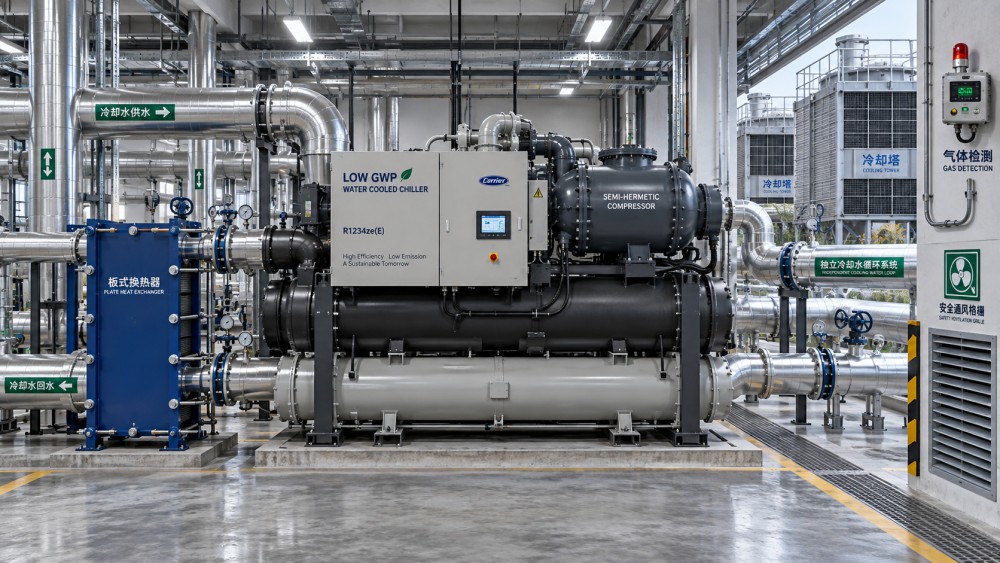
Energy comparisons often fail because proposals quote performance under different assumptions. The efficiency of any vapor-compression cooling system changes with the gap between the required cooling temperature and the heat-rejection temperature. Lower leaving-water temperatures, warmer ambient conditions, fouled heat exchangers, high glycol concentration, and poor condenser-water control all increase this temperature lift and raise power demand.
For that reason, compare suppliers using the same operating schedule. Ask for performance at the plant’s expected water temperatures and representative ambient or condenser-water conditions, not only at a single favorable rating point. Where the load varies, request part-load performance and explain how compressors, fans, pumps, and cooling-tower equipment will be controlled.
Several design choices can have as much impact as the refrigerant itself:
- Variable-speed compression and pumping: Valuable where process demand changes materially over a shift, season, or production campaign.
- Condenser selection: Air-cooled equipment avoids cooling-water infrastructure but can use more power in hot conditions. Water-cooled systems may offer a stronger energy case where water quality, treatment, and heat-rejection infrastructure are manageable.
- Free cooling or economization: Can reduce compressor operating hours where climate and process temperatures allow it. It should be evaluated against water-side complexity, controls, and maintenance needs.
- Heat recovery: Condenser heat may be useful for wash water, preheating, or low-temperature process heat. Its value depends on a stable simultaneous heat demand; recovered heat with no regular use is not a business case.
- Heat exchanger approach temperatures: Undersized or fouled heat exchangers force the system to work harder. Easy cleaning access and water treatment should be considered alongside initial equipment cost.
Do not assume the highest nominal efficiency unit will produce the lowest site energy bill. A well-controlled, correctly sized unit serving an efficient hydraulic circuit can outperform a more sophisticated chiller connected to oversized pumps, restrictive piping, or unstable process controls.
Capital cost is only the visible part of the decision
Low-GWP projects may have a higher initial cost where they need a dedicated machine room, gas detection, explosion protection, pressure-rated equipment, secondary loops, or changes to the electrical and cooling-water systems. Treating these as late-stage add-ons creates misleading comparisons. They should be included from the first commercial evaluation.
A useful total-cost model separates costs into five areas:
- Installed capital: Equipment, piping, civil work, electrical upgrades, controls integration, safety systems, commissioning, and temporary cooling during changeover.
- Energy and utilities: Compressor, fan, pump, tower, water-treatment, and glycol-related energy or consumables.
- Maintenance: Routine servicing, specialist callouts, inspection requirements, consumables, spare parts, and anticipated component replacement.
- Production risk: The economic consequence of lost cooling capacity, slow restart, temperature excursions, and unavailable spares.
- Future flexibility: Expansion capacity, refrigerant availability, service-market maturity, and the ability to alter process temperatures later.
This approach changes the discussion from “Which package is cheapest?” to “Which design has the lowest credible cost of ownership for this duty?” It also makes assumptions visible. A bid with a low installed price may depend on existing pumps, electrical capacity, or cooling towers that are already near their practical limits. Another bid may include redundancy that looks expensive until the cost of an unplanned production stop is considered.
Retrofit decisions deserve separate treatment
Replacing an existing refrigerant with a lower-GWP alternative is not always a simple fluid change. Refrigerant properties affect compressor operation, oil behavior, heat-transfer performance, pressure levels, expansion devices, safety classification, and system controls. A replacement may be technically feasible but still produce a capacity reduction, a change in discharge temperature, or a maintenance burden that was not part of the original plant design.
For aging equipment, there are usually three realistic pathways: continue operating while planning replacement, retrofit the refrigerant and selected components, or replace the cooling plant while retaining as much distribution infrastructure as practical. The right choice depends on equipment condition, leak history, remaining component life, process criticality, and the cost of downtime during conversion.
Retrofit is most compelling when the core plant is mechanically sound, the refrigerant change is compatible with the design, and the efficiency penalty is acceptable for the remaining service life. Full replacement makes more sense when compressors, controls, heat exchangers, or electrical systems also need major work. Combining several overdue renewals into one project can reduce repeated shutdown costs, but only after confirming that the redesigned capacity and hydraulic arrangement fit future production.
Questions that make supplier comparisons usable
A technically detailed quotation is not automatically comparable. Require each supplier to answer the same operating and commercial questions in a consistent format:
- What cooling capacity is delivered at the stated process water temperatures and expected heat-rejection conditions?
- What is included outside the chiller or refrigeration package, including pumps, controls, ventilation, detection, electrical work, and commissioning?
- How does the system respond to partial load, high ambient conditions, and a failed major component?
- Which maintenance activities require specialist personnel, and what routine site capability is assumed?
- What refrigerant charge is expected, where is it contained, and what safety systems are included in the project scope?
- What assumptions have been made about water quality, glycol concentration, available electrical power, and existing pipework?
- What capacity margin and redundancy philosophy are included, and what production load can still be supported during maintenance?
These questions expose differences that brochure specifications tend to hide. They also reduce the risk of selecting a solution that transfers essential scope, operating risk, or integration cost back to the plant after the purchase order is issued.
Choose a route that the site can operate for the next decade
There is no universal winner among low-GWP cooling solutions. Large, centralized industrial loads may justify ammonia or other natural-refrigerant architectures when the site can support the required safety and maintenance framework. Packaged lower-GWP chillers can be a practical route for retrofit projects and distributed process loads where installation speed and familiar operating practices matter. Carbon dioxide may be attractive for specific refrigeration duties, particularly where its pressure requirements and ambient performance are designed into the system from the outset. Hydrocarbons can be highly effective when charge, location, and ignition-control conditions are suitable.
The decision should be made through a site-specific lifecycle comparison, with identical load assumptions and a realistic allowance for installation, utilities, safety infrastructure, maintenance, and downtime. GTC-Matrix’s coverage of industrial cooling, compression power, and heat-exchange technologies can support this type of evaluation by connecting refrigerant choices to the wider thermal system: compressors, heat exchangers, controls, and the energy conditions that ultimately determine operating cost.
A procurement process is strongest when it begins with verified process conditions, treats safety scope as part of the equipment cost, and compares projected performance across the hours the plant actually runs. That produces a cooling investment that is lower in climate impact without creating an avoidable operational burden.
Related News
- When do smart thermal systems with sensors reduce chiller energy use?Author :Cryogenic Systems Expert

- Low-GWP Cooling Solutions for Process Plants: Comparing Safety, Efficiency, and CostAuthor :Cryogenic Systems Expert

- How to size energy efficient industrial cooling for a process loadAuthor :Cryogenic Systems Expert

- How to specify high-precision temperature control in EuropeAuthor :Cryogenic Systems Expert

- How cooling system design affects cleanroom contamination controlAuthor :Cryogenic Systems Expert

- When does industrial cooling heat recovery pay back in energy savings?Author :Cryogenic Systems Expert

- How to size an industrial cooling system for peak process loadsAuthor :Cryogenic Systems Expert

- When are aluminum electronics cooling solutions suitable for high-density designs?Author :Cryogenic Systems Expert

- A thermal management guide for preventing chiller capacity lossAuthor :Cryogenic Systems Expert

- When does aluminum make sense for electronics cooling solutions?Author :Cryogenic Systems Expert

- EU Battery Carbon Footprint Labels Become Mandatory on Aug 18 for Battery-Integrated Cooling and Energy Storage ExportsAuthor :Cryogenic Systems Expert

- China-UAE Direct Sea Route Cuts Lead Times for Industrial Cooling and Compression ExportsAuthor :Cryogenic Systems Expert

- EPA Rule Takes Effect for R-410A Equipment ImportsAuthor :Cryogenic Systems Expert

- EN 378-1:2026 Tightens EU Export ChecksAuthor :Cryogenic Systems Expert

- How to Compare Semiconductor Cooling Solutions by Heat Load and Uptime RiskAuthor :Cryogenic Systems Expert

- EU Label Deadline Hits China Chiller ExportsAuthor :Cryogenic Systems Expert

- How Smart Thermal Systems Improve Industrial Cooling EfficiencyAuthor :Cryogenic Systems Expert

- How to Choose Process Cooling Equipment for Stable Temperature ControlAuthor :Cryogenic Systems Expert

- EU Finalizes 2026 HFC Quota Cut for R-134a ChillersAuthor :Cryogenic Systems Expert

- EU Tightens HFC-134a Quotas for Industrial ChillersAuthor :Cryogenic Systems Expert

- REACH SVHC Update Pressures HFC-134a Chiller Supply ChainsAuthor :Cryogenic Systems Expert

- EU PFAS Coolant Ban Reshapes Chiller ExportsAuthor :Cryogenic Systems Expert

- EU REACH Restricts PFAS Cooling Media ImportsAuthor :Cryogenic Systems Expert

- EU Ecodesign Rule Takes Effect for Industrial ChillersAuthor :Cryogenic Systems Expert

- EU REACH Rule Takes Effect for PFAS in Industrial Cooling ExportsAuthor :Cryogenic Systems Expert

- Industrial Cooling for Plastic Processing: How to Size for Stable Cycle TimesAuthor :Cryogenic Systems Expert

- EU F-Gas Update Bars R404A/R507 in Commercial CoolingAuthor :Cryogenic Systems Expert

- DOE Raises Chiller Efficiency Standard From October 2026Author :Cryogenic Systems Expert

- India Mandates BIS Energy Certification for Industrial ChillersAuthor :Cryogenic Systems Expert

- Energy-Efficient Heat Exchange for Process Cooling: Cost vs PaybackAuthor :Cryogenic Systems Expert

- EPA R-134a Import Ban Takes Effect on July 13, 2026Author :Cryogenic Systems Expert

- India BIS Rule Takes Effect for Industrial ChillersAuthor :Cryogenic Systems Expert

- EPA Cuts R134a Import Quotas 20% From July 10Author :Cryogenic Systems Expert

- How to Compare Energy-Efficient Cooling Systems for Factory Expansion ProjectsAuthor :Cryogenic Systems Expert

- Chiller Price Index Rises 11.3% in Q2Author :Cryogenic Systems Expert

- Saudi SASO Tightens Chiller Import Compliance From July 10Author :Cryogenic Systems Expert