Designing Energy-Efficient Industrial Cooling for Variable Process Loads




A cooling plant can look excellent on a design-day calculation and still waste substantial energy once production begins. The reason is simple: most industrial processes do not operate at one steady load. Batch reactors heat up and cool down in cycles. Packaging lines accelerate and pause. Semiconductor tools shift between recipes. Ambient conditions change from a cool morning to a humid afternoon, while future capacity plans quietly alter the original assumptions.
For project managers, this creates a familiar tension. The system must protect process temperature during the worst credible condition, yet it should not spend the rest of its life running oversized equipment inefficiently at part load. Designing an energy efficient industrial cooling solution for variable process loads is therefore not just an equipment-selection exercise. It is a coordinated decision about load profiling, redundancy, hydraulics, control philosophy, heat rejection, commissioning, and the way performance will be verified after handover.
The most successful projects begin by treating cooling demand as a moving pattern rather than a single number.
Start with the load profile, not the nameplate capacity
A process cooling schedule often begins with a peak-load estimate expressed in kW, tons of refrigeration, or flow and temperature difference. That figure is necessary, but it is not enough. A single peak value cannot explain how often the peak occurs, how rapidly the load changes, whether several users peak at the same time, or what happens when one process is taken offline.
Before selecting chillers, cooling towers, dry coolers, pumps, or control valves, develop a time-based load profile. Ideally, this includes representative operating data at 15-minute or hourly intervals across production shifts, seasons, product recipes, cleaning cycles, and planned expansion scenarios. Where historical data is limited, interviews with operations personnel can reveal useful realities that rarely appear in process diagrams: a line that restarts every Monday morning, a reactor that produces sharp exothermic peaks, or a quality-sensitive load that cannot tolerate a brief supply-temperature deviation.
Project teams should distinguish among at least four load types:
- Base load: the relatively stable cooling demand that persists through normal operation.
- Variable production load: demand that rises and falls with throughput, batch stages, or machine utilization.
- Intermittent peak load: short-duration events such as pull-down, mold cooling surges, or process changeovers.
- Contingency load: demand associated with backup operation, abnormal conditions, or future expansion.
These categories should not automatically be added together. Diversity matters. If two process units are unlikely to reach maximum demand at the same moment, designing for the arithmetic total can lead to unnecessary capital cost and persistent part-load inefficiency. Conversely, assuming diversity without evidence can create an uncomfortable surprise during the first hot-weather production run.
Right-size the plant by staging capacity, not by choosing one large machine
Oversizing is often defended as “safe.” In reality, an oversized single chiller may cycle frequently, operate outside its best efficiency range, and make temperature control less stable when demand is low. It may also leave the facility with a large single point of failure.
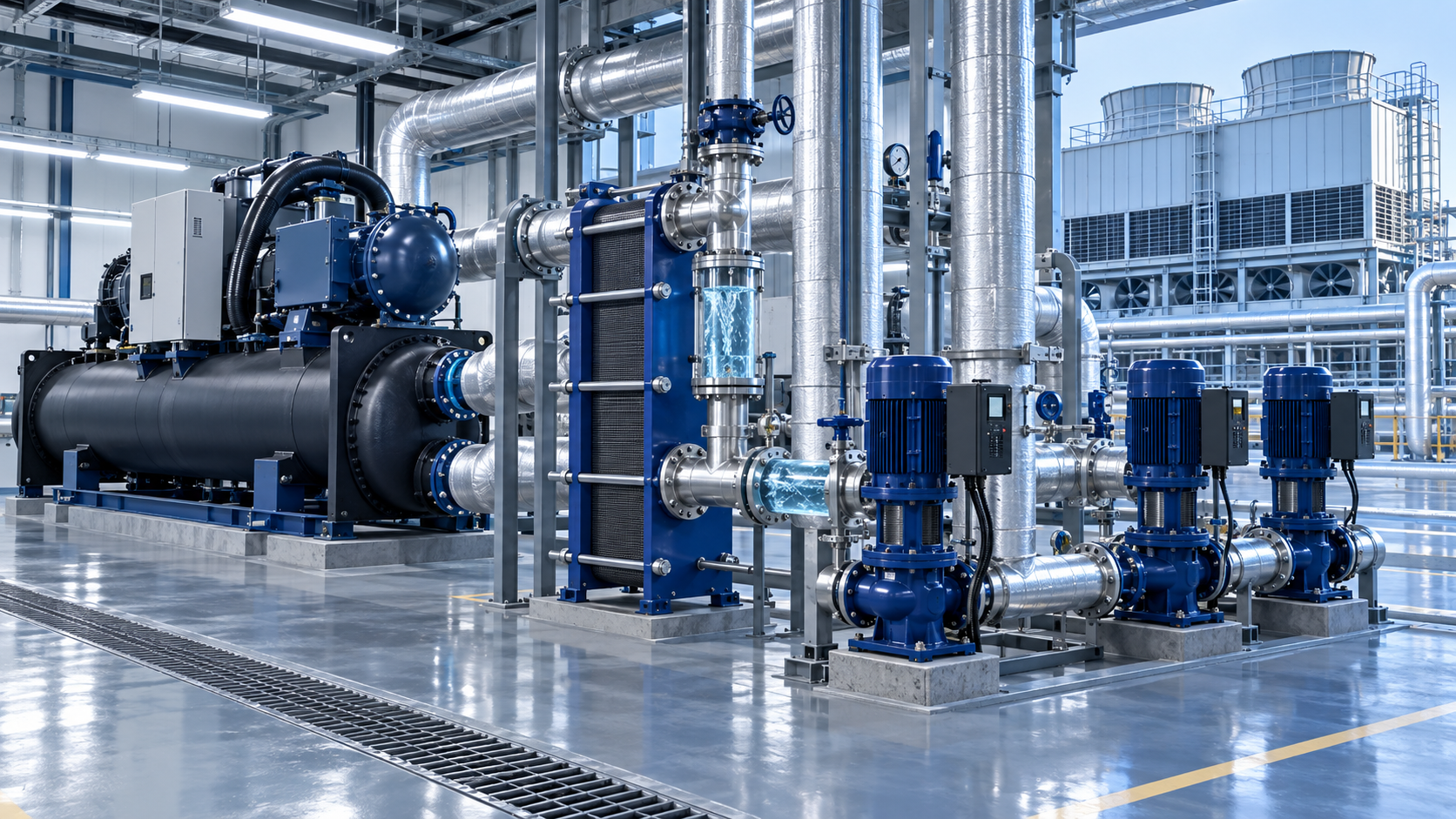
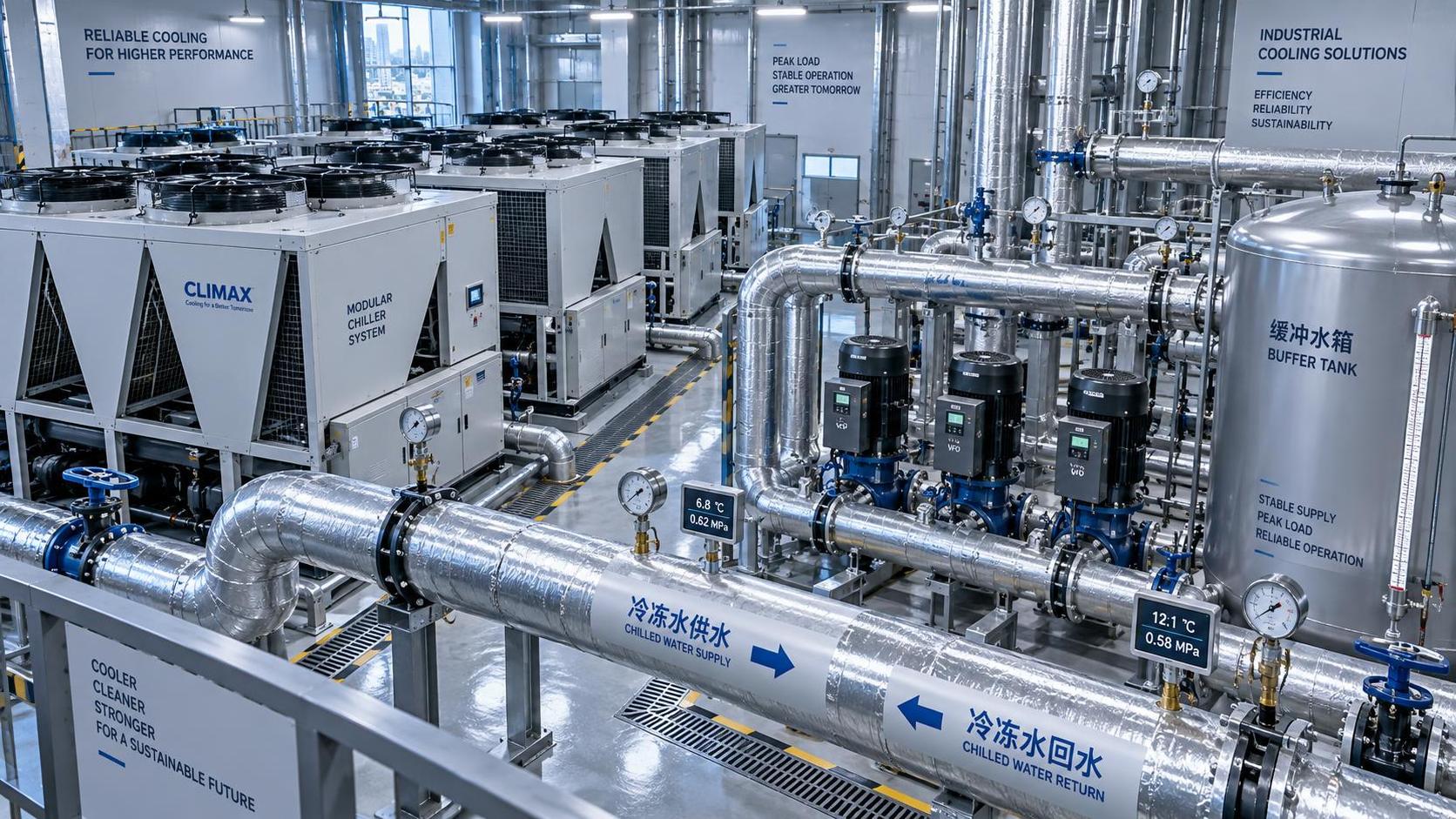
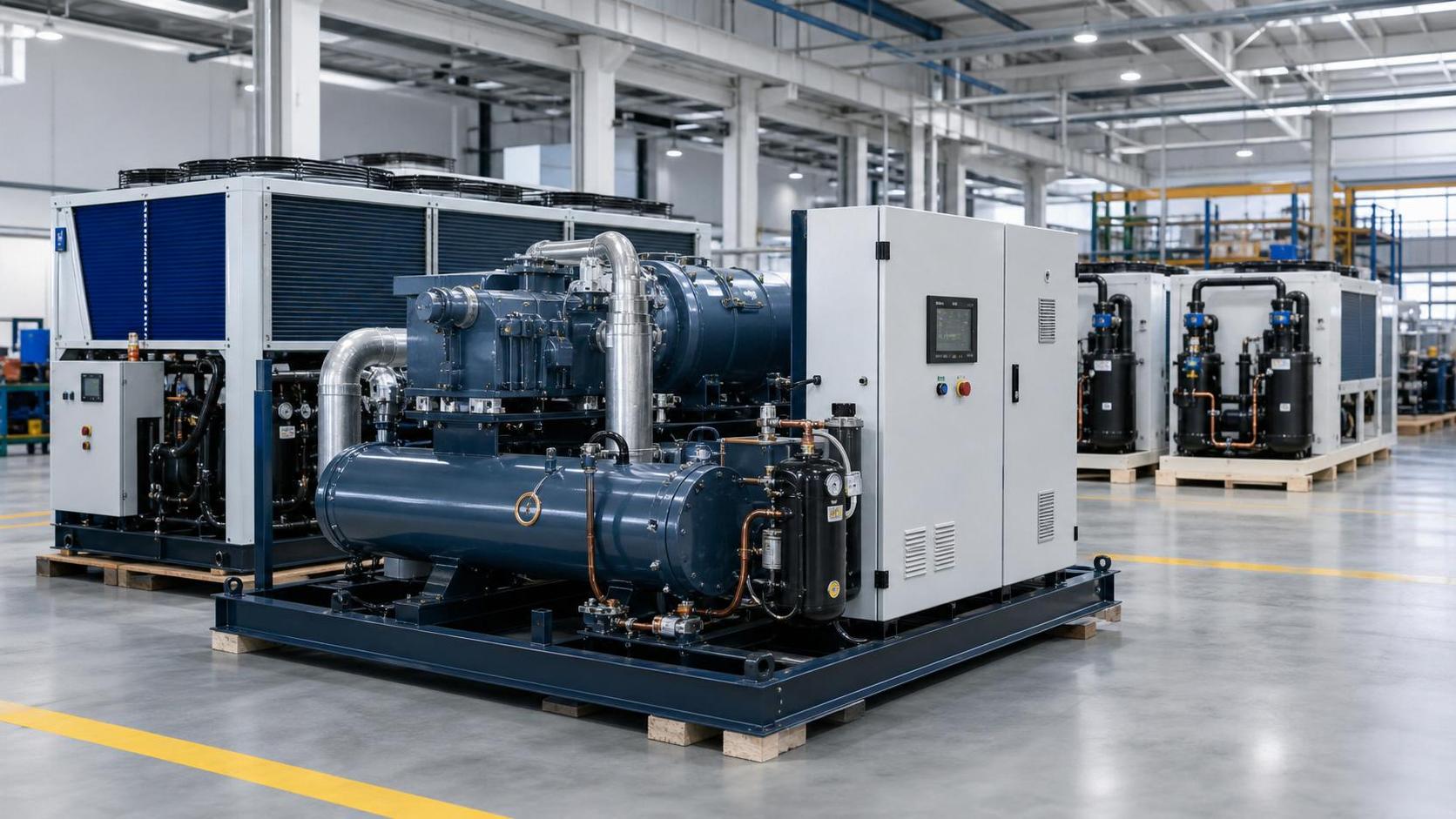
A modular plant arrangement provides a more practical response to changing demand. Rather than relying on one chiller sized for the full calculated peak, a project may use multiple units with staged capacities. The exact configuration depends on the process criticality and maintenance strategy, but the principle is consistent: the system should be able to match active capacity to actual load with as little cycling as possible.
For example, a plant with a stable base load and occasional high peaks may benefit from a smaller lead chiller that runs efficiently for much of the year, supported by additional machines that enter service only when required. For critical manufacturing, the redundancy philosophy should be defined explicitly. “N+1” is not a universal answer; it must clarify whether the spare capacity covers a failed compressor, an entire chiller, a pump, a power feeder, or a cooling-water circuit.
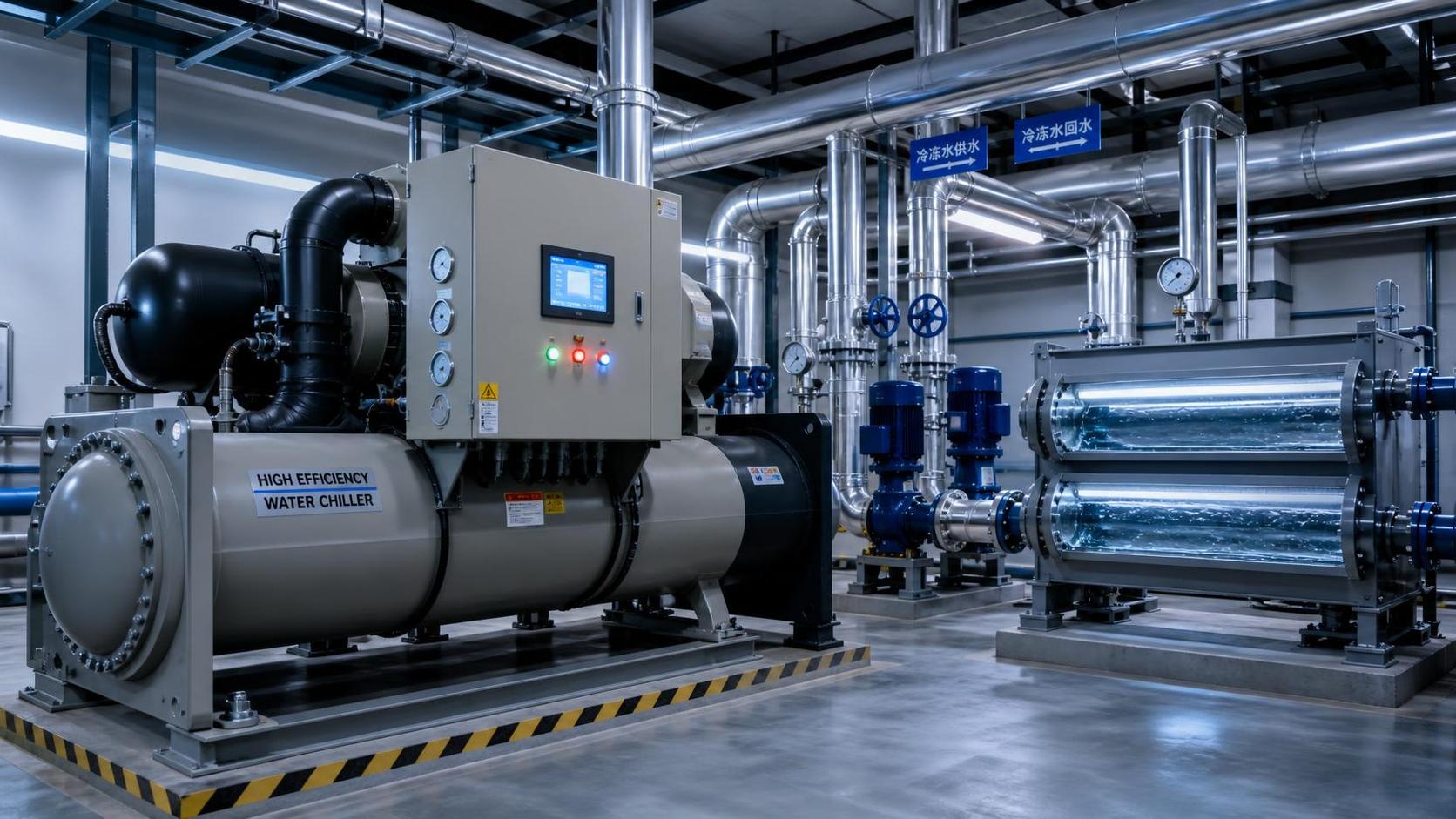
Part-load performance deserves as much attention as full-load efficiency. Ask suppliers for performance maps at the expected entering condenser-water or ambient temperatures, chilled-water supply temperatures, and load points—not only a single catalog rating. A variable-speed centrifugal chiller, screw chiller, magnetic-bearing machine, air-cooled unit, or hybrid arrangement may each make sense under different conditions. The best choice emerges from the annual operating profile and site constraints, rather than from a generic technology preference.
Temperature stability is a system behavior
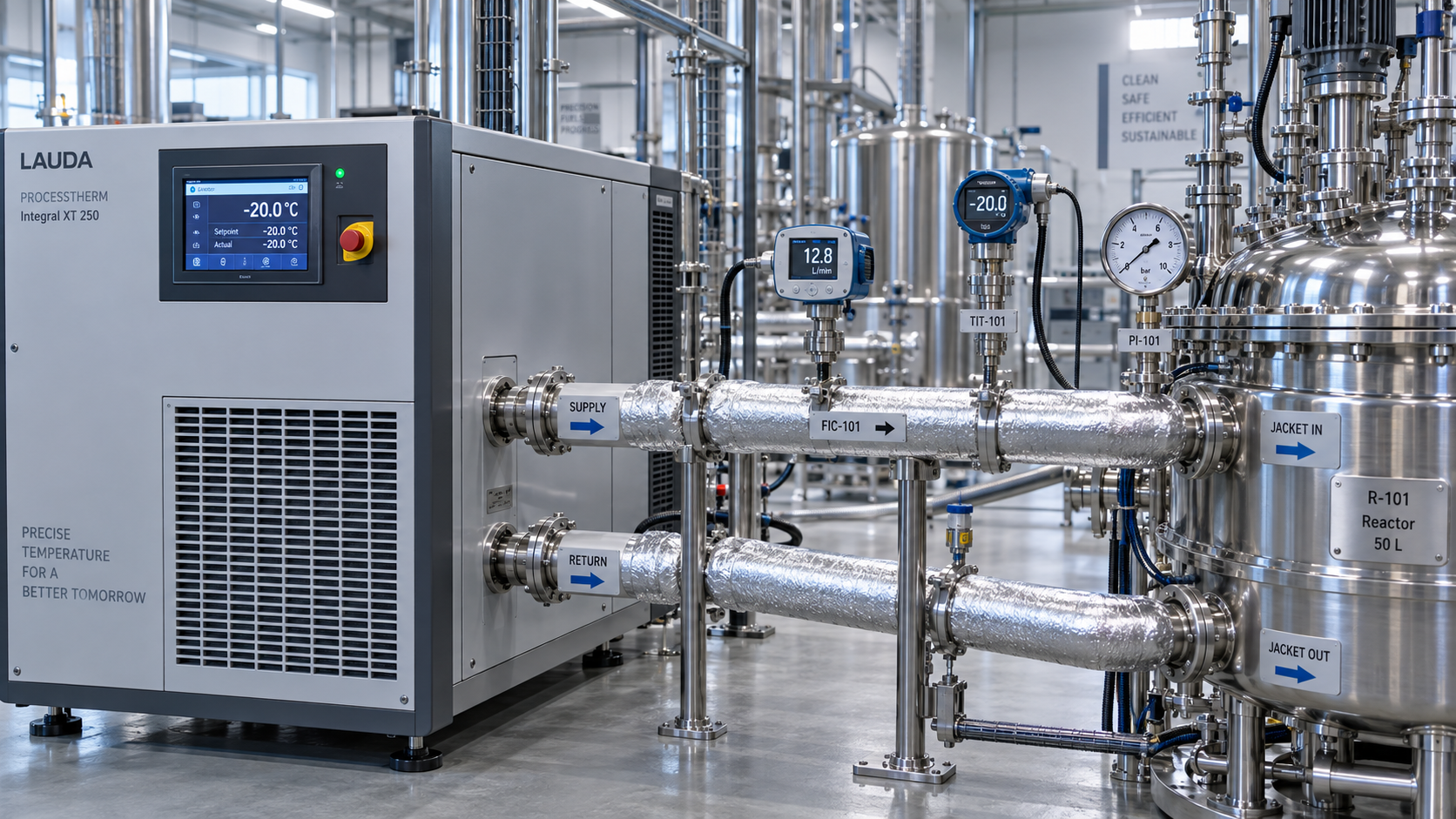
In variable-load projects, temperature control cannot be delegated entirely to the chiller controller. The process sees the combined behavior of cooling generation, pumping, pipe volume, control valves, heat exchangers, sensor placement, and return-water mixing. A plant can have efficient chillers and still struggle with unstable process temperatures if these elements are poorly coordinated.
Thermal buffering is often useful where load changes are faster than the refrigeration system can respond. A correctly sized buffer tank adds water volume, reduces rapid compressor cycling, and gives the controls time to stabilize. Yet a buffer tank is not a cure for every problem. If the underlying issue is an improperly selected control valve, excessive bypass flow, or a sensor mounted in a poorly mixed location, more volume may simply hide the problem while increasing footprint and heat gain.
Supply-temperature reset should also be evaluated carefully. Raising chilled-water temperature can reduce compressor lift and improve energy performance, particularly when process conditions allow it. But aggressive reset logic may conflict with the requirements of the most temperature-sensitive user. The right question is not “Can the plant reset?” but “Which loads can tolerate reset, under what operating state, and how will the controls prevent one critical load from being compromised?”
Design the hydraulic network for variable flow without sacrificing reliability
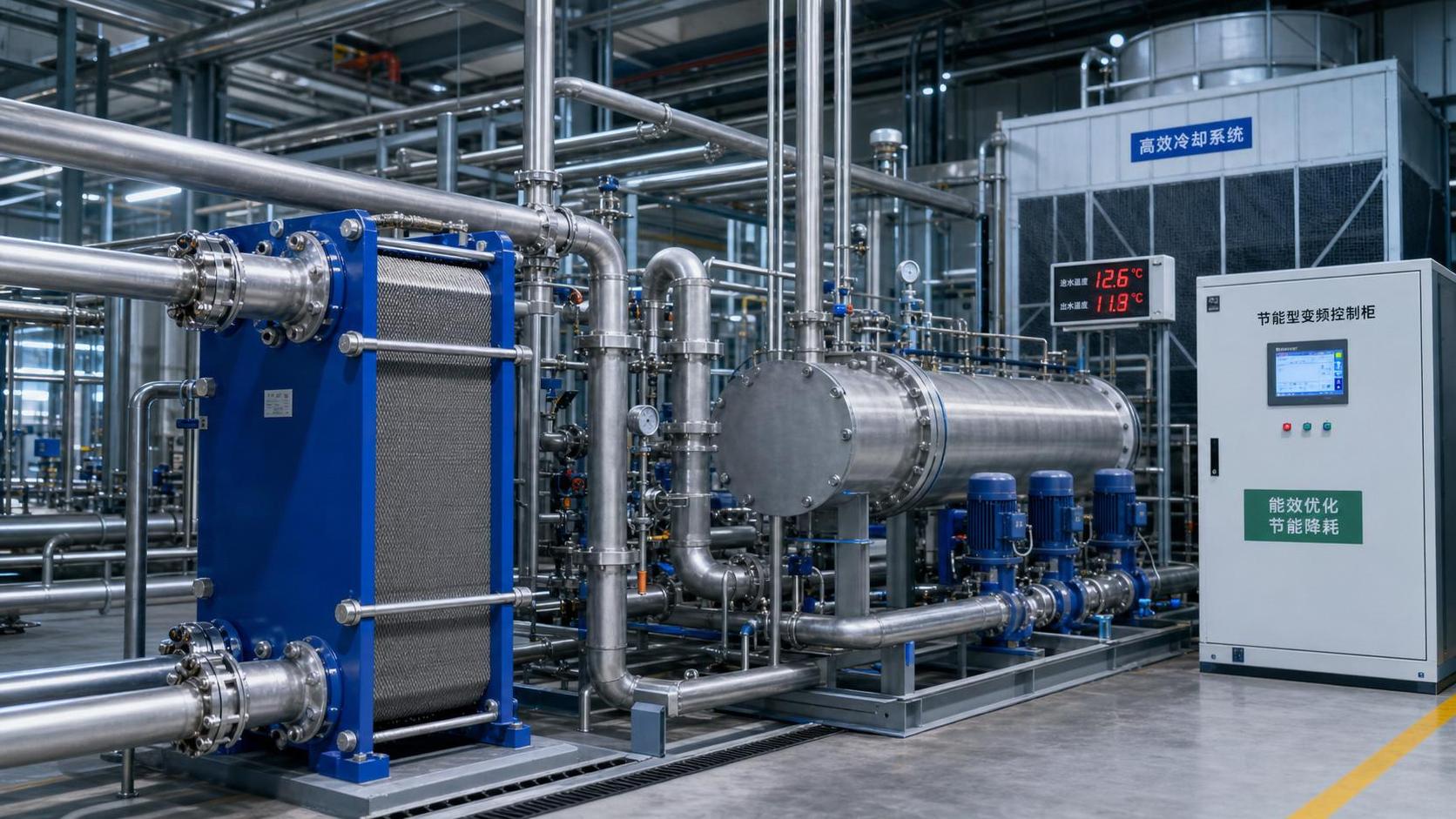
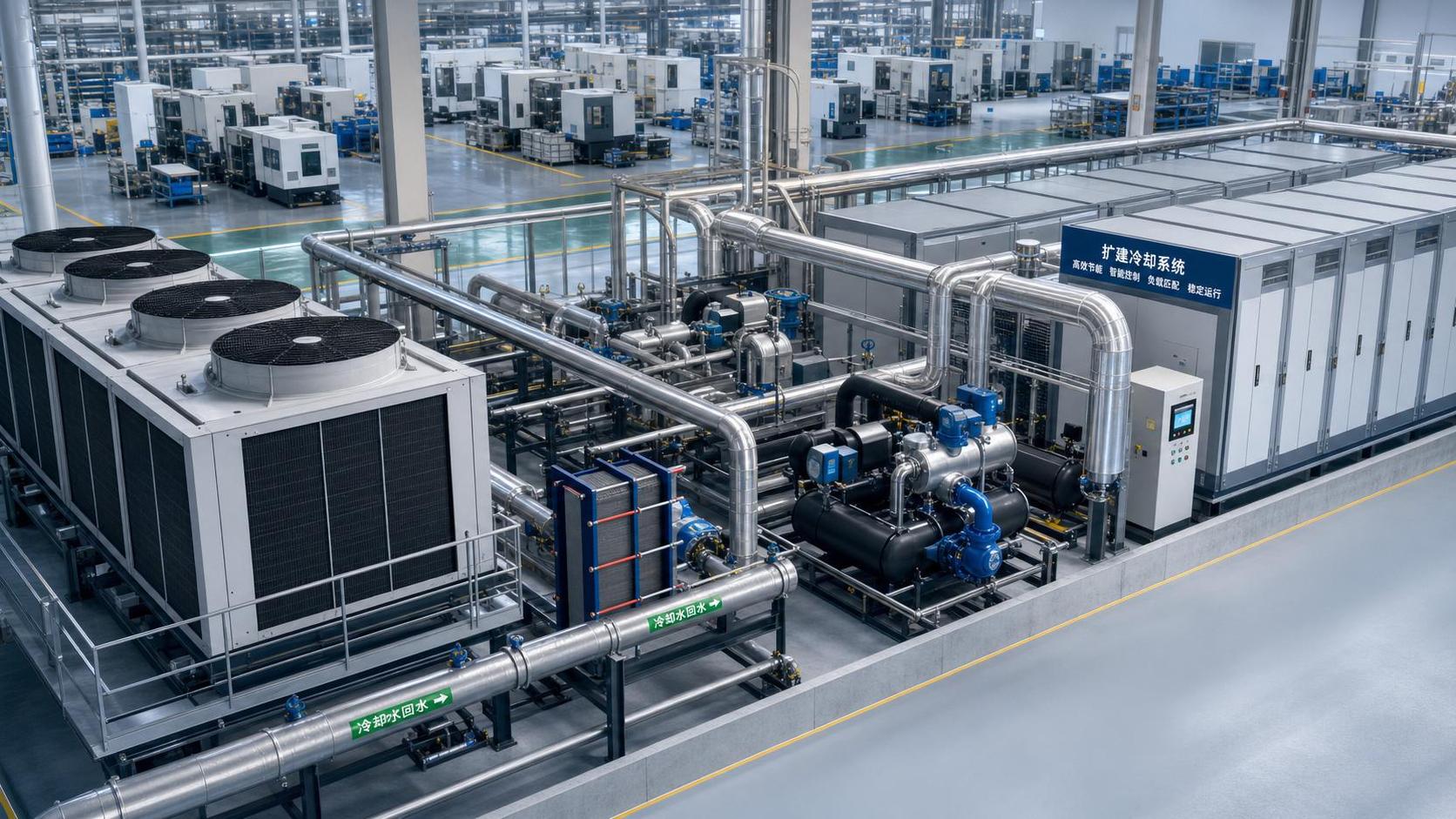
Pumping energy is frequently underestimated during early project planning. In a large industrial cooling loop, pump power can become a material share of annual electricity use, especially when throttling valves are used to absorb excess pressure or when the plant maintains unnecessarily high differential pressure.
Variable-speed pumps offer significant opportunity, but only when the hydraulic design supports them. Pipe sizing, valve authority, minimum-flow requirements, decoupler arrangements, and differential-pressure sensor locations must all be considered together. A sensor installed too close to the pump may report adequate pressure while remote users starve. Placing it at the hydraulically critical point can improve control, though that point may change as production areas expand or operate under different configurations.
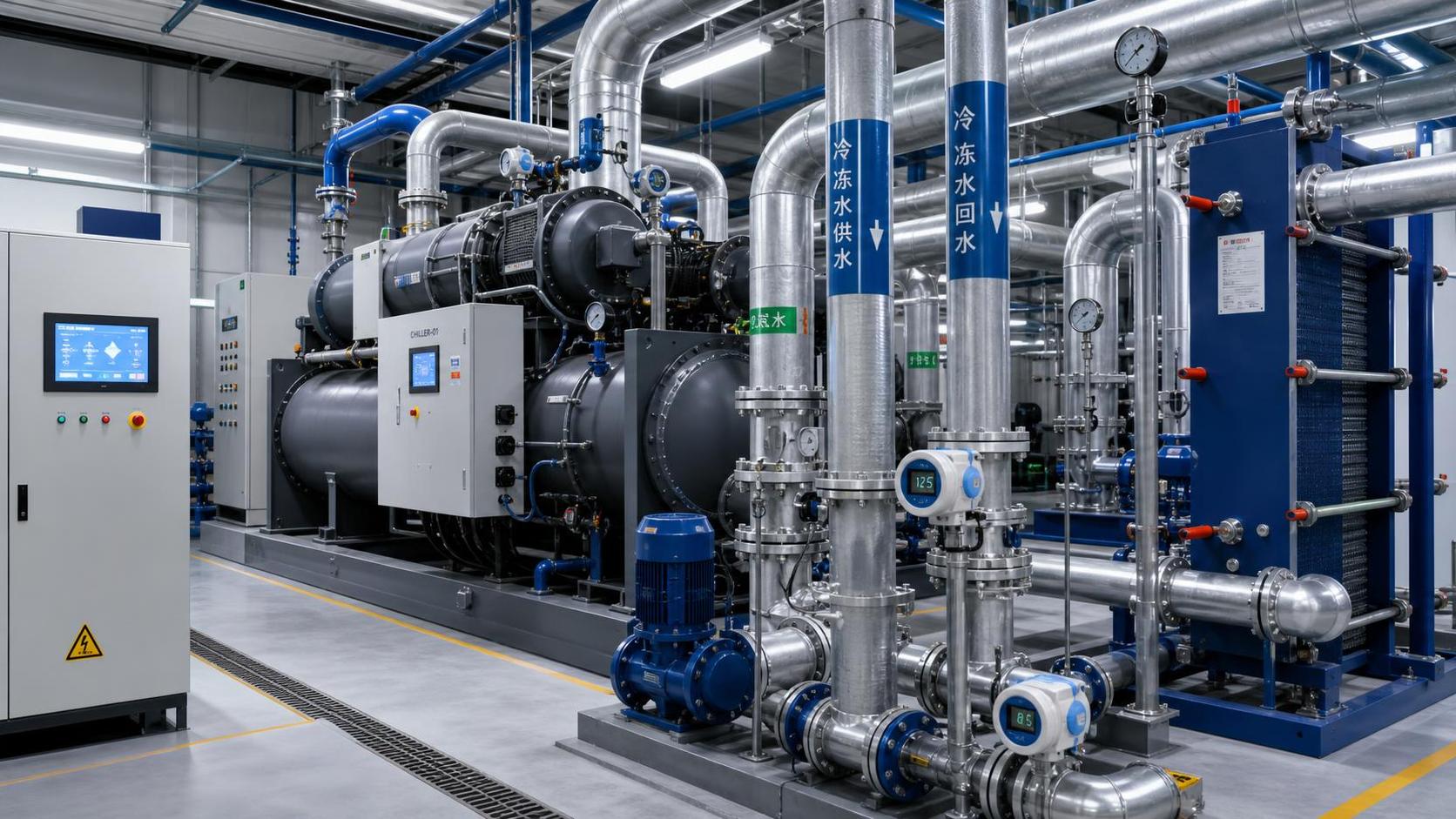
Primary-only variable-flow systems can be effective, but they require a clear understanding of chiller evaporator flow limits and control stability. Primary-secondary arrangements can offer hydraulic separation and operational resilience, although they may introduce mixing losses if not designed and controlled carefully. Neither layout is automatically superior. The decision should reflect equipment limitations, process segregation needs, future expansion, and the operations team’s ability to maintain the system.
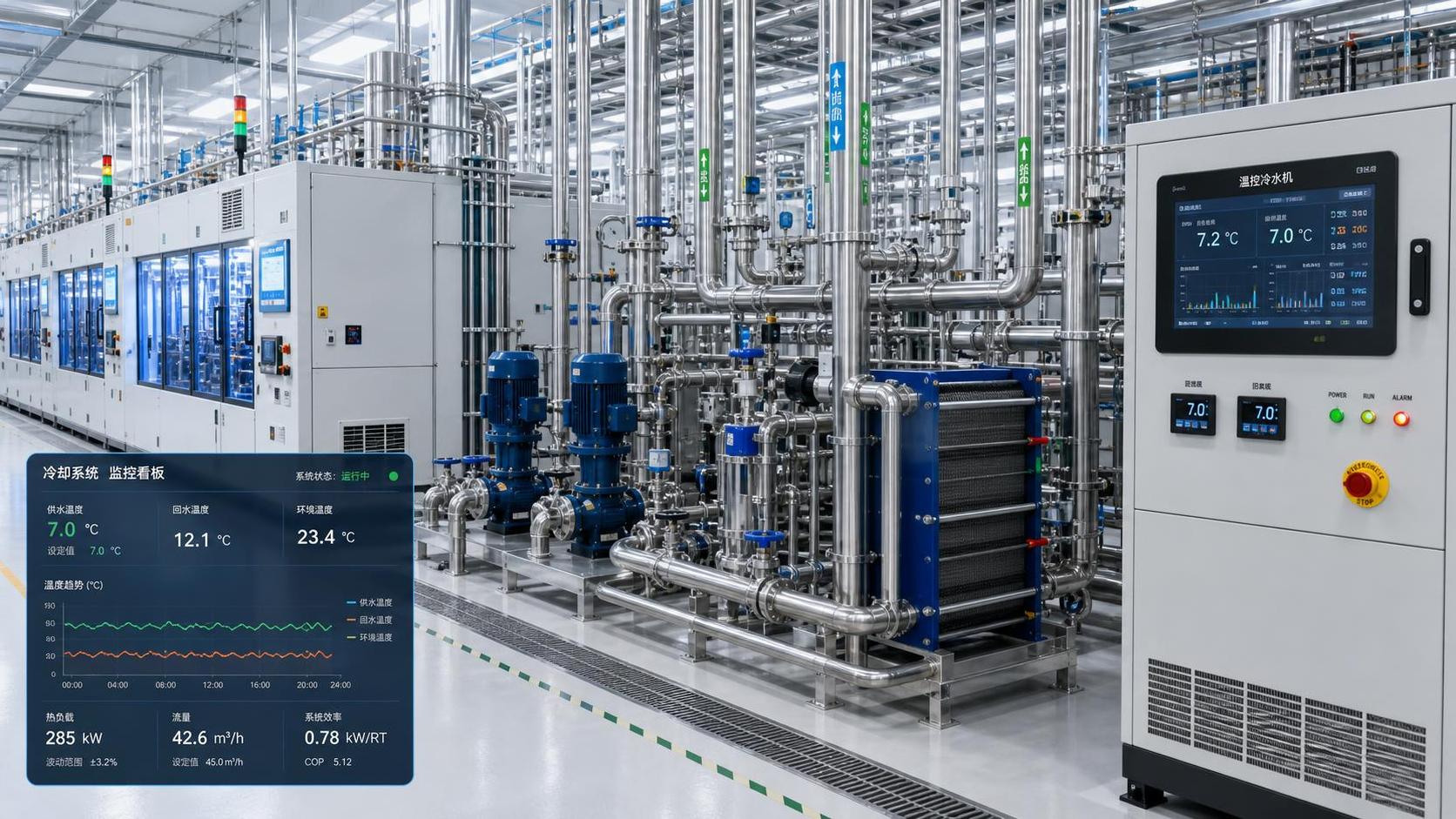
Pay particular attention to low-load operation. When many two-way valves close, the system needs a credible strategy for maintaining minimum flow where required without creating excessive bypass flow. This is where a plant can quietly lose efficiency: chilled water returns too cold, chillers see poor delta-T, pumps operate at higher speed than necessary, and operators begin making manual adjustments to keep the process steady.
Do not ignore the heat-rejection side
Cooling energy is shaped by where the heat ultimately goes. In water-cooled systems, condenser-water temperature, cooling tower approach, water treatment, fan control, and local wet-bulb conditions influence chiller lift and annual consumption. In air-cooled systems, dry-bulb temperature, coil cleanliness, recirculation risk, and fan staging become equally important.
For facilities with seasonal ambient advantages, free cooling or economizer operation may be worth evaluating. This can take the form of waterside economization, dry coolers, adiabatic assistance, or hybrid cooling arrangements. The opportunity is especially relevant for data-intensive manufacturing, precision equipment rooms, and processes with moderate supply-temperature requirements. However, free cooling should be assessed against water availability, climate variability, fouling risk, freeze protection, maintenance capability, and the cost of additional controls.
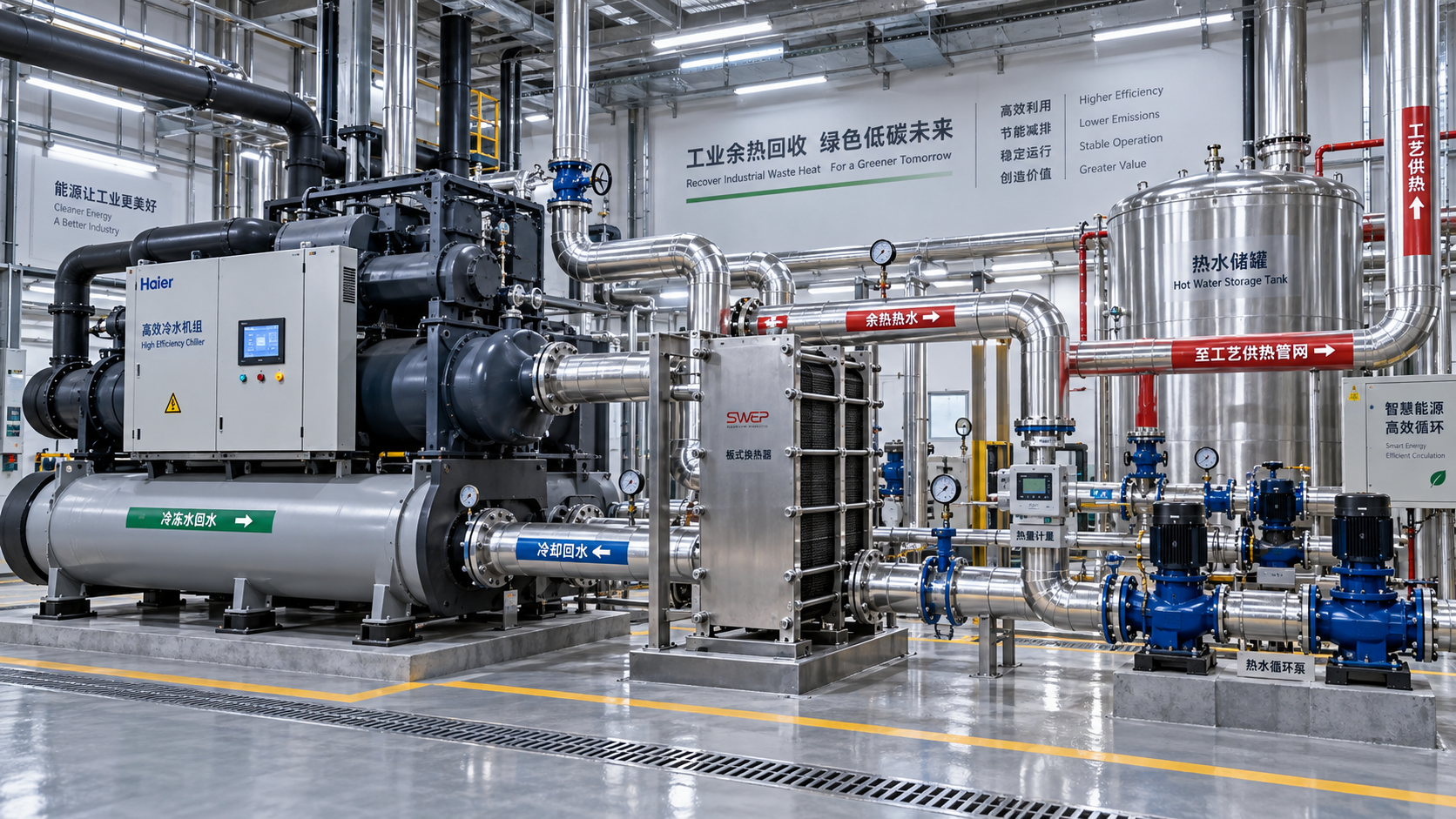
Heat recovery is another possibility when there is a consistent demand for useful low- or medium-temperature heat. Compressor heat, condenser heat, or process-loop heat may support preheating, wash-water systems, space heating, or other thermal users. The project should avoid assuming that all rejected heat is recoverable. Useful recovery depends on temperature level, timing, cleanliness, distance to the heat user, and the certainty of demand.
Build the control sequence around operating modes
Variable process loads create changing plant conditions, so the control narrative should describe changing modes—not merely list setpoints. A robust sequence typically defines how equipment starts, stages, unloads, resets, rotates, alarms, and returns to service. It should also state what happens during sudden load loss, a sensor failure, tower fan fault, pump trip, communication loss, or a transition between production shifts.
At a minimum, the control design should address:
- Chiller staging based on load, efficiency, run hours, and available capacity rather than a simple fixed order.
- Variable-speed pump control using meaningful differential-pressure or flow feedback.
- Condenser-water or fan-speed optimization within equipment operating limits.
- Chilled-water temperature reset rules linked to verified process permissions.
- Anti-short-cycling logic and minimum on/off times.
- Alarm priorities that distinguish a maintenance issue from an immediate process risk.
- Trend logging for supply and return temperatures, flows, power, valve positions, ambient conditions, and equipment status.
Control points must be measured before they can be optimized. This sounds obvious, yet many projects reach handover with limited metering and no reliable way to separate chiller energy, pumping energy, heat-rejection energy, and process load. Submetering should be planned early, not added after an energy-performance dispute emerges.
Commission for the conditions the plant will actually face
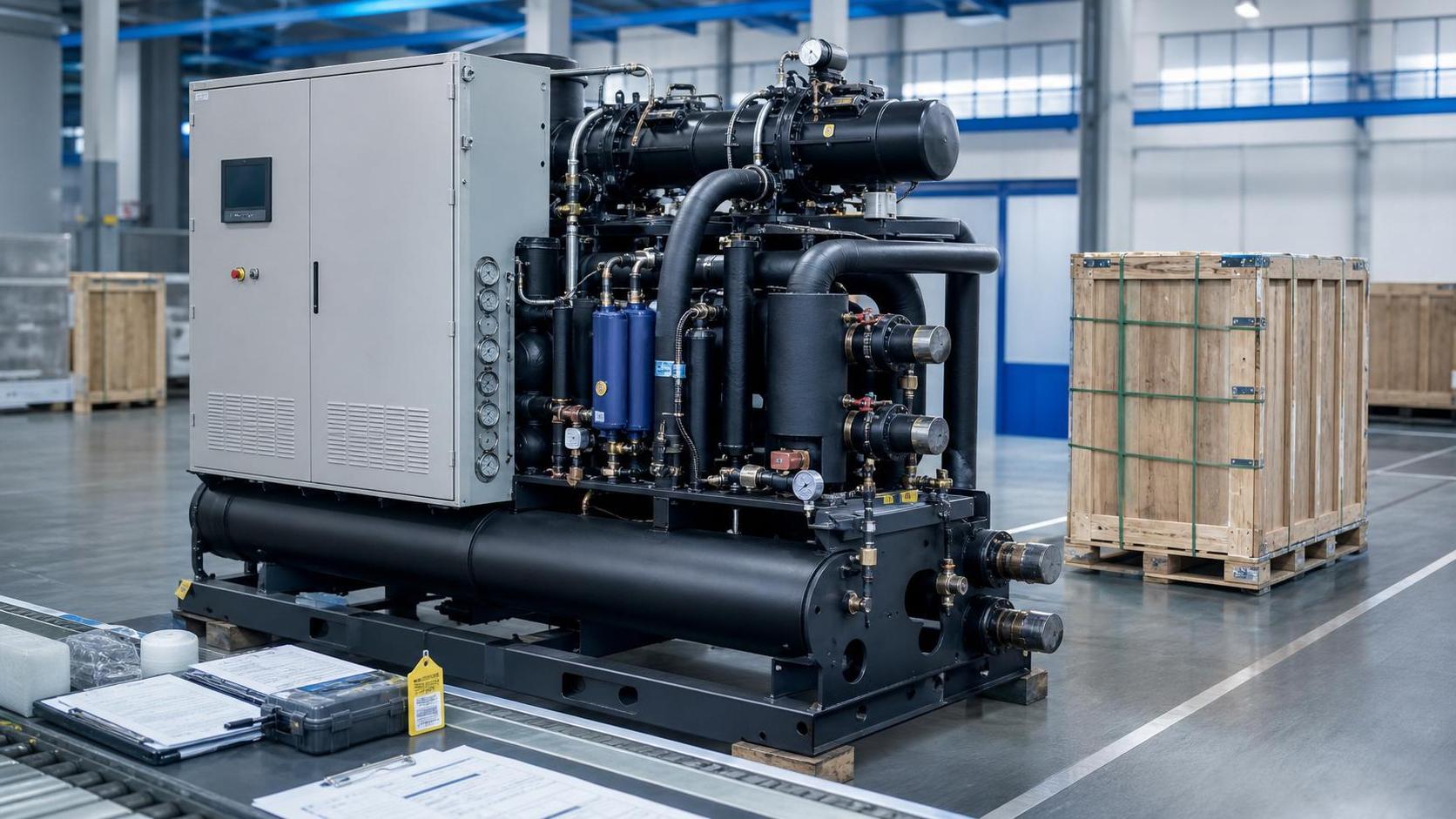
Factory testing and functional checks are valuable, but they do not fully demonstrate plant performance under real process variability. Commissioning should include staged-load scenarios, low-load conditions, transitions between chillers, pump turndown, remote-user pressure checks, and simulated equipment failures where appropriate. The objective is to prove both performance and behavior.
A practical acceptance plan might require the team to observe how the system responds when a major process load drops suddenly, when a standby chiller is called, or when ambient conditions rise. Trend data should be reviewed with operations staff, because they will often recognize whether a control sequence reflects the production rhythm of the facility.
There is also a human dimension. If operators do not understand why a plant stages equipment in a certain way, they may override it during a stressful shift. Clear graphics, documented operating modes, alarm rationalization, and brief training sessions can preserve the intent of the energy design long after the project team has left the site.
A decision framework for project managers
When comparing an energy efficient industrial cooling solution, project managers should resist the urge to reduce the decision to installed cost or nominal COP alone. A stronger review compares alternatives across process risk, annual energy behavior, maintainability, water and refrigerant considerations, electrical infrastructure, footprint, construction phasing, and expansion flexibility.
It is useful to ask vendors and design partners a few direct questions: What load profile was used? At which conditions is the quoted efficiency valid? How does the system behave at 25%, 50%, and 75% load? What is the minimum stable operating point? Which components create single points of failure? How will performance be metered? What operating assumptions would invalidate the projected savings?
These questions turn an attractive proposal into an auditable engineering strategy.
For GTC-Matrix readers, the broader lesson is that industrial cooling sits at the intersection of thermodynamics, production reliability, and energy economics. As refrigerant policies, electricity tariffs, water constraints, and decarbonization expectations evolve, the cooling plant must remain adaptable rather than merely adequate on day one. An intelligent design does not chase the highest peak capacity. It follows the real process, responds smoothly to change, and gives the operations team a system they can trust when the production schedule becomes unpredictable.
Related News
- When do smart thermal systems with sensors reduce chiller energy use?Author :Cryogenic Systems Expert

- How to Specify a High-Precision Temperature Chiller for Tight-Tolerance ProcessesAuthor :Cryogenic Systems Expert

- Designing Energy-Efficient Industrial Cooling for Variable Process LoadsAuthor :Cryogenic Systems Expert

- Low-GWP Cooling Solutions for Process Plants: Comparing Safety, Efficiency, and CostAuthor :Cryogenic Systems Expert

- How to size energy efficient industrial cooling for a process loadAuthor :Cryogenic Systems Expert

- How to specify high-precision temperature control in EuropeAuthor :Cryogenic Systems Expert

- How cooling system design affects cleanroom contamination controlAuthor :Cryogenic Systems Expert

- When does industrial cooling heat recovery pay back in energy savings?Author :Cryogenic Systems Expert

- How to size an industrial cooling system for peak process loadsAuthor :Cryogenic Systems Expert

- When are aluminum electronics cooling solutions suitable for high-density designs?Author :Cryogenic Systems Expert

- A thermal management guide for preventing chiller capacity lossAuthor :Cryogenic Systems Expert

- When does aluminum make sense for electronics cooling solutions?Author :Cryogenic Systems Expert

- EU Battery Carbon Footprint Labels Become Mandatory on Aug 18 for Battery-Integrated Cooling and Energy Storage ExportsAuthor :Cryogenic Systems Expert

- China-UAE Direct Sea Route Cuts Lead Times for Industrial Cooling and Compression ExportsAuthor :Cryogenic Systems Expert

- EPA Rule Takes Effect for R-410A Equipment ImportsAuthor :Cryogenic Systems Expert

- EN 378-1:2026 Tightens EU Export ChecksAuthor :Cryogenic Systems Expert

- How to Compare Semiconductor Cooling Solutions by Heat Load and Uptime RiskAuthor :Cryogenic Systems Expert

- EU Label Deadline Hits China Chiller ExportsAuthor :Cryogenic Systems Expert

- How Smart Thermal Systems Improve Industrial Cooling EfficiencyAuthor :Cryogenic Systems Expert

- How to Choose Process Cooling Equipment for Stable Temperature ControlAuthor :Cryogenic Systems Expert

- EU Finalizes 2026 HFC Quota Cut for R-134a ChillersAuthor :Cryogenic Systems Expert

- EU Tightens HFC-134a Quotas for Industrial ChillersAuthor :Cryogenic Systems Expert

- REACH SVHC Update Pressures HFC-134a Chiller Supply ChainsAuthor :Cryogenic Systems Expert

- EU PFAS Coolant Ban Reshapes Chiller ExportsAuthor :Cryogenic Systems Expert

- EU REACH Restricts PFAS Cooling Media ImportsAuthor :Cryogenic Systems Expert

- EU Ecodesign Rule Takes Effect for Industrial ChillersAuthor :Cryogenic Systems Expert

- EU REACH Rule Takes Effect for PFAS in Industrial Cooling ExportsAuthor :Cryogenic Systems Expert

- Industrial Cooling for Plastic Processing: How to Size for Stable Cycle TimesAuthor :Cryogenic Systems Expert

- EU F-Gas Update Bars R404A/R507 in Commercial CoolingAuthor :Cryogenic Systems Expert

- DOE Raises Chiller Efficiency Standard From October 2026Author :Cryogenic Systems Expert

- India Mandates BIS Energy Certification for Industrial ChillersAuthor :Cryogenic Systems Expert

- Energy-Efficient Heat Exchange for Process Cooling: Cost vs PaybackAuthor :Cryogenic Systems Expert

- EPA R-134a Import Ban Takes Effect on July 13, 2026Author :Cryogenic Systems Expert

- India BIS Rule Takes Effect for Industrial ChillersAuthor :Cryogenic Systems Expert

- EPA Cuts R134a Import Quotas 20% From July 10Author :Cryogenic Systems Expert

- How to Compare Energy-Efficient Cooling Systems for Factory Expansion ProjectsAuthor :Cryogenic Systems Expert