Can environmentally friendly refrigerants be used in existing HVAC systems?




Yes, some existing HVAC systems can use environmentally friendly refrigerants, but only when the equipment, replacement refrigerant, safety provisions, and local rules are compatible. A lower-global-warming-potential refrigerant is not automatically a direct replacement: it may require changes to components, controls, lubricant, or service procedures. In other systems, replacement of the equipment is the more practical route.
For technical evaluators, the decision begins with the refrigerant and equipment actually installed—not with a generic list of “green” alternatives. The strongest candidate is one that can operate within the system’s design limits, satisfy the applicable safety requirements, and deliver an acceptable whole-life outcome.
When can environmentally friendly refrigerants for HVAC be used in existing equipment?
A retrofit is feasible when the equipment manufacturer permits a specific replacement refrigerant or provides a defined conversion procedure, and when the resulting installation meets applicable safety and regulatory requirements. Permission matters because two refrigerants with similar environmental profiles can behave differently under the same operating conditions.
The equipment’s original refrigerant, compressor design, pressure ratings, metering device, lubricant, seals, and controls all affect the decision. The building matters too: an alternative with a different flammability classification may change the requirements for installation location, charge quantity, leak detection, or ventilation.
Do not treat a refrigerant as a drop-in replacement simply because its pressure or cooling capacity appears similar. A practical retrofit requires compatibility across the complete system and its intended operating range. Refrigerant mixtures also require attention to composition and temperature glide, which can affect charging, heat-exchanger performance, and service procedures.
If the equipment manufacturer does not provide a conversion path, or if the installation cannot satisfy the requirements associated with the proposed refrigerant, replacement should be evaluated alongside continued operation with the permitted refrigerant and improved leak management.
Start with the existing refrigerant and equipment
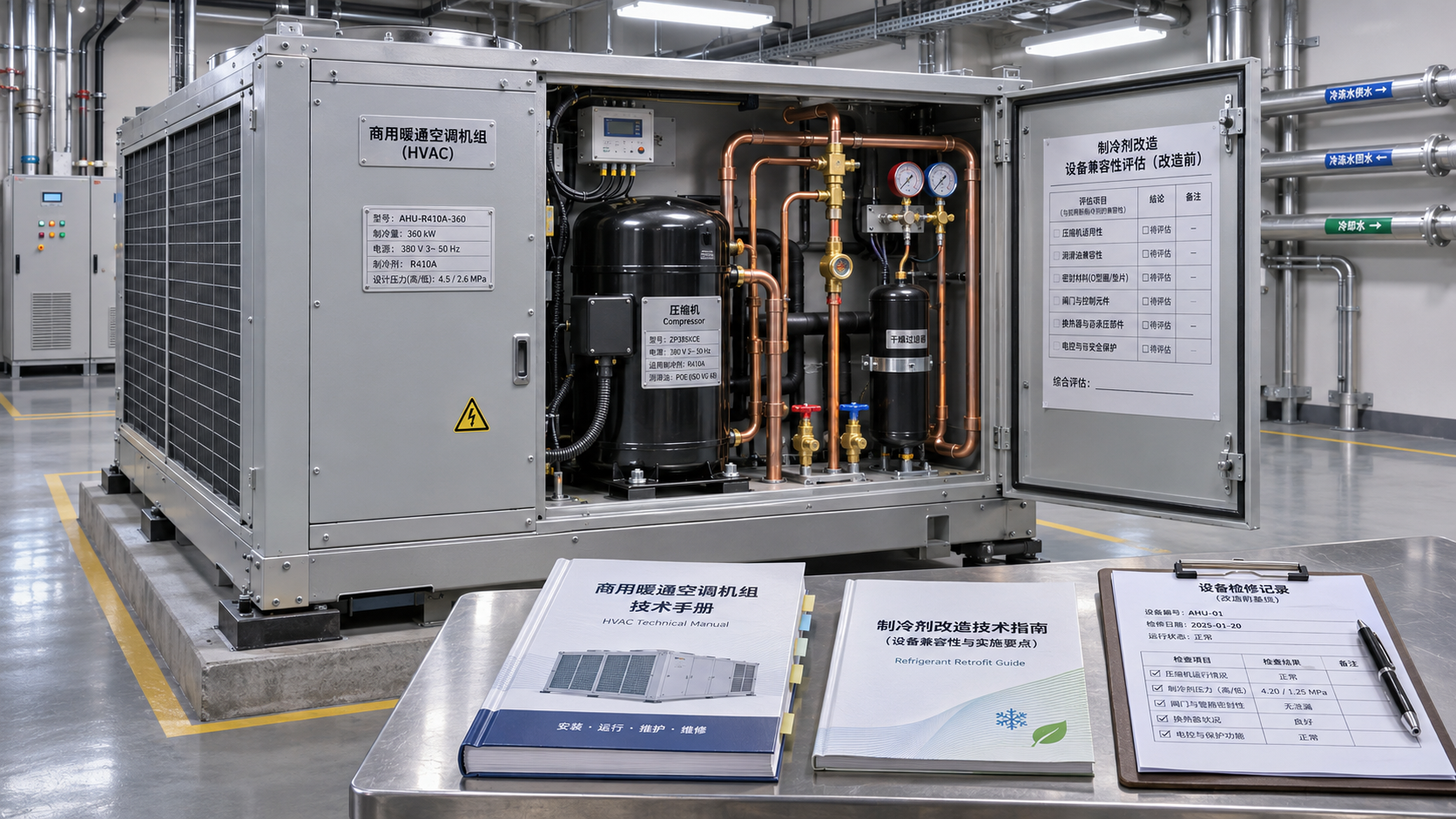
Before comparing alternatives, identify the exact equipment model and the refrigerant currently charged. A system that has already been modified may not match its original nameplate configuration, so service records and the physical installation both matter. Record any previous refrigerant conversion, compressor replacement, lubricant change, or recurring leak issue.
Then separate the decision into three possible paths: an approved refrigerant conversion, continued operation with the existing permitted refrigerant, or equipment replacement. The right path depends on more than the age of the unit. A relatively new system may be a poor retrofit candidate if no approved alternative exists; an older but sound system may remain viable where a documented conversion is available and the economics support it.
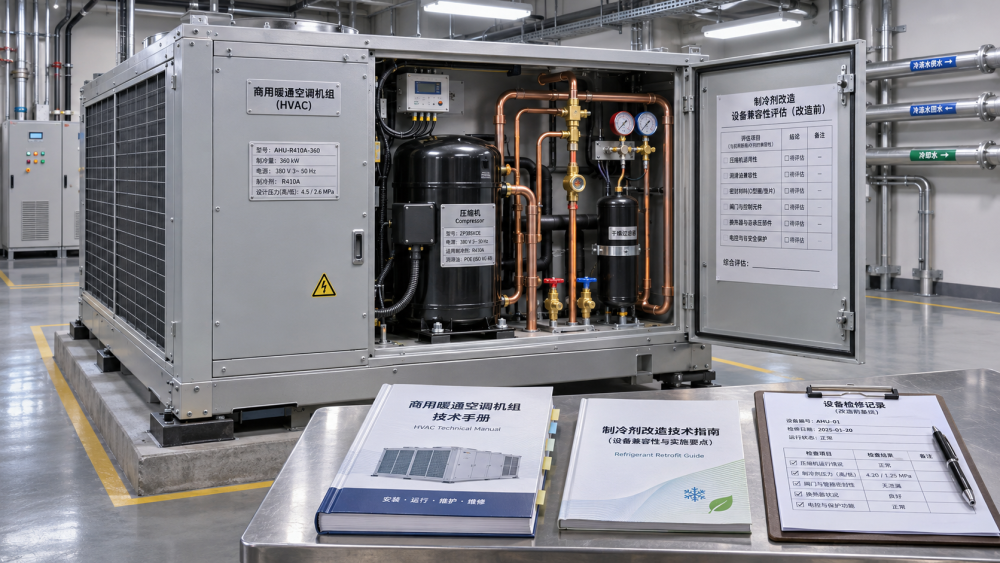
The following comparison helps frame the initial assessment. It does not imply that every system has access to all three options.
Check the technical limits before selecting a replacement
Pressure, temperature, and compressor operation
The replacement refrigerant must remain within the pressure and temperature limits of the compressor, heat exchangers, piping, valves, and protective devices. Compare expected operation across the full range of conditions the system encounters, including startup, low-load operation, high ambient temperatures, and defrost or heat-pump modes where applicable.
Compressor suitability is especially important. A refrigerant can produce a usable cooling effect yet place the compressor outside its approved operating envelope. Discharge temperature, motor loading, oil return, and control response all influence reliability. A conversion that works under a single design condition may still be unsuitable when the system operates at part load or in extreme weather.
Lubricant, seals, and the refrigerant circuit
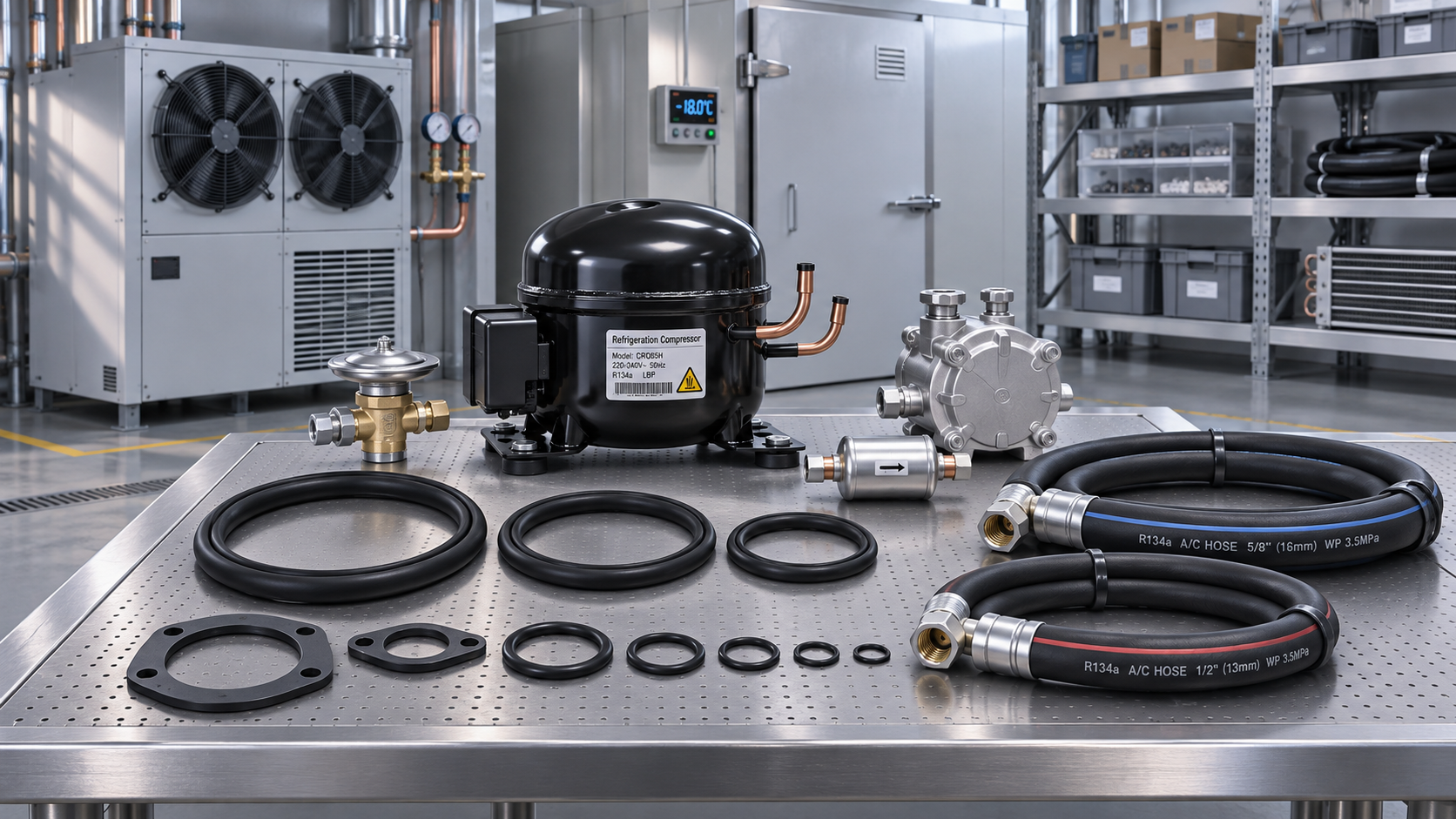
The refrigerant and lubricant must work together to support oil return and compressor lubrication. Some conversions require a lubricant change; others depend on limits for residual oil or specific cleaning procedures. Refrigerant and lubricant compatibility with elastomers, gaskets, hoses, and other materials also needs to be assessed for the proposed conversion.
Metering devices and expansion controls may need adjustment or replacement because refrigerants differ in flow characteristics and operating conditions. Filter driers, pressure controls, and relief devices may also be affected. These details can turn an apparently simple refrigerant change into a broader equipment modification.
Capacity and control stability
A lower-GWP alternative does not guarantee the same cooling or heating capacity. The evaluator should compare the proposed configuration against the actual load, including critical operating conditions rather than nominal capacity alone. In a process cooling application, for example, a small loss of capacity during peak demand may matter more than acceptable performance under average conditions.
Control stability deserves equal attention. A system that cycles excessively or struggles to regulate temperature can undermine energy savings and process quality. For refrigerant blends with temperature glide, the conversion procedure and performance assessment should account for how temperatures are specified and measured across the heat exchangers.
Assess flammability and installation constraints early
Some lower-GWP refrigerants have different flammability characteristics from the refrigerants used in older equipment. That difference can be decisive. Electrical components, ignition sources, equipment location, room size, charge quantity, ventilation, and leak detection may all affect whether a proposed installation is permissible.
A refrigerant’s availability does not authorize its use in every system. A unit designed for a nonflammable refrigerant should not be assumed suitable for a flammable or mildly flammable alternative without an approved conversion and the required safety measures. The evaluation must cover both the equipment and the space in which it operates.
Local requirements also influence the available options for installation, refrigerant handling, recovery, and servicing. For a multi-site operator, a technically attractive refrigerant may be unsuitable as a single standard if site conditions or applicable rules differ. Establish those constraints before committing engineering resources to detailed performance calculations.
Compare environmental outcomes over the system’s remaining life
Global warming potential is an important screening measure, but it does not describe the entire environmental result. Refrigerant emissions can occur through leakage, servicing, and end-of-life handling. Electricity use also contributes to the system’s footprint, so a conversion that reduces refrigerant impact but substantially worsens efficiency may offer less benefit than expected.
A useful comparison considers the expected remaining service life, leakage history, refrigerant charge, energy consumption, and the likely impact of replacing the equipment. It should also include the condition of major components. If a compressor or heat exchanger is already approaching replacement, combining that work with a broader equipment upgrade may be more practical than converting a deteriorating system.
Leak reduction remains valuable regardless of the selected path. Repeated top-ups without finding the source of leakage increase operating burden and can obscure whether a system is a sound candidate for continued use. Addressing underlying leaks before a conversion also helps protect the expected environmental benefit.
A practical retrofit assessment workflow
- Document the installed system. Identify the equipment model, current refrigerant, lubricant where known, operating duty, service history, and any previous modifications.
- Screen for an approved conversion. Identify refrigerants and procedures supported for that equipment, including required component changes and operating limits. If no suitable path exists, move the comparison toward continued operation or replacement.
- Review site safety and compliance. Assess the proposed refrigerant’s classification against the installation location, charge, ventilation, detection, and servicing requirements that apply to the site.
- Check performance at real operating conditions. Evaluate compressor limits, capacity, controls, heat-exchanger behavior, and energy use across the expected load and ambient range.
- Compare lifecycle implications. Include conversion work, downtime, maintenance needs, refrigerant availability, leakage history, expected remaining life, and the alternative of replacing the equipment.
- Plan commissioning and handover. Define recovery, component changes, charging, labeling, operating checks, documentation, and technician training in the approved procedure.
Commissioning should establish that the converted system operates within its permitted limits and meets the required heating or cooling duty. The service record should identify the refrigerant and lubricant used, changes made, and relevant operating observations. Clear labeling is particularly important for future maintenance and recovery.
When replacement is the stronger choice
Replacement becomes more compelling when an approved conversion is unavailable, the proposed refrigerant introduces safety requirements that are impractical at the site, or the existing equipment cannot meet the required duty after conversion. Extensive corrosion, persistent leakage, obsolete controls, or major component work can also weaken the case for retaining the system.
A new unit can be selected as a complete system around its intended refrigerant and operating conditions. That does not automatically make it the lower-impact choice in every case: manufacturing, installation work, disposal, and the remaining useful life of the current unit belong in the comparison. The decision should reflect the specific installation and the period over which it will operate.
For an existing HVAC system, the most useful first question is therefore specific: is there a documented, safe conversion path for this equipment at this site? If there is, evaluate its performance and whole-life implications. If there is not, focus on maintaining the existing system responsibly while assessing a replacement designed for the intended refrigerant.
Ready when you are. Send us a message to get started.
Related News
- Can environmentally friendly refrigerants be used in existing HVAC systems?Author :Cryogenic Systems Expert

- EU Extends Refrigerant Exemption for Certain Heat Pumps Through 2027Author :Cryogenic Systems Expert

- ECHA Socio-Economic Analysis Committee Backs EU-Wide PFAS BanAuthor :Cryogenic Systems Expert

- EPA Extends Commercial Refrigeration Low-GWP Transition to 2032Author :Cryogenic Systems Expert

- EPA Sets End-2026 Installation Deadline for Most New R-410A VRF SystemsAuthor :Cryogenic Systems Expert

- Oman Revises Refrigerant and Equipment Import RulesAuthor :Cryogenic Systems Expert

- Oman Revises Import Rules for Refrigerants and EquipmentAuthor :Cryogenic Systems Expert

- Refrigerants Australia Warns of Sharp Drop in Key Refrigerant Supplies This SummerAuthor :Cryogenic Systems Expert

- Trinidad and Tobago and Uganda Advance HFC Controls Under Kigali AmendmentAuthor :Cryogenic Systems Expert

- US Refrigerant Sales Diverge in Q3: Solstice Up 8%, Chemours Down 9%Author :Cryogenic Systems Expert

- GB/T 18837-2026 Takes Effect, Adding A2L Refrigerants and Revising Efficiency EvaluationAuthor :Cryogenic Systems Expert

- Ningbo Seminar Addresses R290 Refrigerants and Air Conditioner EfficiencyAuthor :Cryogenic Systems Expert

- Q4 Refrigerant Contract Prices Rise CNY 500/Tonne; October AC Production Plans ReleasedAuthor :Cryogenic Systems Expert

- R22 Prices Retreat as China's Refrigerant Market Faces Tight Quotas and Soft DemandAuthor :Cryogenic Systems Expert

- Chemours Faces Investor Lawsuit Over Opteon Refrigerant Sales ForecastsAuthor :Cryogenic Systems Expert

- LG Expands R290 Monobloc Heat Pump Range with New 12–16 kW ModelsAuthor :Cryogenic Systems Expert

- EU Issues Updated Guidance on Industrial Refrigeration Efficiency and F-gas AlternativesAuthor :Cryogenic Systems Expert

- Do U.S. refrigerant regulations require replacing R-410A systems?Author :Cryogenic Systems Expert

- Where R-134a Restrictions Apply and How They Affect Refrigeration EquipmentAuthor :Cryogenic Systems Expert

- R-22 Phase-Out: Repair, Retrofit, or Replace Aging Commercial Cooling Systems?Author :Cryogenic Systems Expert

- R-410A Phase-Down Rules: Planning HVAC Replacements Before Supply TightensAuthor :Cryogenic Systems Expert

- Freon Policy Updates: What Facility Managers Must Review Before Equipment ServiceAuthor :Cryogenic Systems Expert

- How to verify refrigerant regulations and safety standards for a facilityAuthor :Cryogenic Systems Expert

- When refrigerant management software makes sense for multi-site complianceAuthor :Cryogenic Systems Expert

- EU Ends Duty-Free Small Parcels From July 1Author :Cryogenic Systems Expert

- China R410A Export Quotes Rise to RMB 60,000/TonAuthor :Cryogenic Systems Expert

- EU PFAS Curbs Raise Compliance Review for Cooling ExportsAuthor :Cryogenic Systems Expert

- EU PFAS Proposal Puts Refrigerant and Vacuum Exports Under ReviewAuthor :Cryogenic Systems Expert

- EU REACH PFAS Draft Raises New Export ChecksAuthor :Cryogenic Systems Expert

- EU Cuts High-GWP Refrigerant Import Quotas by 35%Author :Cryogenic Systems Expert

- EU Cuts Q4 2026 Quotas for High-GWP RefrigerantsAuthor :Cryogenic Systems Expert

- EU F-Gas Revision Cuts R410A Quotas 40%Author :Cryogenic Systems Expert

- EPA Freezes R-410A Quotas, Fast-Tracks R-32Author :Cryogenic Systems Expert

- Low GWP Refrigerants HFO Blends: Key Stability and Safety FactorsAuthor :Cryogenic Systems Expert

- R-32 Price Spike Reshapes Chiller ProcurementAuthor :Cryogenic Systems Expert

- How to Compare Environmentally Friendly Refrigerants by GWP, Safety, and CostAuthor :Cryogenic Systems Expert