



Do U.S. refrigerant regulations require replacing R-410A systems?




No—U.S. federal refrigerant regulations do not impose a blanket requirement to replace existing R-410A systems. When a customer hears that R-410A is being “phased out,” a routine service call can turn into a request for an unnecessary equipment replacement. The first distinction is between operating and repairing an installed system and manufacturing, selling, or installing new equipment.
For technicians checking refrigerant regulations USA, that distinction affects the diagnosis, quotation, and explanation given to the customer. An existing R-410A unit can generally remain in service and receive repairs, provided the work complies with applicable refrigerant-handling rules. New installations, major equipment changes, refrigerant sourcing, and certain leak-management obligations require separate checks.
Three regulatory issues that should not be treated as one
The phrase “R-410A ban” compresses several different regulatory programs into one misleading label. Each program answers a different question.
R-410A is an HFC blend. Its inclusion in the transition does not mean every charged system becomes illegal on the date a restriction begins for new equipment. Nor does a federal restriction necessarily prohibit every replacement component used to maintain installed equipment.
EPA’s Technology Transitions program distinguishes between products and field-assembled systems, with requirements varying by subsector. Residential split air conditioning, packaged equipment, variable refrigerant flow systems, and industrial applications should not be assigned a single universal deadline. Manufacturing, import, sale, distribution, and installation restrictions can also operate differently.
At the service call: identify what the proposed work actually is
A failed capacitor and a complete system changeout are plainly different jobs. The harder cases involve a compressor replacement, a leaking coil, or an outdoor-unit replacement while retaining other components. Those jobs need a defined scope before anyone makes a compliance claim.
Repairing an installed system
Replacing an electrical component, repairing a refrigerant leak, or installing an appropriate service component does not automatically require conversion to another refrigerant. Confirm the equipment model, refrigerant designation, component compatibility, and manufacturer’s service instructions. The repair should preserve the approved operating configuration rather than introduce an unsupported refrigerant or component combination.
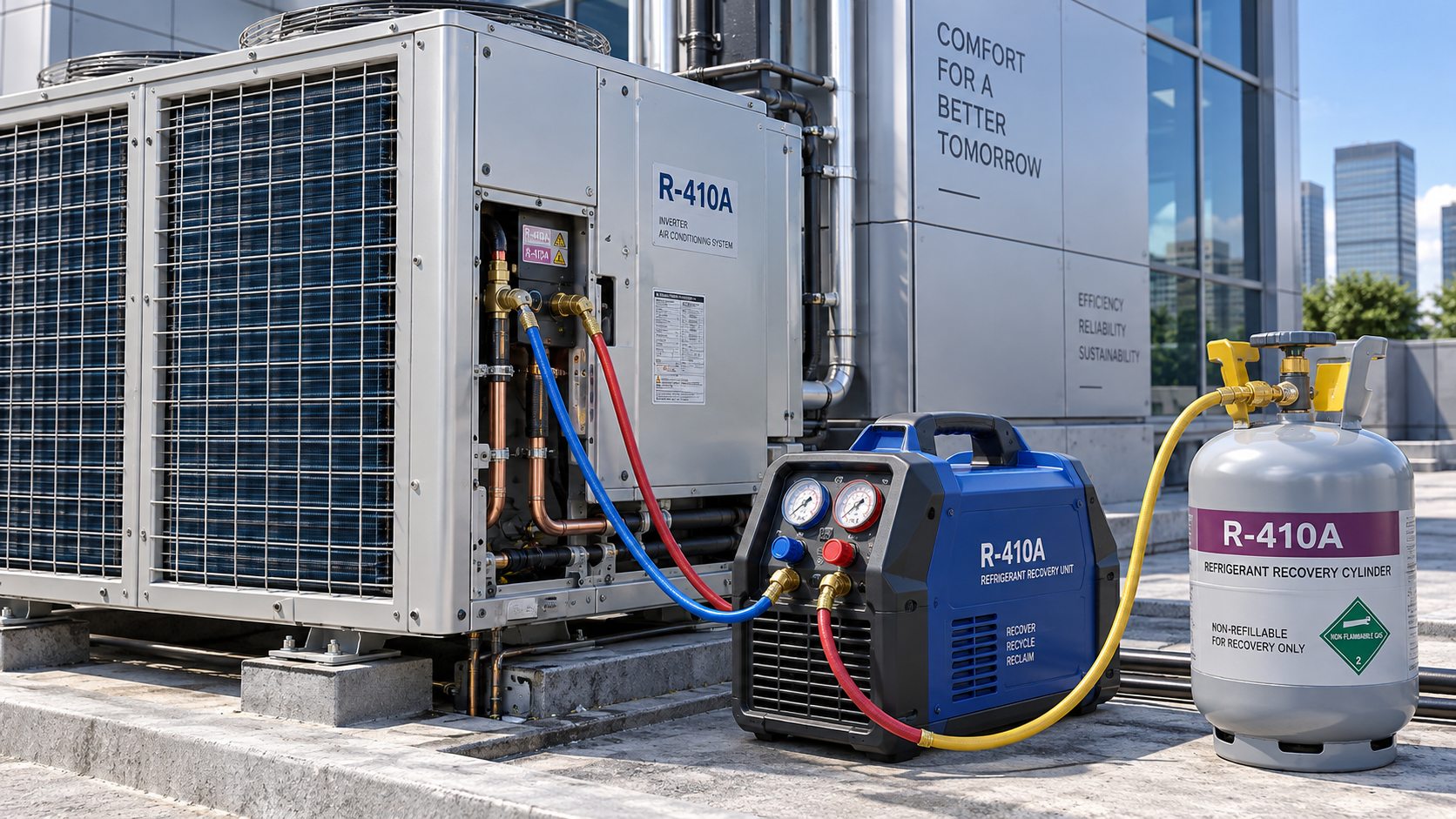
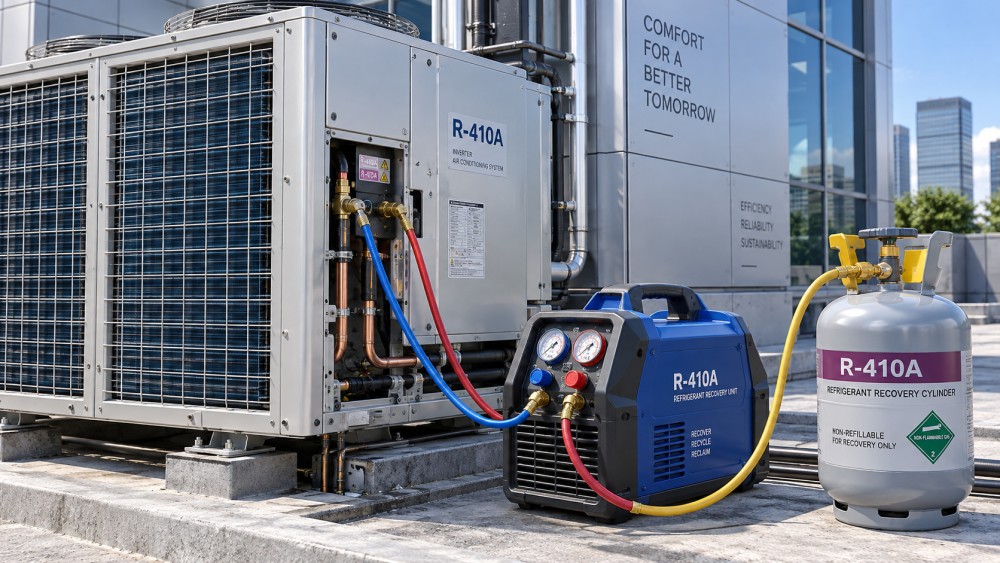
A leak repair can include recovery, component replacement, evacuation, testing, and recharging with the specified refrigerant. The regulatory transition does not eliminate these service activities. However, an acceptable repair still requires compliant handling, suitable recovery equipment, and any records or follow-up actions applicable to that equipment.
Replacing enough equipment to create a new system
A proposal described as a “repair” may cross into a new-system installation under the applicable rules. Replacing an outdoor unit while retaining an indoor coil, for example, requires more than checking that both components use R-410A. The regulatory definition, component function, manufacturer-approved combination, and relevant installation restrictions must all be examined.
Do not use the invoice description as the compliance test. Calling a changeout “maintenance” does not establish that it qualifies as service of an existing system. Conversely, a major repair is not automatically prohibited simply because it is expensive.
Before ordering equipment, record which components remain, which will be replaced, and whether any change affects capacity, refrigerant circuitry, or equipment classification. Use that scope when reviewing the applicable EPA provisions and manufacturer documentation.
R-410A service supply is not the same as new-equipment eligibility
The HFC phasedown reduces the permitted production and consumption of HFCs through an allowance system. It is not a nationwide instruction to empty existing systems, and it does not make all service refrigerant unavailable at once. Lawfully supplied R-410A can continue to support existing equipment, subject to applicable restrictions.
Nevertheless, a service department should not promise unlimited availability or stable pricing. Supply conditions, distributor inventories, and the balance between virgin and reclaimed refrigerant can change. For critical equipment, refrigerant sourcing belongs in maintenance planning rather than being left until a major leak occurs.
- Buy through traceable channels. Confirm refrigerant identity, supplier documentation, cylinder condition, and any applicable purchaser requirements.
- Keep recovery streams separate. Mixing refrigerants can make identification and reclamation more difficult and can compromise later service work.
- Distinguish recovered from reclaimed refrigerant. Recovery removes refrigerant from equipment; reclamation processes it to the specified purity standard.
- Check transfer restrictions. Recovered refrigerant is not automatically eligible for resale or transfer to another owner without reclamation by an EPA-certified reclaimer.
Refrigerant recovered from one owner’s equipment may have different reuse conditions from refrigerant transferred to another owner. Apply the relevant EPA requirements and verify refrigerant condition; a cylinder labeled “recovered R-410A” is not proof that its contents are suitable for charging.
A compliant repair still requires proper refrigerant management
Permission to keep equipment operating does not remove service obligations. Section 608 requirements include technician certification for covered work, appropriate recovery practices, and restrictions on intentional venting. R-410A must not be released simply because the system is being retired or the refrigerant is becoming less common in new equipment.
Leak obligations need a separate review. EPA’s HFC management requirements under the AIM Act are distinct from the longstanding Section 608 leak-repair provisions for ozone-depleting refrigerants. Do not assume that a threshold remembered from one program applies to every R-410A installation.
Applicable duties can depend on refrigerant type, full charge, equipment use, effective date, and exclusions. Certain HFC-containing appliances are subject to leak-repair and related requirements, while residential and light-commercial air-conditioning and heat-pump equipment has specific exclusions from those federal HFC leak-repair provisions. An exclusion from a particular leak-repair program is not permission to vent refrigerant.
For a leaking system, the service record should capture the equipment identity, refrigerant type, known or calculated charge, refrigerant added or recovered, leak location, corrective work, and test results. Where mandatory leak calculations, verification tests, reporting, or deadlines apply, those require additional documentation. A recharge quantity alone does not establish compliance.
Repeatedly adding refrigerant without investigating the loss is also a poor maintenance strategy, even where a particular federal leak-repair threshold does not apply. It leaves the fault unresolved and makes future operating costs harder to predict.
Do not convert an R-410A unit by simply changing the refrigerant
Keeping an existing system does not mean it can accept whichever lower-GWP refrigerant is available. R-32 and R-454B, used in some newer equipment, are not drop-in replacements for R-410A. Similar applications or operating pressures do not establish interchangeability.
R-410A is classified as A1 under ASHRAE Standard 34. R-32 and R-454B are classified as A2L, introducing lower-flammability considerations that must be addressed in equipment design and installation. Refrigerant compatibility also involves compressors, lubricants, seals, expansion devices, controls, and performance across the operating range.
A field refrigerant substitution can affect the equipment’s safety listing and code compliance. Depending on the application, newer A2L equipment may require provisions involving charge limits, occupied-space conditions, leak detection, mitigation controls, labeling, and service tools. These are not resolved by attaching a different refrigerant label.
Use the refrigerant specified for the equipment unless an expressly supported conversion pathway exists and satisfies all applicable requirements. For ordinary R-410A comfort-cooling equipment, replacement with a purpose-designed system is generally the relevant transition path—not an improvised A2L retrofit.
Repair or replace: build the recommendation around the fault
Regulation is one decision factor, not a substitute for assessing equipment condition. A sound R-410A system with an isolated electrical fault presents a different choice from equipment with recurring coil leaks, compressor damage, and unavailable replacement parts.
Present the customer with the actual reason for replacement. “The coil is severely deteriorated and the repair has significant limitations” is materially different from “the government requires every R-410A unit to be removed.” The latter is not an accurate statement of the federal transition.
For process-critical sites, also compare the interruption required for each option. A repair may restore service with limited disruption, while a planned replacement may reduce exposure to repeated failures. Neither outcome should be promised without reviewing the equipment and operating requirements.
Verify the rule against the equipment before issuing the quotation
Use EPA’s current AIM Act Technology Transitions materials for new-equipment restrictions, its HFC management materials for applicable service obligations, and Section 608 resources for certification and refrigerant handling. Check the actual regulatory text when a project depends on a definition, exception, or transition provision; a distributor summary is not enough for a borderline installation.
State and local requirements need their own review. State HFC restrictions, mechanical and fire codes, adopted safety standards, and permit requirements can affect the proposed work. Federal eligibility does not by itself establish that a particular installation is permitted locally.
- Identify the application and equipment category from nameplates and technical records.
- Write the proposed repair or replacement scope, including retained components.
- Confirm the current federal provisions and any relevant exceptions for that scope.
- Check state requirements, adopted codes, and manufacturer installation instructions.
- Retain the supporting documents with the quotation and service record.
When classification remains uncertain, resolve it before ordering restricted equipment or promising an installation date. A useful quotation separates mandatory compliance work, corrective repair, and optional modernization. That gives the customer a defensible choice without presenting the refrigerant transition as an automatic replacement order.
Ready when you are. Send us a message to get started.
Related News
- Chemours Faces Investor Lawsuit Over Opteon Refrigerant Sales ForecastsAuthor :Cryogenic Systems Expert

- LG Expands R290 Monobloc Heat Pump Range with New 12–16 kW ModelsAuthor :Cryogenic Systems Expert

- EU Issues Updated Guidance on Industrial Refrigeration Efficiency and F-gas AlternativesAuthor :Cryogenic Systems Expert

- Do U.S. refrigerant regulations require replacing R-410A systems?Author :Cryogenic Systems Expert

- Where R-134a Restrictions Apply and How They Affect Refrigeration EquipmentAuthor :Cryogenic Systems Expert

- R-22 Phase-Out: Repair, Retrofit, or Replace Aging Commercial Cooling Systems?Author :Cryogenic Systems Expert

- R-410A Phase-Down Rules: Planning HVAC Replacements Before Supply TightensAuthor :Cryogenic Systems Expert

- Freon Policy Updates: What Facility Managers Must Review Before Equipment ServiceAuthor :Cryogenic Systems Expert

- How to verify refrigerant regulations and safety standards for a facilityAuthor :Cryogenic Systems Expert

- When refrigerant management software makes sense for multi-site complianceAuthor :Cryogenic Systems Expert

- EU Ends Duty-Free Small Parcels From July 1Author :Cryogenic Systems Expert

- China R410A Export Quotes Rise to RMB 60,000/TonAuthor :Cryogenic Systems Expert

- EU PFAS Curbs Raise Compliance Review for Cooling ExportsAuthor :Cryogenic Systems Expert

- EU PFAS Proposal Puts Refrigerant and Vacuum Exports Under ReviewAuthor :Cryogenic Systems Expert

- EU REACH PFAS Draft Raises New Export ChecksAuthor :Cryogenic Systems Expert

- EU Cuts High-GWP Refrigerant Import Quotas by 35%Author :Cryogenic Systems Expert

- EU Cuts Q4 2026 Quotas for High-GWP RefrigerantsAuthor :Cryogenic Systems Expert

- EU F-Gas Revision Cuts R410A Quotas 40%Author :Cryogenic Systems Expert

- EPA Freezes R-410A Quotas, Fast-Tracks R-32Author :Cryogenic Systems Expert

- Low GWP Refrigerants HFO Blends: Key Stability and Safety FactorsAuthor :Cryogenic Systems Expert

- R-32 Price Spike Reshapes Chiller ProcurementAuthor :Cryogenic Systems Expert

- How to Compare Environmentally Friendly Refrigerants by GWP, Safety, and CostAuthor :Cryogenic Systems Expert

- R-454B Export Quota Cut 18% as Lead Times DoubleAuthor :Cryogenic Systems Expert

- Japan Cuts R32 and R290 Import Quotas From July 10Author :Cryogenic Systems Expert

- EPA Cuts R-134a Import Quotas 42% From July 2026Author :Cryogenic Systems Expert
![]()
- Low GWP Refrigerants HFO Blends: Performance and Compliance in 2026Author :Cryogenic Systems Expert

- R-513A Jumps 23% as China Tightens Export QuotasAuthor :Cryogenic Systems Expert

- Environmentally Friendly Refrigerants in 2026: Compliance Risks and Upgrade PrioritiesAuthor :Cryogenic Systems Expert

- Pharmaceutical Temperature Control Systems: Common Compliance RisksAuthor :Cryogenic Systems Expert

- China Tightens Q3 R32 Export QuotasAuthor :Cryogenic Systems Expert

- California EPR Deadline Nears for Refrigeration MakersAuthor :Cryogenic Systems Expert

- Resource Circularity Trends Reshaping Refrigerants and Cooling SystemsAuthor :Cryogenic Systems Expert

- HFCs Filing Rules Enter Full EnforcementAuthor :Cryogenic Systems Expert

- How Environmentally Friendly Refrigerants Affect Chiller ComplianceAuthor :Cryogenic Systems Expert

- EU REACH Tightens Refrigerant Impurity Limits for R134a ExportsAuthor :Cryogenic Systems Expert

- China Seeks Feedback on 2027 Refrigerant QuotasAuthor :Cryogenic Systems Expert