Freon Policy Updates: What Facility Managers Must Review Before Equipment Service




A service visit can become a compliance problem before a technician connects a gauge set. A refrigerant cylinder may be mislabeled, a leak repair may lack verification records, or a planned top-up may no longer be permitted under the rules that apply to the site. These gaps can affect environmental performance, maintenance release decisions, workplace safety, and equipment availability.
The practical response to a Freon policy update is not simply to ask whether a refrigerant is “banned.” Before equipment service, facility teams should confirm the refrigerant identity, the type of work planned, the applicable restrictions on supply and handling, technician qualifications, recovery arrangements, and the records that must be retained. Policy requirements differ by jurisdiction and equipment category, so the service scope should be reviewed against current local rules rather than assumptions made during the last maintenance cycle.
Start with the equipment record, not the service request
A work order that says “low cooling capacity” or “add Freon” is not enough for a compliant maintenance decision. The first review should establish what is actually installed and what the service team intends to do. This prevents a routine corrective action from becoming an unauthorized recharge, an incompatible retrofit, or an unrecorded release.
Pull the equipment file before authorizing work. For packaged air-conditioning units, process chillers, cold rooms, heat pumps, refrigeration racks, and laboratory equipment, the useful record is usually the manufacturer nameplate plus the maintenance history. Confirm that the field record matches the physical unit; older assets may have been modified, relabeled, or combined with components from another system.
- Equipment identification number, location, and duty served
- Refrigerant designation shown on the nameplate and in the asset register
- Factory charge, known operating charge, and previous refrigerant additions or removals
- Compressor oil type, major replacement parts, and evidence of prior conversion work
- Leak history, repair dates, pressure-test records, and follow-up inspection results
- Planned service activity: diagnosis, leak repair, recovery, recharge, retrofit, decommissioning, or disposal
The distinction between these activities matters. A policy may treat maintenance of existing equipment differently from installation of new equipment, placing equipment on the market, use of reclaimed material, transport of cylinders, or disposal of recovered refrigerant. A technician cannot make a sound compliance decision from a generic instruction to “restore cooling.”
Clarify what “Freon” means at the site
“Freon” is frequently used as a site shorthand for refrigerant, but it is not a technical identification. Policy requirements generally apply to a specific refrigerant class and product designation, not to the informal name used in a maintenance request. The refrigerant may be an ozone-depleting substance, a high-global-warming-potential hydrofluorocarbon, a lower-GWP blend, a hydrocarbon, ammonia, carbon dioxide, or another fluid with its own operational limits.
Quality and safety review should require the exact designation from the nameplate, cylinder label, service documentation, or approved technical record. Avoid authorizing a substitute based only on an informal equivalent. Refrigerant blends may have glide characteristics, charging requirements, and recovery rules that differ from single-component refrigerants. Mixing refrigerants in a recovery cylinder can render the recovered material unsuitable for reuse or reclamation and complicate waste handling.
Review the policy change against the actual service scope
Not every regulatory or corporate policy update changes the same part of the maintenance process. One update may concern production or import limits. Another may restrict sale, require leak checks for certain equipment, alter recordkeeping expectations, or limit use of a refrigerant in new equipment. A site should identify the operational consequence rather than relying on a broad statement that a refrigerant is “being phased down.”
Ask the service provider to state, in writing where appropriate, the refrigerant that will be handled, the purpose of the work, the source of any replacement charge, and the recovery destination for removed material. This is especially important when a repair requires a substantial recharge or when a supplier has reported changed availability. Short supply does not justify bypassing recovery procedures, using an unapproved substitute, or charging an unidentified blend.
Internal environmental requirements may also be stricter than the minimum legal baseline. A corporate refrigerant management program may require escalation after repeated leakage, set approval thresholds for refrigerant purchases, or require asset replacement review for units with persistent loss of charge. These controls should be incorporated into the work authorization process, not reviewed after invoices and service reports have arrived.
Do not approve a recharge until the leak decision is clear
Repeated refrigerant addition is often a sign that the service process is treating a symptom rather than controlling the release. In a cooling system operating with reduced charge, low capacity, unstable superheat, compressor overheating, icing, nuisance alarms, and energy waste may appear in different combinations. Those symptoms do not prove a leak by themselves, but they justify diagnosis before refrigerant is added.
The quality question is straightforward: can the service record demonstrate why refrigerant was lost, what was repaired, and how the repair was verified? The answer should be supported by the maintenance report, not merely by a statement that the unit is “running normally.” Depending on the system and applicable requirements, a robust record may include the suspected leak location, detection method, repair performed, pressure or vacuum test details, verification method, quantity recovered, and quantity charged.
Where no leak is found, the report should distinguish between a confirmed loss of refrigerant and another operating fault. Restricted airflow, fouled heat-exchange surfaces, failed fans, sensor errors, control faults, water-flow problems, expansion device issues, and poor condenser conditions can produce similar performance complaints. Adding refrigerant to a system with a non-refrigerant fault can increase pressure risk and make later diagnosis harder.
When a replacement or retrofit discussion is necessary
A policy update can expose a planning problem rather than a maintenance problem. If permitted refrigerant supply is uncertain, leakage is recurrent, parts are difficult to obtain, or the existing refrigerant has a high compliance burden, a facility may need to compare repair with replacement. That decision should not be reduced to the availability of one cylinder of refrigerant.
A retrofit may affect compressor application limits, lubricants, elastomers, expansion valves, pressure controls, safety devices, capacity, electrical loading, labeling, and emergency procedures. Refrigerant replacement is not automatically a drop-in change. The equipment manufacturer’s approved guidance and the refrigerant supplier’s technical information should be reviewed before work begins. Where compatibility or performance cannot be confirmed, replacement planning may be safer than an improvised field conversion.
Verify contractor readiness and site controls
Before the visit, confirm that the service organization is authorized and competent to perform the planned work under the rules that apply locally. This includes any required technician certification, refrigerant handling authorization, transport requirements, and waste management arrangements. A valid qualification should match the work being done; routine comfort-cooling service and work on equipment containing flammable or toxic refrigerants can require different capabilities and controls.
Site readiness deserves equal attention. The maintenance team should know where equipment is located, whether access is restricted, whether the area has adequate ventilation, and whether the service could affect occupied spaces or critical production. Refrigerants can create hazards through oxygen displacement, toxicity, flammability, elevated pressure, cold contact injury, or decomposition products generated by exposure to high heat. The hazard profile depends on the fluid and the task, so generic PPE language is not a substitute for a task-specific review.
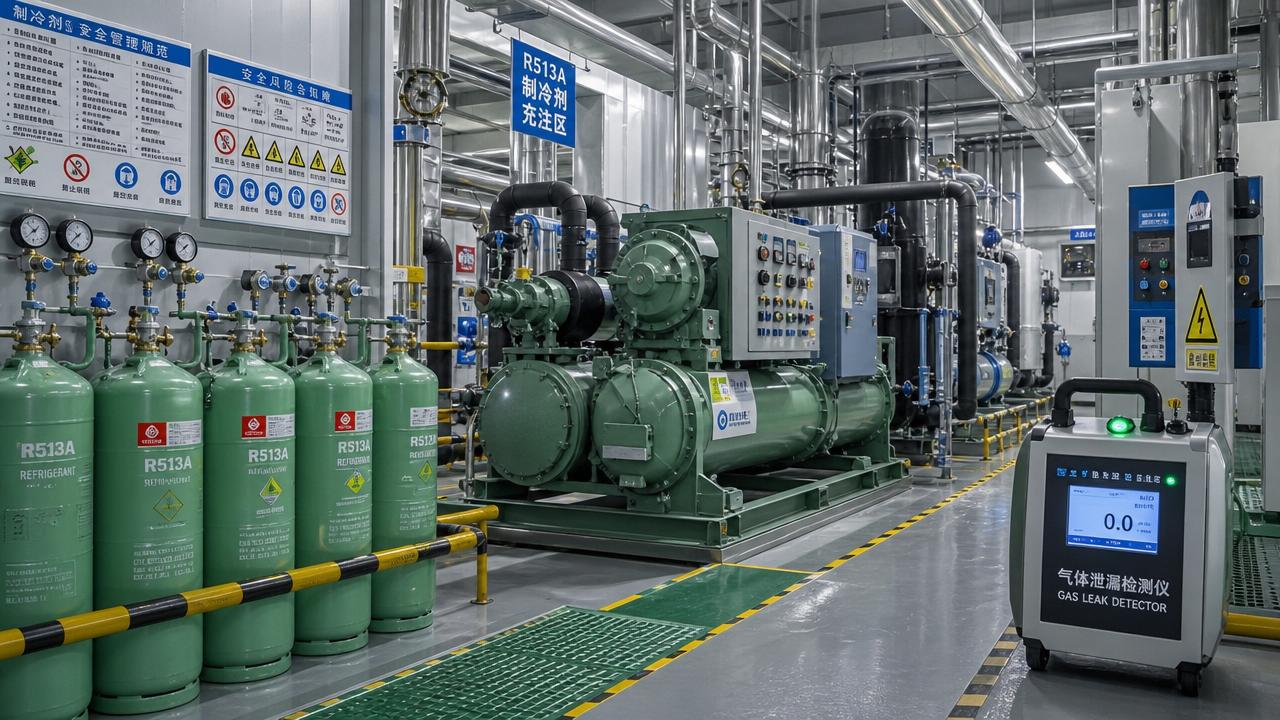
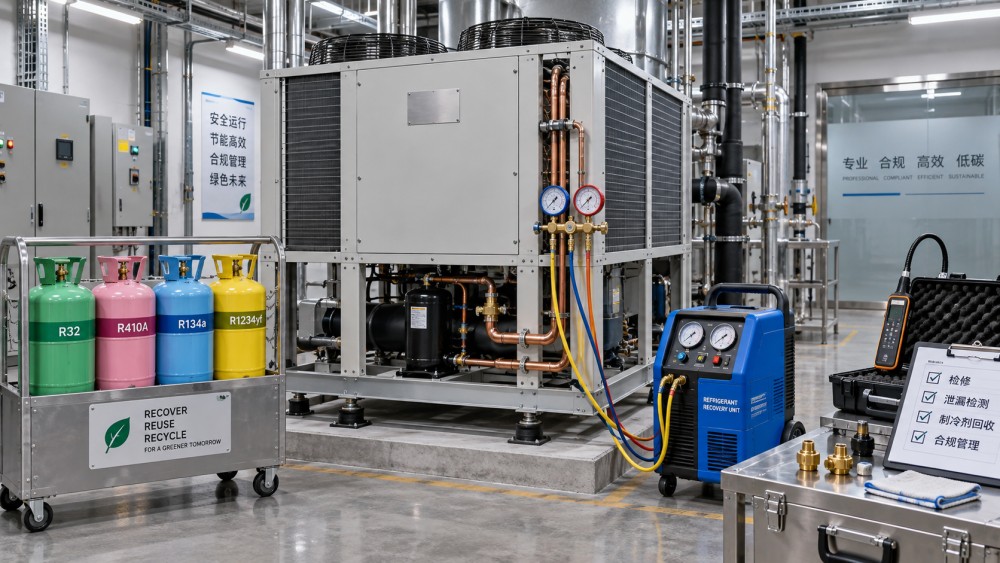
- Confirm that recovery machines, hoses, manifolds, cylinders, scales, and leak-detection equipment are suitable for the refrigerant and in serviceable condition.
- Ensure recovery cylinders are correctly identified, not overfilled, and assigned to compatible refrigerant streams.
- Check whether hot work, ignition sources, confined-space controls, roof access permits, or isolation procedures apply.
- Establish how alarms, ventilation shutdowns, production interruptions, or refrigerant releases will be communicated.
- Verify that Safety Data Sheet access and emergency contact arrangements are available for the refrigerant being handled.
For equipment using flammable refrigerants, an ordinary service routine may require a different approach to area control, ignition management, ventilation, and gas detection. For ammonia or other toxic refrigerants, emergency response planning and exposure controls need additional scrutiny. The correct response is to match the method statement to the refrigerant classification and installation environment, rather than assuming all cooling equipment presents the same service risk.
Make records usable for both quality review and compliance
Records often fail not because the facility keeps nothing, but because information is split among work orders, supplier invoices, handwritten technician sheets, and a maintenance management system that does not capture refrigerant details. A policy change is a useful trigger to standardize the service record. The goal is traceability: a reviewer should be able to follow the refrigerant from the system, through recovery or recharge, to its documented destination.
At minimum, retain the asset identity, refrigerant type, reason for service, technician or contractor details, refrigerant quantity added and removed, leak findings, repairs completed, verification performed, and disposition of recovered refrigerant. Keep supporting documents for cylinders and reclaimed material when these are relevant to the site’s obligations. Record the date and the person approving any exception, such as temporary operation pending a planned replacement.
Quality managers can use these records to identify patterns that are easy to miss in isolated service calls. Rising recharge frequency, repeat leaks at the same component, unexplained differences between purchased and charged quantities, or recovery records that lack a receiving destination all warrant follow-up. The purpose is not to create paperwork for its own sake; it is to detect loss of containment, questionable service practices, and future downtime risk early.
Release the equipment only after the service outcome is defined
A completed work order should answer more than whether the unit restarted. Before releasing equipment back to normal operation, check that required panels and labels are restored, service ports are properly secured, safety devices have not been bypassed, and operating readings are consistent with the service objective. Where a leak repair was made, ensure the required verification was performed and documented before treating the issue as closed.
For process cooling and temperature-sensitive areas, the release decision should also consider product and operational impact. A unit may appear mechanically stable while still failing to maintain the temperature, humidity, pressure, or redundancy conditions expected by the process. The service report should identify any temporary operating limitations, pending parts, monitoring needs, or follow-up inspection date. This avoids a quiet handover in which the equipment is technically running but the underlying risk remains unmanaged.
Questions that often arise during policy reviews
Can existing equipment still be serviced after a refrigerant restriction changes?
Often, the answer depends on the refrigerant, equipment type, location, and nature of the work. Restrictions on new equipment, sale, import, use, recovery, or recharge are not always identical. Confirm the applicable requirement before approving the work, especially where refrigerant must be added.
Is recovered refrigerant acceptable for reuse?
It may be, but conditions can apply. The refrigerant must be correctly identified, handled to prevent contamination, and managed according to local requirements and the intended use. Recovered material from an unknown or mixed source should not be treated as interchangeable with verified refrigerant.
Does a small refrigerant top-up require documentation?
Even a small addition can be evidence of a leak or a change in system charge. Recording the quantity, reason, and service findings supports future troubleshooting and helps demonstrate that refrigerant handling was controlled.
A disciplined pre-service review turns a Freon policy update into a manageable operating control: identify the refrigerant precisely, define the work scope, verify legal and site requirements, prevent uncontrolled release, and retain evidence of what happened to every refrigerant charge. That sequence protects both the equipment and the people responsible for approving its maintenance.
Related News
- R-410A Phase-Down Rules: Planning HVAC Replacements Before Supply TightensAuthor :Cryogenic Systems Expert

- Freon Policy Updates: What Facility Managers Must Review Before Equipment ServiceAuthor :Cryogenic Systems Expert

- How to verify refrigerant regulations and safety standards for a facilityAuthor :Cryogenic Systems Expert

- When refrigerant management software makes sense for multi-site complianceAuthor :Cryogenic Systems Expert

- EU Ends Duty-Free Small Parcels From July 1Author :Cryogenic Systems Expert

- China R410A Export Quotes Rise to RMB 60,000/TonAuthor :Cryogenic Systems Expert

- EU PFAS Curbs Raise Compliance Review for Cooling ExportsAuthor :Cryogenic Systems Expert

- EU PFAS Proposal Puts Refrigerant and Vacuum Exports Under ReviewAuthor :Cryogenic Systems Expert

- EU REACH PFAS Draft Raises New Export ChecksAuthor :Cryogenic Systems Expert

- EU Cuts High-GWP Refrigerant Import Quotas by 35%Author :Cryogenic Systems Expert

- EU Cuts Q4 2026 Quotas for High-GWP RefrigerantsAuthor :Cryogenic Systems Expert

- EU F-Gas Revision Cuts R410A Quotas 40%Author :Cryogenic Systems Expert

- EPA Freezes R-410A Quotas, Fast-Tracks R-32Author :Cryogenic Systems Expert

- Low GWP Refrigerants HFO Blends: Key Stability and Safety FactorsAuthor :Cryogenic Systems Expert

- R-32 Price Spike Reshapes Chiller ProcurementAuthor :Cryogenic Systems Expert

- How to Compare Environmentally Friendly Refrigerants by GWP, Safety, and CostAuthor :Cryogenic Systems Expert

- R-454B Export Quota Cut 18% as Lead Times DoubleAuthor :Cryogenic Systems Expert

- Japan Cuts R32 and R290 Import Quotas From July 10Author :Cryogenic Systems Expert

- EPA Cuts R-134a Import Quotas 42% From July 2026Author :Cryogenic Systems Expert
![]()
- Low GWP Refrigerants HFO Blends: Performance and Compliance in 2026Author :Cryogenic Systems Expert

- R-513A Jumps 23% as China Tightens Export QuotasAuthor :Cryogenic Systems Expert

- Environmentally Friendly Refrigerants in 2026: Compliance Risks and Upgrade PrioritiesAuthor :Cryogenic Systems Expert

- Pharmaceutical Temperature Control Systems: Common Compliance RisksAuthor :Cryogenic Systems Expert

- China Tightens Q3 R32 Export QuotasAuthor :Cryogenic Systems Expert

- California EPR Deadline Nears for Refrigeration MakersAuthor :Cryogenic Systems Expert

- Resource Circularity Trends Reshaping Refrigerants and Cooling SystemsAuthor :Cryogenic Systems Expert

- HFCs Filing Rules Enter Full EnforcementAuthor :Cryogenic Systems Expert

- How Environmentally Friendly Refrigerants Affect Chiller ComplianceAuthor :Cryogenic Systems Expert

- EU REACH Tightens Refrigerant Impurity Limits for R134a ExportsAuthor :Cryogenic Systems Expert

- China Seeks Feedback on 2027 Refrigerant QuotasAuthor :Cryogenic Systems Expert

- EU to Ban High-GWP ACs in 2029 as R410A Exits HomesAuthor :Cryogenic Systems Expert

- US, UK Delay HFC Phaseout, Extending R32/R134a Export WindowAuthor :Cryogenic Systems Expert

- EU HFC Cut Tightens by 2029 as Gen-3 Output Falls 10%Author :Cryogenic Systems Expert

- Kuwait Bans HCFC AC Imports as Shift to R32/R290 Speeds UpAuthor :Cryogenic Systems Expert

- Saudi SASO Rules Tighten AC Imports in DecemberAuthor :Cryogenic Systems Expert

- Environmentally Friendly Refrigerants: Compliance, Safety, and Retrofit RisksAuthor :Cryogenic Systems Expert