R-410A Phase-Down Rules: Planning HVAC Replacements Before Supply Tightens




A facility can appear well prepared for another cooling season and still be exposed to R-410A supply risk. The rooftop units are operating, split systems are holding temperature, and the maintenance budget assumes routine repairs. Then a major leak, compressor failure, or replacement decision turns a familiar refrigerant into a procurement problem: availability may be less predictable, service quotations may change quickly, and a repair that once seemed straightforward can require a broader capital decision.
The practical answer to concerns about an r410a ban is not to assume every installed system must be removed immediately. Rules differ by jurisdiction and equipment category, while many existing R-410A systems can continue operating and be serviced where permitted. The larger planning issue is that R-410A is being phased down through refrigerant-management policies, new-equipment standards, and supply controls. Businesses should therefore identify their exposure now, prioritize aging or high-risk equipment, and schedule replacements before an unexpected failure forces a rushed choice.
Why R-410A replacement planning has moved from maintenance to capital strategy
R-410A became widely used in comfort cooling because it supported efficient air-conditioning and heat-pump designs. Its challenge is its relatively high global-warming impact compared with newer refrigerant options. As the market transitions toward lower-impact refrigerants, the operational risk is not limited to whether cylinders can be obtained on a given day. It also includes how long an older asset can be economically maintained, whether compatible components remain readily available, and whether a replacement design will meet current local requirements.
For a business leader, this changes the question from “Can we repair this unit?” to “Is repair still the best use of capital for this location?” A low-cost repair may be sensible for equipment with stable performance, a clean maintenance record, and several useful years remaining. The same repair becomes harder to justify when the unit is leak-prone, undersized for current loads, near the end of its expected service life, or located in a process-critical area where downtime carries operational consequences.
Supply tightening can amplify decisions that were already approaching. Refrigerant cost volatility is one factor, but it should not be treated as the only one. A site that depends on a small number of aging R-410A systems may face greater disruption from lead times for replacement equipment, contractor availability, permitting, electrical upgrades, controls integration, or temporary cooling arrangements than from the refrigerant purchase itself.
The misconception behind “ban” language
“Ban” is often used as shorthand for a much more complicated transition. It can refer to limits on new equipment using a refrigerant, reduced production or import allowances, restrictions that apply to particular end uses, or future changes in servicing practices. Those categories have different effects on an installed HVAC fleet.
An organization should separate three questions:
- Can the existing equipment remain in operation? Existing systems are not automatically unusable simply because the market is moving away from R-410A.
- Can it still be repaired and recharged? This depends on applicable rules, refrigerant availability, recovery practices, and the practical condition of the equipment.
- Can the same type of equipment be purchased as a replacement? New-product requirements may change before existing systems become impossible to service.
Confusing these questions creates two costly errors. One is premature replacement of stable equipment without a sound business case. The other is assuming that continued operation means replacement can be delayed indefinitely. The right response is a managed transition plan, not a blanket reaction to headlines.
Start with an asset view, not a refrigerant inventory alone
A refrigerant inventory is essential, but it is only the first layer. Decision makers need an asset register that connects refrigerant type to operational importance, condition, age, energy use, maintenance history, and replacement constraints. The outcome should be a ranked view of which R-410A systems deserve immediate engineering attention and which can remain under normal maintenance.
For each system or equipment group, capture the installed location, equipment type, cooling duty, refrigerant charge, known leak history, major component condition, service accessibility, and whether the area is comfort cooling or supports a critical process. Include associated dependencies such as building controls, ventilation, electrical capacity, backup cooling, and production schedules. A unit in a lightly occupied office and a unit protecting a server room may use similar refrigerant, but their failure consequences are entirely different.
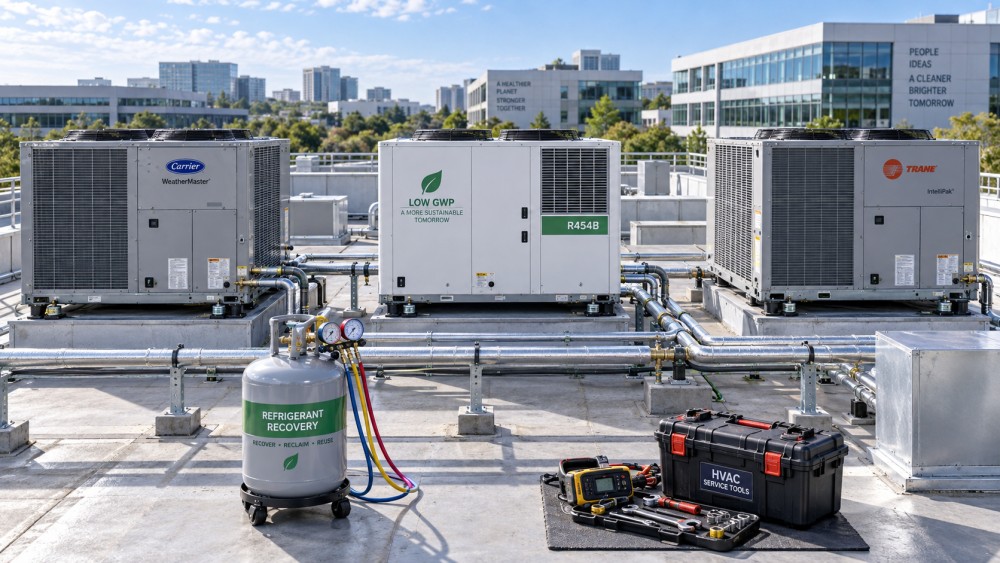
Maintenance records can reveal more than nameplate data. Repeated top-ups, recurring pressure or temperature alarms, oil-related compressor issues, coil corrosion, and frequent contactor or fan failures indicate that an asset may be moving beyond economical maintenance. A single refrigerant leak does not automatically require replacement. Repeated leakage without a durable root-cause correction is a stronger signal, particularly as refrigerant planning becomes more constrained.
Classify the equipment by business consequence
A useful internal classification does not need to be overly elaborate. Systems can be grouped according to whether failure would create inconvenience, disrupt normal operations, affect product quality, interrupt IT or communications, compromise environmental conditions, or stop production. This classification helps prevent a common budget mistake: replacing equipment solely by age while overlooking newer assets that support high-consequence spaces and have poor redundancy.
Critical systems should also be reviewed for recovery capability. If an R-410A unit fails during peak demand, can the load be shifted, can temporary cooling be connected, or can operations continue safely at a reduced capacity? The less recovery flexibility a site has, the earlier it should make replacement decisions.
Repair, replace, or defer: a disciplined decision framework
There is no universal age at which every R-410A system should be retired. The decision is more reliable when it is based on remaining serviceability, operating performance, and the consequences of failure. The table below provides a practical way to frame the discussion between finance, operations, and facility teams.
Deferral can be reasonable when the equipment is demonstrably sound and the organization has a credible contingency plan. It is less reasonable when deferral merely transfers risk to an emergency procurement process. Emergency replacement often narrows the available equipment choices, disrupts operations, and makes it harder to evaluate lifecycle operating cost.
One useful threshold is the nature of the repair. Routine electrical or mechanical maintenance may extend the useful life of a sound unit. A major compressor replacement, significant coil failure, or recurring refrigerant circuit repair deserves a replacement comparison. The comparison should include not only repair cost, but expected energy use, downtime exposure, refrigerant-service risk, installation disruption, and how the new system fits longer-term site plans.
Do not treat lower-GWP refrigerants as drop-in substitutes
When R-410A availability becomes a concern, teams may ask whether another refrigerant can simply be installed in the existing equipment. In most cases, that is not a routine field substitution. R-410A equipment was designed around specific pressure, lubricant, controls, expansion components, safety classifications, and performance characteristics. Changing refrigerant without an approved engineering pathway can create reliability, capacity, safety, warranty, and compliance problems.
New replacement equipment may use a lower-global-warming-potential refrigerant, but the decision involves more than selecting a refrigerant label. Some newer alternatives have different flammability classifications and can require changes in equipment construction, installation practices, room considerations, detection provisions, ventilation arrangements, technician procedures, and local code review. A replacement scope should therefore be based on the selected equipment manufacturer’s requirements and the rules applicable at the installation site.
The safest commercial assumption is simple: plan to replace R-410A equipment with purpose-designed equipment rather than planning around an informal retrofit. Any retrofit proposal should be evaluated against documented equipment approvals, technical compatibility, safety requirements, and applicable regulations—not just claimed refrigerant availability.
Build the replacement program around operational windows
Once high-priority assets are identified, sequence the work around the periods when the business can tolerate installation and commissioning activity. Cooling replacements are rarely isolated mechanical projects. They may require crane access, roof work, electrical shutdowns, condensate modifications, duct transitions, controls programming, air balancing, and verification under actual load conditions.
Begin with a site-specific load review. Occupancy, process equipment, IT loads, operating hours, envelope changes, and ventilation requirements may have changed since the original R-410A system was selected. Replacing like-for-like without checking the current load can perpetuate oversizing, undersizing, humidity problems, short cycling, or poor part-load performance.
Then define the decision milestones before a failure occurs. These can include the point at which a repeated leak triggers replacement review, the repair cost threshold requiring capital approval, the minimum lead time needed before peak season, and the assets that need advance temporary-cooling arrangements. Assigning these triggers in advance prevents maintenance personnel from carrying a capital decision alone during an urgent outage.
Procurement questions that reduce future surprises
Procurement teams should ask suppliers and contractors for information that supports long-term operation rather than focusing only on initial equipment cost. Useful questions include:
- Which refrigerant and safety classification does the proposed unit use, and what installation conditions follow from that choice?
- What electrical, controls, structural, ventilation, or access modifications are included or excluded?
- How will the contractor recover, document, and handle the existing R-410A charge?
- What commissioning steps will verify capacity, airflow, refrigerant circuit operation, controls response, and alarm functions?
- Which parts, training, and maintenance procedures will be needed by the site team after handover?
These questions are especially important where a replacement is part of a broader energy or decarbonization program. Higher nominal efficiency does not guarantee lower site energy use if controls are poorly integrated, airflow is not corrected, or the equipment operates far outside its intended duty cycle.
Protect service continuity while the fleet transitions
A phased replacement program still requires an active service strategy for the equipment that remains. Maintain accurate refrigerant records, require leak investigation rather than repeated top-off practices, and ensure recovery equipment and procedures are available to service providers. Verify that critical systems have clear escalation paths and that the organization understands who can authorize emergency rental cooling, major repair work, or accelerated replacement.
It is also worth reviewing maintenance contract language. A contract may cover labor but leave uncertainty around refrigerant supply, equipment lead times, temporary cooling, or after-hours mobilization. Those gaps become more visible as older R-410A assets become harder to support economically. Clear responsibilities are more valuable than assuming a service agreement will resolve every supply constraint.
R-410A phase-down planning is most effective when it is treated as a portfolio decision. Keep efficient, reliable systems in service where that remains sensible; address leak-prone and business-critical units early; and avoid allowing a sudden failure to dictate technology, timing, and budget. That approach preserves cooling reliability while giving the organization room to select compliant, lower-impact equipment on its own terms.
Related News
- R-410A Phase-Down Rules: Planning HVAC Replacements Before Supply TightensAuthor :Cryogenic Systems Expert

- Freon Policy Updates: What Facility Managers Must Review Before Equipment ServiceAuthor :Cryogenic Systems Expert

- How to verify refrigerant regulations and safety standards for a facilityAuthor :Cryogenic Systems Expert

- When refrigerant management software makes sense for multi-site complianceAuthor :Cryogenic Systems Expert

- EU Ends Duty-Free Small Parcels From July 1Author :Cryogenic Systems Expert

- China R410A Export Quotes Rise to RMB 60,000/TonAuthor :Cryogenic Systems Expert

- EU PFAS Curbs Raise Compliance Review for Cooling ExportsAuthor :Cryogenic Systems Expert

- EU PFAS Proposal Puts Refrigerant and Vacuum Exports Under ReviewAuthor :Cryogenic Systems Expert

- EU REACH PFAS Draft Raises New Export ChecksAuthor :Cryogenic Systems Expert

- EU Cuts High-GWP Refrigerant Import Quotas by 35%Author :Cryogenic Systems Expert

- EU Cuts Q4 2026 Quotas for High-GWP RefrigerantsAuthor :Cryogenic Systems Expert

- EU F-Gas Revision Cuts R410A Quotas 40%Author :Cryogenic Systems Expert

- EPA Freezes R-410A Quotas, Fast-Tracks R-32Author :Cryogenic Systems Expert

- Low GWP Refrigerants HFO Blends: Key Stability and Safety FactorsAuthor :Cryogenic Systems Expert

- R-32 Price Spike Reshapes Chiller ProcurementAuthor :Cryogenic Systems Expert

- How to Compare Environmentally Friendly Refrigerants by GWP, Safety, and CostAuthor :Cryogenic Systems Expert

- R-454B Export Quota Cut 18% as Lead Times DoubleAuthor :Cryogenic Systems Expert

- Japan Cuts R32 and R290 Import Quotas From July 10Author :Cryogenic Systems Expert

- EPA Cuts R-134a Import Quotas 42% From July 2026Author :Cryogenic Systems Expert
![]()
- Low GWP Refrigerants HFO Blends: Performance and Compliance in 2026Author :Cryogenic Systems Expert

- R-513A Jumps 23% as China Tightens Export QuotasAuthor :Cryogenic Systems Expert

- Environmentally Friendly Refrigerants in 2026: Compliance Risks and Upgrade PrioritiesAuthor :Cryogenic Systems Expert

- Pharmaceutical Temperature Control Systems: Common Compliance RisksAuthor :Cryogenic Systems Expert

- China Tightens Q3 R32 Export QuotasAuthor :Cryogenic Systems Expert

- California EPR Deadline Nears for Refrigeration MakersAuthor :Cryogenic Systems Expert

- Resource Circularity Trends Reshaping Refrigerants and Cooling SystemsAuthor :Cryogenic Systems Expert

- HFCs Filing Rules Enter Full EnforcementAuthor :Cryogenic Systems Expert

- How Environmentally Friendly Refrigerants Affect Chiller ComplianceAuthor :Cryogenic Systems Expert

- EU REACH Tightens Refrigerant Impurity Limits for R134a ExportsAuthor :Cryogenic Systems Expert

- China Seeks Feedback on 2027 Refrigerant QuotasAuthor :Cryogenic Systems Expert

- EU to Ban High-GWP ACs in 2029 as R410A Exits HomesAuthor :Cryogenic Systems Expert

- US, UK Delay HFC Phaseout, Extending R32/R134a Export WindowAuthor :Cryogenic Systems Expert

- EU HFC Cut Tightens by 2029 as Gen-3 Output Falls 10%Author :Cryogenic Systems Expert

- Kuwait Bans HCFC AC Imports as Shift to R32/R290 Speeds UpAuthor :Cryogenic Systems Expert

- Saudi SASO Rules Tighten AC Imports in DecemberAuthor :Cryogenic Systems Expert

- Environmentally Friendly Refrigerants: Compliance, Safety, and Retrofit RisksAuthor :Cryogenic Systems Expert