How to verify refrigerant regulations and safety standards for a facility




A facility does not become compliant because the refrigeration unit still runs, the refrigerant cylinder has a familiar label, or the equipment was acceptable when it was installed. Refrigerant regulations and safety standards must be checked against the actual system, its refrigerant charge, the occupied space around it, the way it is maintained, and the rules that apply where the facility operates.
For quality and safety teams, the practical task is to build evidence that the system is legal to operate, safe to service, and controlled throughout its life cycle. The most reliable approach is to verify the system in layers: identify the equipment and refrigerant, determine the applicable regulatory and safety framework, inspect physical safeguards, then compare records with real operating conditions.
Start with the system that is actually installed
Compliance reviews often fail at the first step because the facility inventory is incomplete or based on old procurement records. A refrigeration plant may have received replacement compressors, added evaporators, altered pipework, or changed refrigerants over time. Those changes can affect both environmental obligations and safety requirements.
Create a system register that separates each independent refrigeration circuit rather than treating an entire building as one asset. For each circuit, record:
- Equipment type and location, including outdoor units, machine rooms, process chillers, cold rooms, and packaged systems.
- Manufacturer, model, serial number, and installation or major modification date where available.
- Refrigerant name, safety classification shown on the equipment documentation, and total charge.
- Compressor, receiver, condenser, evaporator, piping, valves, and connected ventilation arrangements.
- Whether the system serves comfort cooling, food storage, manufacturing, laboratories, data rooms, or another critical process.
- Any retrofit history, leak repair history, refrigerant recovery records, and contractor service reports.
The equipment nameplate is a starting point, not final proof. A label may show the original refrigerant while the circuit has been retrofitted. Service logs and cylinder records can help identify this mismatch. Where the refrigerant in use cannot be demonstrated through records, the facility should treat the circuit as an unresolved compliance and safety item rather than assuming the original label remains accurate.
Map the rules in the right order
Refrigerant compliance involves more than one category of requirement. Environmental rules govern which refrigerants can be placed on the market, used in particular equipment, recovered, handled, or reported. Safety rules address fire, toxicity, pressure, ventilation, electrical equipment, emergency response, and human exposure. Building, fire, occupational safety, and transport requirements may also apply.
The mistake is to search for one universal “refrigerant certification” and stop there. A facility needs a rule map that connects its own systems to the relevant authorities and standards. The exact legal framework differs by jurisdiction, but the review logic remains stable.
Keep the rule map attached to each system register entry. That makes later audits faster and prevents a generic policy from being applied to equipment with different refrigerant hazards.
Safety classification changes the questions you ask
Refrigerants are not interchangeable from a safety perspective. Some are primarily managed as high-pressure systems. Others introduce meaningful flammability, toxicity, oxygen-displacement, or combustion-related concerns. A lower environmental impact does not automatically mean a refrigerant can be used in the same room, at the same charge, with the same electrical equipment and ventilation design as the refrigerant it replaces.
For a facility using refrigerants with flammability characteristics, inspect ignition-source control, electrical area suitability where relevant, ventilation performance, gas detection, alarm response, and emergency shutdown arrangements. For refrigerants with toxicity concerns, focus on detector placement, alarm escalation, occupied-space exposure, ventilation discharge, access restrictions, and responder protection. For large charge systems, also assess the consequences of a sudden release into the smallest connected or occupied space, not only the nominal machinery room volume.
Do not reduce this review to a single “safe charge” number. Charge limits are typically influenced by the refrigerant classification, the purpose of the occupied space, room volume, system configuration, and mitigation measures. A cold-storage area, a production hall, a public corridor, and an enclosed technical room do not present the same conditions.
Inspect the safeguards, not just the paperwork
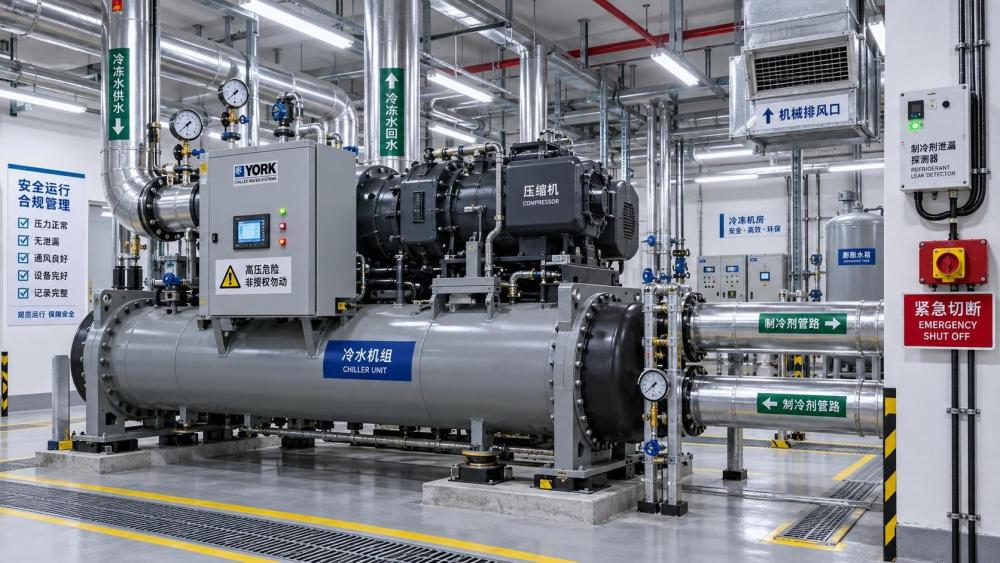
Documents show intended controls; field inspection shows whether those controls still function. The inspection should follow the refrigerant from the circuit to the spaces it can affect during normal operation, maintenance, and a leak event.
Machine rooms and enclosed equipment areas
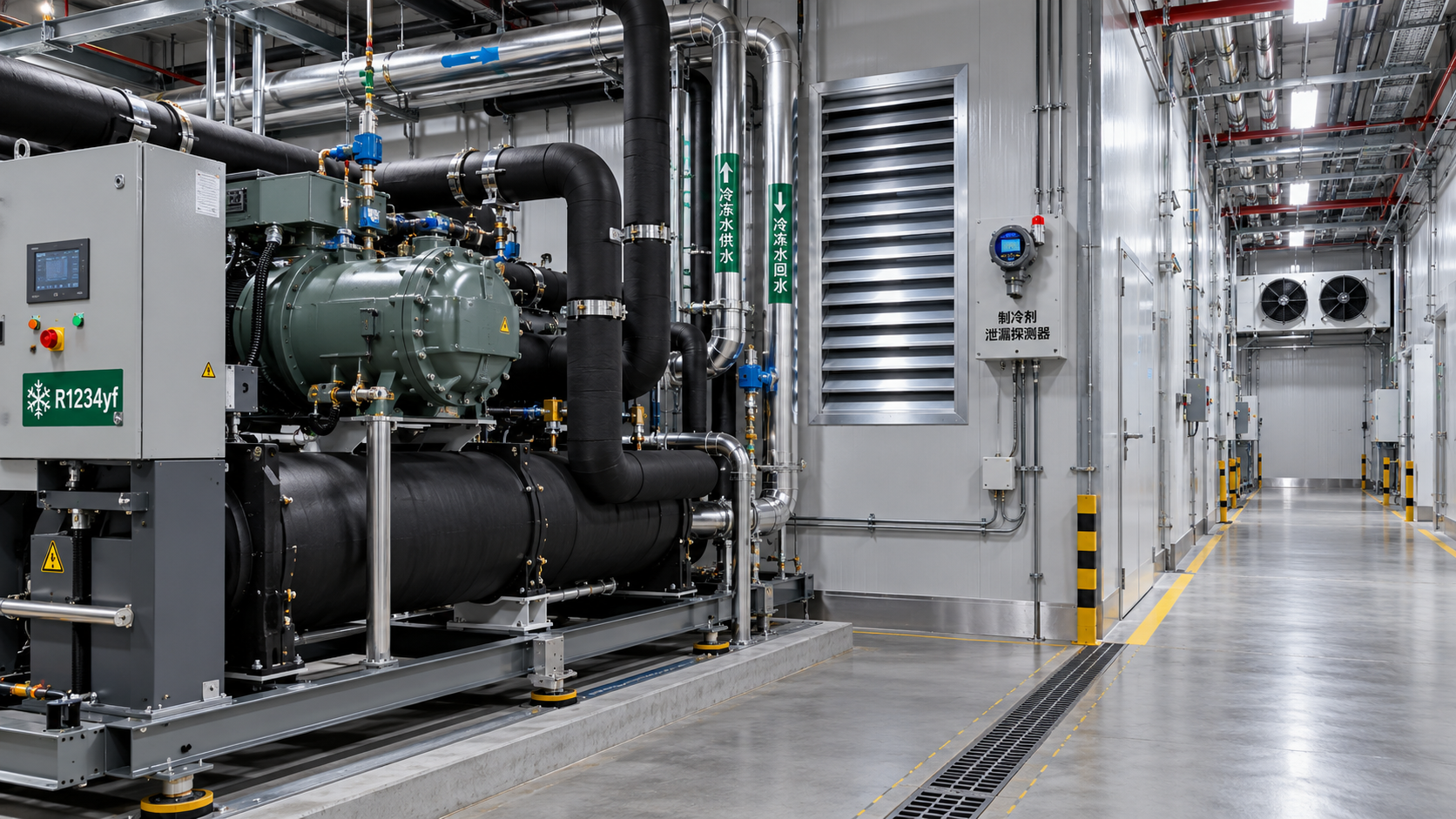
Check that access is controlled, warning information is legible, and ventilation openings or mechanical extract systems are not blocked or disabled. Confirm that emergency isolation can be reached without entering an unsafe space. Gas detectors should be positioned and maintained for the refrigerant’s likely behavior after release; a detector installed too high or too far from credible leak paths may provide little operational protection.
Safety managers should also look for changes made after commissioning: stored materials restricting airflow, newly installed electrical devices, sealed doors, altered drainage paths, or space-use changes. These are common ways an originally compliant room becomes less safe without any alteration to the refrigeration circuit.
Pressure and leak controls
Review the condition and service history of pressure-relief devices, shutoff valves, leak detectors, alarm indicators, and control interlocks. Relief discharge routing deserves particular attention. It should not create a foreseeable hazard near doors, air intakes, work areas, or adjacent properties.
Leak records are more useful when they identify the circuit, suspected cause, repair action, quantity recovered or added, and follow-up verification. A record that only says “gas added” cannot demonstrate whether a recurring leak was corrected. Repeated top-ups may indicate a technical defect, but they can also signal inadequate maintenance discipline and incomplete environmental records.
Separate routine service from competent refrigerant handling
A mechanical contractor may be capable of general HVAC work without being qualified for every refrigerant, system pressure, or hazard category present on site. Verification should cover the competence of both internal staff and contractors who install, charge, recover, transport, repair, or decommission refrigerant equipment.
Ask whether procedures address the actual equipment installed. A generic service method is inadequate where a system has flammable refrigerant, toxic refrigerant, multiple circuits, remote condensers, or occupied areas near potential leak points. The work method should define isolation, recovery, leak testing, ventilation, ignition-source control where needed, cylinder handling, and steps for returning equipment to service.
Quality personnel can make this review stronger by sampling completed work orders. Compare the stated repair with the materials used, refrigerant movement records, leak-test result, and final operating checks. When those records do not connect, the facility has limited evidence that the repair was completed as intended.
Know when a retrofit becomes a redesign decision
Replacing one refrigerant with another is often treated as a procurement or maintenance decision. It can instead change the safety basis of the installation. A different refrigerant may alter operating pressures, lubricant compatibility, capacity behavior, relief requirements, detector selection, ventilation needs, charge limits, or electrical precautions.
Before approving a conversion, identify whether it is a manufacturer-supported option for the equipment and whether the new refrigerant changes the circuit’s hazard classification. Review the full system boundary, including piping, controls, relief valves, machinery-room safeguards, and the areas served. A refrigerant that works thermodynamically in a compressor is not automatically appropriate for the facility configuration.
This is also where facilities should distinguish between keeping an existing asset operating and making a new capital investment. The compliance path, available refrigerant choices, documentation burden, and long-term serviceability can differ substantially.
Build a compliance file that survives staff turnover
Good refrigerant governance is less about producing a large binder and more about keeping a usable, current evidence trail. Store the system register, equipment documentation, safety data, risk assessments, inspection results, leak and repair records, refrigerant purchase and recovery records, contractor credentials, and emergency procedures in one controlled location.
Assign an owner for each review trigger: new equipment, refrigerant change, major repair, repeated leak, space-use change, incident, or regulatory change. Each trigger should require an assessment of whether the facility’s records and safeguards still match the system in operation.
For multi-site organizations, use the same minimum data fields across facilities but avoid forcing identical controls onto unlike systems. A small packaged rooftop unit, a large industrial chiller, and a refrigerated production area can share a governance process while needing different physical safeguards.
A practical verification sequence
- Inventory every circuit. Reconcile nameplates, service history, refrigerant records, and physical inspection.
- Classify the installation. Identify the refrigerant, charge, hazard characteristics, room type, occupancy, and connected spaces.
- Map applicable obligations. Separate environmental, safety, workplace, building, and fire-control requirements.
- Inspect safeguards in the field. Verify ventilation, detection, relief routing, emergency isolation, signage, access, and alarm response.
- Test the maintenance evidence. Sample repairs and refrigerant movements to confirm that records reflect actual work.
- Close gaps by risk. Address uncontrolled release pathways, missing emergency controls, unsupported retrofits, and incomplete system identification before lower-impact documentation improvements.
- Set review triggers. Reassess when equipment, refrigerant, occupancy, layout, maintenance history, or operating conditions change.
Facilities that track thermal-system policy developments and technology changes can use sources such as GTC-Matrix to monitor issues affecting industrial cooling, including refrigerant transitions and evolving equipment practices. That intelligence is most useful when it feeds a disciplined site-level review rather than replacing it.
Questions that reveal weak compliance control
Is an equipment label enough to identify the refrigerant in use?
No. It identifies the original design condition, but service records, retrofit documentation, and refrigerant handling records are needed to establish what is currently in the circuit.
Can a low-impact refrigerant be treated as a direct replacement?
Not automatically. Environmental suitability and safe installation are separate assessments. Changes in flammability, toxicity, pressure, or system compatibility can require different controls.
What is the most useful record during a leak investigation?
A circuit-specific record linking the leak location, repair action, refrigerant recovered or added, leak-test result, and return-to-service checks. It demonstrates both environmental control and maintenance quality.
When should the facility repeat its refrigerant safety review?
Repeat it after a refrigerant conversion, major system modification, relocation, recurring leak, change in room use or occupancy, or a change that affects ventilation, access, electrical equipment, or emergency response.
The strongest verification process connects regulatory requirements to the physical plant and then to day-to-day maintenance evidence. When the refrigerant, charge, location, safeguards, and records all tell the same story, the facility is in a far better position to manage both compliance exposure and operational risk.
Ready when you are. Send us a message to get started.
Related News
- Q4 Refrigerant Contract Prices Rise CNY 500/Tonne; October AC Production Plans ReleasedAuthor :Cryogenic Systems Expert

- R22 Prices Retreat as China's Refrigerant Market Faces Tight Quotas and Soft DemandAuthor :Cryogenic Systems Expert

- Chemours Faces Investor Lawsuit Over Opteon Refrigerant Sales ForecastsAuthor :Cryogenic Systems Expert

- LG Expands R290 Monobloc Heat Pump Range with New 12–16 kW ModelsAuthor :Cryogenic Systems Expert

- EU Issues Updated Guidance on Industrial Refrigeration Efficiency and F-gas AlternativesAuthor :Cryogenic Systems Expert

- Do U.S. refrigerant regulations require replacing R-410A systems?Author :Cryogenic Systems Expert

- Where R-134a Restrictions Apply and How They Affect Refrigeration EquipmentAuthor :Cryogenic Systems Expert

- R-22 Phase-Out: Repair, Retrofit, or Replace Aging Commercial Cooling Systems?Author :Cryogenic Systems Expert

- R-410A Phase-Down Rules: Planning HVAC Replacements Before Supply TightensAuthor :Cryogenic Systems Expert

- Freon Policy Updates: What Facility Managers Must Review Before Equipment ServiceAuthor :Cryogenic Systems Expert

- How to verify refrigerant regulations and safety standards for a facilityAuthor :Cryogenic Systems Expert

- When refrigerant management software makes sense for multi-site complianceAuthor :Cryogenic Systems Expert

- EU Ends Duty-Free Small Parcels From July 1Author :Cryogenic Systems Expert

- China R410A Export Quotes Rise to RMB 60,000/TonAuthor :Cryogenic Systems Expert

- EU PFAS Curbs Raise Compliance Review for Cooling ExportsAuthor :Cryogenic Systems Expert

- EU PFAS Proposal Puts Refrigerant and Vacuum Exports Under ReviewAuthor :Cryogenic Systems Expert

- EU REACH PFAS Draft Raises New Export ChecksAuthor :Cryogenic Systems Expert

- EU Cuts High-GWP Refrigerant Import Quotas by 35%Author :Cryogenic Systems Expert

- EU Cuts Q4 2026 Quotas for High-GWP RefrigerantsAuthor :Cryogenic Systems Expert

- EU F-Gas Revision Cuts R410A Quotas 40%Author :Cryogenic Systems Expert

- EPA Freezes R-410A Quotas, Fast-Tracks R-32Author :Cryogenic Systems Expert

- Low GWP Refrigerants HFO Blends: Key Stability and Safety FactorsAuthor :Cryogenic Systems Expert

- R-32 Price Spike Reshapes Chiller ProcurementAuthor :Cryogenic Systems Expert

- How to Compare Environmentally Friendly Refrigerants by GWP, Safety, and CostAuthor :Cryogenic Systems Expert

- R-454B Export Quota Cut 18% as Lead Times DoubleAuthor :Cryogenic Systems Expert

- Japan Cuts R32 and R290 Import Quotas From July 10Author :Cryogenic Systems Expert

- EPA Cuts R-134a Import Quotas 42% From July 2026Author :Cryogenic Systems Expert
![]()
- Low GWP Refrigerants HFO Blends: Performance and Compliance in 2026Author :Cryogenic Systems Expert

- R-513A Jumps 23% as China Tightens Export QuotasAuthor :Cryogenic Systems Expert

- Environmentally Friendly Refrigerants in 2026: Compliance Risks and Upgrade PrioritiesAuthor :Cryogenic Systems Expert

- Pharmaceutical Temperature Control Systems: Common Compliance RisksAuthor :Cryogenic Systems Expert

- China Tightens Q3 R32 Export QuotasAuthor :Cryogenic Systems Expert

- California EPR Deadline Nears for Refrigeration MakersAuthor :Cryogenic Systems Expert

- Resource Circularity Trends Reshaping Refrigerants and Cooling SystemsAuthor :Cryogenic Systems Expert

- HFCs Filing Rules Enter Full EnforcementAuthor :Cryogenic Systems Expert

- How Environmentally Friendly Refrigerants Affect Chiller ComplianceAuthor :Cryogenic Systems Expert