Global Energy Costs: When to Reassess Cooling System Plans




As global energy costs continue to reshape industrial economics, business decision-makers can no longer treat cooling system planning as a fixed capital decision. From refrigerant policy shifts to efficiency-driven equipment upgrades, the right time to reassess depends on both market volatility and long-term operational resilience. This article explores the signals, risks, and strategic opportunities that should guide smarter cooling investments.
For manufacturers, data centers, food processors, pharmaceutical plants, and semiconductor facilities, cooling is no longer a background utility. It is a direct lever on operating margin, uptime, product quality, and carbon performance. When electricity prices swing by 10%–30% over a planning cycle, even a previously acceptable system design can become financially outdated.
That is why reassessment should not wait for equipment failure. A disciplined review of load profile, refrigerant exposure, maintenance burden, and total energy intensity can reveal whether current plans still fit tomorrow’s cost environment. For enterprise leaders, the core question is simple: at what point do changing global energy costs justify a new cooling strategy?
Why Global Energy Costs Now Change Cooling Decisions Faster
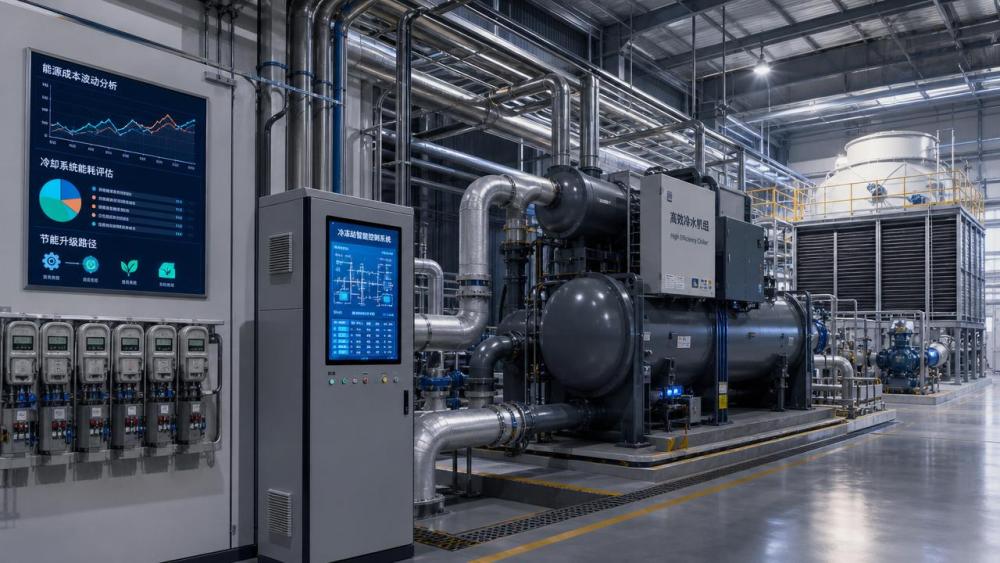
Cooling assets were once evaluated over 10–15 year horizons with relatively stable assumptions around power pricing and service intervals. Today, those assumptions move much faster. Volatile fuel markets, grid congestion, carbon pricing mechanisms, and regional electrification policies can alter cooling economics in 12–24 months rather than over an entire depreciation cycle.
In practical terms, a chiller plant operating at a coefficient of performance difference of only 0.4 to 0.8 from newer alternatives may create a major annual cost gap when run 4,000–8,000 hours per year. For large industrial sites, that gap can outweigh the perceived savings of delaying investment by another budget cycle.
The four cost drivers decision-makers should track
- Electricity tariff volatility across peak, shoulder, and off-peak periods
- Refrigerant transition pressure and quota-related replacement risk
- Maintenance frequency, especially for aging condensers, compressors, and controls
- Production sensitivity to temperature drift, downtime, or unstable process cooling
These drivers are interconnected. A facility facing both high peak demand charges and tighter refrigerant compliance timelines may need reassessment sooner than a site with stable utility rates and low process criticality. In sectors where ±1°C temperature control matters, cooling strategy has direct commercial consequences.
Why energy volatility affects more than utility bills
When global energy costs rise, the impact extends into compressed air support loads, heat rejection efficiency, water use, spare parts planning, and emissions reporting. In integrated industrial systems, cooling performance often affects adjacent assets such as air compressors, vacuum pumps, cleanroom units, and heat exchangers.
This is especially relevant for decision-makers evaluating plant expansion, line retrofits, or regional capacity shifts. A cooling system designed for yesterday’s utility structure can become a structural cost disadvantage in a highly competitive manufacturing environment.
Typical trigger thresholds for reassessment
Many enterprises begin a formal cooling review when one or more thresholds appear. Common triggers include a projected power price increase above 15%, annual maintenance growth above 8%–10%, process load changes above 20%, or refrigerant compliance exposure within the next 24–36 months.
The Signals That It Is Time to Reassess Cooling System Plans
A reassessment should be based on observable signals, not intuition alone. The strongest indicators usually come from operations, procurement, engineering, and finance at the same time. When those functions all see pressure, delaying review often increases risk rather than preserving capital.
Operational signs inside the plant
On-site signals often appear before finance teams quantify them. Repeated compressor cycling, unstable leaving water temperatures, increasing condenser fouling, or rising alarm frequency are early warnings. If maintenance teams intervene more than once per month on the same thermal bottleneck, the system may already be underperforming economically.
Another warning sign is part-load inefficiency. Many legacy systems were sized for peak production scenarios but now run 50%–70% loaded for most of the year. If controls cannot respond efficiently at partial load, the site may be paying a premium every operating hour.
Financial and strategic signs
From a board or plant leadership perspective, reassessment becomes urgent when cooling costs rise faster than output, or when capacity expansion depends on thermal stability. If energy spend per unit produced increases for 2–3 consecutive quarters without a clear production reason, cooling should move into the capital review agenda.
It also matters when cooling limits strategic flexibility. For example, a pharmaceutical or semiconductor facility may require tighter process tolerances, cleaner thermal loops, or redundancy standards such as N+1 resilience. In that case, the issue is not just cost but risk-adjusted continuity.
The table below outlines common signals and the planning response they usually require across industrial environments.
The key lesson is that timing matters. Waiting until all four signals become severe usually raises both capital urgency and implementation risk. Early reassessment provides more supplier choice, better shutdown planning, and stronger budget control.
How to Evaluate Cooling Options Under Different Energy Cost Scenarios
Not every rise in global energy costs requires a complete system replacement. In many cases, the best response is a structured comparison between optimization, retrofit, staged replacement, and full redesign. The right path depends on operating hours, process sensitivity, utility tariff design, and asset age.
A practical four-path decision model
- Optimize controls and sequencing if the core equipment is still efficient.
- Retrofit heat exchangers, variable speed drives, or monitoring if losses are localized.
- Replace high-energy components first when budget timing is constrained.
- Redesign the system when load profile and compliance requirements have materially changed.
This model helps enterprises avoid a binary choice between “do nothing” and “replace everything.” In energy-intensive facilities, even a 5%–12% efficiency gain from controls, pumping strategy, or heat rejection improvement can materially reduce exposure to global energy costs.
What buyers should compare before approving capital
Cooling procurement should be evaluated on total operating profile, not on purchase price alone. At minimum, buyers should compare efficiency at 100%, 75%, and 50% load, expected maintenance intervals, refrigerant pathway, digital monitoring capability, and integration with compressed air or heat recovery systems where relevant.
The following comparison framework is useful during cross-functional review meetings between operations, engineering, and finance teams.
For most industrial buyers, the table highlights one principle: the “best” option depends on context. A lower-capex retrofit may outperform a replacement in a stable plant, while a full redesign may be justified in facilities targeting 24/7 uptime, tighter thermal control, or lower carbon intensity.
Payback should be tested against multiple scenarios
Instead of one payback estimate, use three scenarios: conservative, expected, and high-volatility. Model energy prices across a 3-year to 5-year range, include maintenance changes, and account for downtime avoidance. This makes investment decisions more resilient when global energy costs remain uncertain.
Implementation Risks That Often Undermine Cooling Upgrades
Even when the business case is strong, execution can fail if planning is too narrow. Cooling projects often underperform not because the technology is wrong, but because commissioning, integration, or load assumptions were incomplete. For decision-makers, risk management is just as important as equipment selection.
Common mistakes in reassessment projects
- Using nameplate capacity instead of real hourly load data
- Ignoring seasonal variation over 12 months
- Focusing only on chiller efficiency and not auxiliary loads
- Underestimating refrigerant availability and compliance timing
- Failing to plan shutdown windows, operator training, or controls integration
These mistakes can delay benefits by 6–12 months or reduce projected savings significantly. In high-purity or high-precision sectors, they may also affect yield, product stability, or audit readiness.
A five-step implementation framework
A structured rollout improves both technical and financial outcomes. First, collect 12 months of operating data, including temperature stability, power draw, and maintenance history. Second, define process-critical thresholds such as allowable drift, redundancy level, and restart tolerance.
Third, compare at least three solution pathways on lifecycle cost rather than capex alone. Fourth, align procurement with shutdown windows, spare parts access, and commissioning support. Fifth, verify post-install performance with a 30-day, 90-day, and seasonal review plan.
Where intelligence platforms add value
For enterprise decision-makers, the challenge is often not lack of equipment options, but lack of integrated insight. Industrial intelligence platforms such as GTC-Matrix help teams connect energy cost movements, refrigerant policy shifts, thermal technology evolution, and sector-specific demand patterns into one decision framework.
This matters in industries where the cooling decision intersects with compressed air purity, vacuum process reliability, heat exchange performance, and carbon-reduction targets. Better information reduces the risk of investing too late, over-specifying equipment, or selecting a technology path that loses competitiveness within 2–3 years.
What Enterprise Leaders Should Do in the Next 90 Days
If your organization has not recently reviewed cooling economics, the next 90 days are enough to establish decision clarity. The goal is not to force a purchase, but to determine whether current assumptions still hold under changing global energy costs.
A focused executive checklist
- Map the top 3 cooling loads by annual operating hours and process criticality.
- Review electricity tariff exposure, especially peak demand periods and seasonal variation.
- Identify refrigerant, maintenance, or spare parts risks over the next 24 months.
- Test whether part-load performance matches current production reality.
- Request a lifecycle comparison of optimize, retrofit, phase, and redesign options.
- Set decision gates for budget, downtime tolerance, and compliance deadlines.
This type of review gives finance, operations, and engineering a shared language for action. It also creates a more disciplined basis for vendor engagement, plant upgrades, and long-term thermal strategy.
As global energy costs continue to influence every layer of industrial performance, cooling system planning must become a living decision process rather than a one-time capital event. The companies that reassess early are better positioned to control operating cost, protect uptime, and adapt to refrigerant and efficiency transitions with less disruption.
For decision-makers seeking sharper visibility into industrial cooling, compressed air, vacuum processes, and heat exchange technologies, GTC-Matrix provides intelligence that supports better timing, better procurement, and better thermal efficiency outcomes. Contact us to explore tailored insights, assess your current cooling strategy, and learn more solutions for resilient energy performance.
Ready when you are. Send us a message to get started.
Related News
- Kentucky Regulators Approve $191 Million Cooling Tower at Mitchell Coal PlantAuthor :Thermodynamics Analyst

- Cooling Tower Market Trends Reshaping Replacement Plans and Capital BudgetsAuthor :Thermodynamics Analyst

- Field-Erected Cooling Tower Market: Why Utility Projects Favor Custom DesignsAuthor :Thermodynamics Analyst

- Evaporative Cooling Tower Market Outlook: Demand Drivers, Risks, and Growth AreasAuthor :Thermodynamics Analyst

- When does an industrial cooling radiator outperform a cooling tower?Author :Thermodynamics Analyst

- EU Cooling Tower Standard EN 13771:2026 Takes EffectAuthor :Thermodynamics Analyst

- EU REACH SVHC Update Triggers Cooling Tower DisclosureAuthor :Thermodynamics Analyst

- SASO Adds Bio-Durability Test for Cooling Tower FillAuthor :Thermodynamics Analyst

- EU REACH Update Bars Phthalates in Cooling Tower PVC FillAuthor :Thermodynamics Analyst

- EU Tightens CE Rules for Cooling Tower Steel PartsAuthor :Thermodynamics Analyst

- Shanghai-Rotterdam Cooling Tower Space TightensAuthor :Thermodynamics Analyst

- Hamburg Port Strike Delays Cooling Tower Parts ClearanceAuthor :Thermodynamics Analyst

- ASHRAE 188-2026 Makes Cooling Tower Microbial Control MandatoryAuthor :Thermodynamics Analyst

- India Enforces BIS IS 17842:2026 for Cooling TowersAuthor :Thermodynamics Analyst

- EU REACH Restricts Zinc Inhibitors in Cooling TowersAuthor :Thermodynamics Analyst

- TUV Rheinland Switches Cooling Tower Labels to IEC 61800-9-2Author :Thermodynamics Analyst

- EU REACH Rule Takes Effect for Cooling Tower CoatingsAuthor :Thermodynamics Analyst

- Vietnam to Require IoT Modules in Imported Cooling TowersAuthor :Thermodynamics Analyst

- How to Compare Industrial Cooling Equipment Dry Coolers for Year-Round EfficiencyAuthor :Thermodynamics Analyst

- SASO Tightens Cooling Tower Import Rules for 2027Author :Thermodynamics Analyst

- REACH SVHC Update Limits Copper Corrosion InhibitorsAuthor :Thermodynamics Analyst

- SASO Starts Cooling Tower Data Rule for CoCAuthor :Thermodynamics Analyst

- Saudi SASO Portal Adds Corrosion Data RuleAuthor :Thermodynamics Analyst

- SASO Adds Corrosion Report Rule for Cooling TowersAuthor :Thermodynamics Analyst

- RDHx Prices Rise as AI Demand Lifts Premium ModelsAuthor :Thermodynamics Analyst

- EU EN 13859-2:2026 Mandates Extreme Humidity Heat-Loss TestsAuthor :Thermodynamics Analyst

- VDE Tightens Cooling Tower Test ScopeAuthor :Thermodynamics Analyst

- SASO Tightens Cooling Tower Test Proof for SaberAuthor :Thermodynamics Analyst

- Saudi SABER Cooling Tower Rule Takes Effect EarlyAuthor :Thermodynamics Analyst

- EU Carbon Labels to Cover Cooling Tower ExportsAuthor :Thermodynamics Analyst

- Saudi SABER Cooling Tower Rule Takes Effect EarlyAuthor :Thermodynamics Analyst

- EU Carbon Label Rule Hits Cooling Tower ExportsAuthor :Thermodynamics Analyst

- Saudi SABER Cooling Tower Rule Adds EN 13859-2 TestAuthor :Thermodynamics Analyst

- Saudi SABER Tightens Cooling Tower Energy Report RulesAuthor :Thermodynamics Analyst

- Saudi SASO Tightens Cooling Tower Efficiency FilingAuthor :Thermodynamics Analyst

- Saudi SABER Tightens Cooling Tower Energy Report ChecksAuthor :Thermodynamics Analyst