



Sustainable Manufacturing Trends Changing Plant Cooling Design




As sustainable manufacturing reshapes industrial priorities, plant cooling design is no longer a background utility. It now influences energy intensity, emissions, uptime, compliance, and long-term operating flexibility.
For industrial facilities, sustainable manufacturing means cooling systems must support production quality while reducing waste. Decisions around refrigerants, controls, heat recovery, and load matching now affect lifecycle value more than initial price alone.
Across mixed-use industrial environments, the shift is clear. Cooling plants are being redesigned as connected thermal assets within broader energy strategies, not isolated mechanical packages.
What does sustainable manufacturing change in plant cooling design?
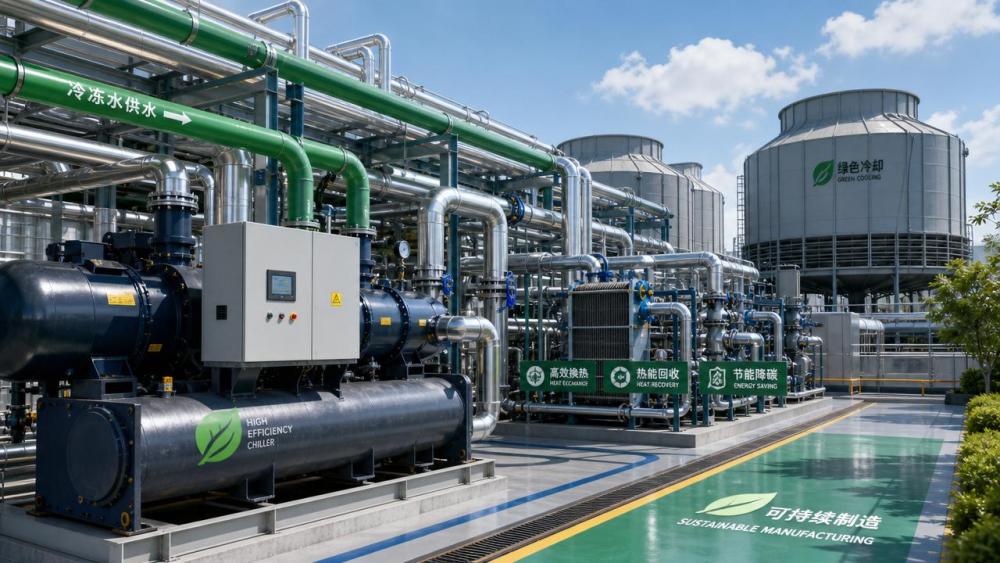
The biggest change is strategic intent. In sustainable manufacturing, cooling design must balance process stability, carbon reduction, water efficiency, and future regulatory readiness at the same time.
Older systems were often sized for peak conditions with generous safety margins. That approach can increase part-load inefficiency, cycling losses, and avoidable capital expense.
New designs prioritize dynamic performance. Engineers increasingly model seasonal loads, process fluctuations, ambient extremes, and maintenance scenarios before selecting chillers, pumps, and heat exchangers.
Sustainable manufacturing also expands the performance boundary. Plant cooling is judged not only by temperature delivery, but by total energy use, refrigerant impact, recoverable heat, and digital visibility.
This is especially relevant in facilities using compressed air, vacuum processes, thermal treatment, clean production, or sensitive packaging lines. Cooling affects every one of those systems.
- Lower total electricity consumption through optimized load profiles
- Reduced indirect emissions from improved plant efficiency
- Better resilience during ambient temperature swings
- Greater compliance with refrigerant and reporting rules
- Improved integration with heat recovery and energy management systems
Why are refrigerant choices becoming central to sustainable manufacturing?
Refrigerant selection now sits at the center of sustainable manufacturing because it affects direct emissions, compliance risk, service availability, safety planning, and long-term equipment viability.
Facilities can no longer choose only by cooling capacity or familiarity. Global warming potential, phase-down schedules, leakage risk, and component compatibility all shape the total decision.
Low-GWP refrigerants are gaining attention, but the best option depends on site conditions. Some applications favor natural refrigerants. Others require carefully managed synthetic alternatives.
The sustainable manufacturing lens asks a broader question: will the refrigerant support future operation without forcing expensive redesigns, retraining, or compliance disruption?
Key evaluation points
- GWP and expected regulatory pathway
- Energy efficiency across real operating temperatures
- Flammability or toxicity classification
- Service ecosystem and spare part continuity
- Compatibility with heat exchangers and controls
A refrigerant with lower environmental impact but poor efficiency at part load may not support sustainable manufacturing goals. The decision must combine environmental and operational data.
How do smart controls and load optimization improve cooling performance?
Smart controls are one of the fastest routes to sustainable manufacturing gains. They help cooling plants respond to real demand instead of fixed assumptions.
In many facilities, cooling loads fluctuate by shift pattern, product mix, process intensity, and weather. Fixed-speed equipment or static setpoints often waste energy during these variations.
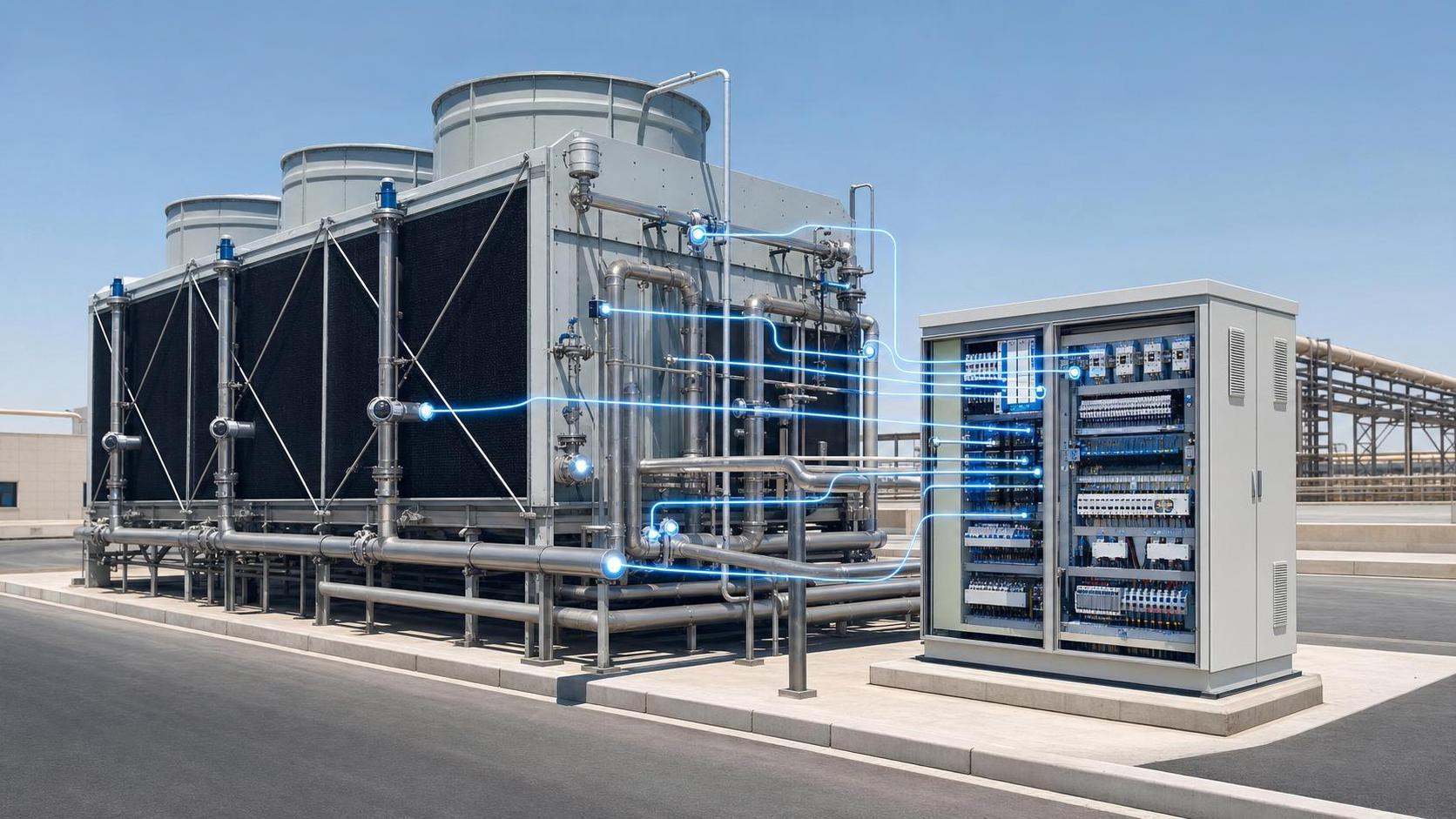
Modern control architecture can coordinate chillers, pumps, cooling towers, dry coolers, and thermal storage. It can also align cooling output with compressed air systems and process heat rejection.
That coordination matters because sustainable manufacturing depends on plant-level optimization. A locally efficient chiller can still be globally inefficient if the whole thermal system is poorly staged.
Common control improvements
- Variable-speed drives on compressors, pumps, and fans
- Adaptive setpoint reset using ambient and process feedback
- Sequencing logic for best efficiency at part load
- Leak, fouling, and performance drift detection
- Dashboards linking thermal KPIs with production data
When paired with reliable instrumentation, these measures reduce oversupply, shorten response time, and improve visibility. That makes sustainable manufacturing more measurable and more controllable.
Where does heat recovery fit into sustainable manufacturing cooling strategies?
Heat recovery changes plant cooling from a cost center into an energy exchange platform. In sustainable manufacturing, rejected heat should be treated as a resource whenever feasible.
Cooling systems often reject useful thermal energy from compressors, condensers, vacuum pumps, and process loops. That heat can support space heating, hot water, preheating, or adjacent processes.
The strongest opportunities appear in sites with simultaneous cooling and heating demand. There, integrated design can cut fuel use while improving overall energy productivity.
However, not every heat recovery project delivers value. Temperature grade, seasonal mismatch, distribution losses, and control complexity must be studied early.
For sustainable manufacturing, the best heat recovery design starts with thermal mapping. Knowing where heat appears, when it appears, and who can use it is essential.
What mistakes can weaken sustainable manufacturing results in plant cooling projects?
Several common mistakes limit performance even when equipment looks advanced. Sustainable manufacturing depends on system thinking, not isolated upgrades.
Frequent errors
- Oversizing equipment to avoid uncertainty
- Ignoring part-load efficiency curves
- Selecting refrigerants without a transition roadmap
- Adding controls without sensor validation
- Treating heat recovery as an afterthought
- Measuring only capital cost, not lifecycle cost
Water-side issues also matter. Poor water treatment, fouled heat exchangers, and unstable flow conditions can erase sustainable manufacturing gains very quickly.
Another risk is fragmented data. If cooling, compressed air, vacuum, and heat systems are monitored separately, hidden inefficiencies remain difficult to diagnose.
A stronger approach links thermal performance with production outcomes. That reveals whether cooling energy supports real process value or simply compensates for design weaknesses.
How should a facility evaluate cooling options under sustainable manufacturing goals?
Evaluation should begin with operating reality. Sustainable manufacturing decisions work best when based on measured loads, site constraints, and future expansion scenarios.
Instead of asking which chiller is best, ask which cooling architecture delivers the best lifecycle outcome. That may include modular plants, hybrid rejection, storage, or staged retrofits.
Practical decision checklist
This evaluation method aligns well with the intelligence focus of GTC-Matrix. Thermal systems perform best when engineering detail is connected with market, policy, and efficiency insight.
What does the next step look like for sustainable manufacturing and cooling design?
The next step is disciplined assessment. Sustainable manufacturing improves when facilities map thermal loads, review refrigerant exposure, quantify recoverable heat, and compare control maturity.
From there, priorities become clearer. Some sites benefit most from optimization and monitoring. Others need deeper redesign, modular replacement, or integrated heat recovery.
The most durable plant cooling strategies combine technical precision with strategic intelligence. That includes thermodynamic analysis, efficiency benchmarking, and awareness of evolving environmental policy.
Sustainable manufacturing is changing plant cooling design because efficiency alone is no longer enough. The winning systems deliver reliability, compliance, adaptability, and measurable carbon progress together.
A practical starting point is simple: audit the current cooling plant, identify its hidden losses, and build a phased roadmap that turns thermal infrastructure into a long-term competitive asset.
Related News
- Cooling Tower Market Trends Reshaping Replacement Plans and Capital BudgetsAuthor :Thermodynamics Analyst

- Field-Erected Cooling Tower Market: Why Utility Projects Favor Custom DesignsAuthor :Thermodynamics Analyst

- Evaporative Cooling Tower Market Outlook: Demand Drivers, Risks, and Growth AreasAuthor :Thermodynamics Analyst

- When does an industrial cooling radiator outperform a cooling tower?Author :Thermodynamics Analyst

- EU Cooling Tower Standard EN 13771:2026 Takes EffectAuthor :Thermodynamics Analyst

- EU REACH SVHC Update Triggers Cooling Tower DisclosureAuthor :Thermodynamics Analyst

- SASO Adds Bio-Durability Test for Cooling Tower FillAuthor :Thermodynamics Analyst

- EU REACH Update Bars Phthalates in Cooling Tower PVC FillAuthor :Thermodynamics Analyst

- EU Tightens CE Rules for Cooling Tower Steel PartsAuthor :Thermodynamics Analyst

- Shanghai-Rotterdam Cooling Tower Space TightensAuthor :Thermodynamics Analyst

- Hamburg Port Strike Delays Cooling Tower Parts ClearanceAuthor :Thermodynamics Analyst

- ASHRAE 188-2026 Makes Cooling Tower Microbial Control MandatoryAuthor :Thermodynamics Analyst

- India Enforces BIS IS 17842:2026 for Cooling TowersAuthor :Thermodynamics Analyst

- EU REACH Restricts Zinc Inhibitors in Cooling TowersAuthor :Thermodynamics Analyst

- TUV Rheinland Switches Cooling Tower Labels to IEC 61800-9-2Author :Thermodynamics Analyst

- EU REACH Rule Takes Effect for Cooling Tower CoatingsAuthor :Thermodynamics Analyst

- Vietnam to Require IoT Modules in Imported Cooling TowersAuthor :Thermodynamics Analyst

- How to Compare Industrial Cooling Equipment Dry Coolers for Year-Round EfficiencyAuthor :Thermodynamics Analyst

- SASO Tightens Cooling Tower Import Rules for 2027Author :Thermodynamics Analyst

- REACH SVHC Update Limits Copper Corrosion InhibitorsAuthor :Thermodynamics Analyst

- SASO Starts Cooling Tower Data Rule for CoCAuthor :Thermodynamics Analyst

- Saudi SASO Portal Adds Corrosion Data RuleAuthor :Thermodynamics Analyst

- SASO Adds Corrosion Report Rule for Cooling TowersAuthor :Thermodynamics Analyst

- RDHx Prices Rise as AI Demand Lifts Premium ModelsAuthor :Thermodynamics Analyst

- EU EN 13859-2:2026 Mandates Extreme Humidity Heat-Loss TestsAuthor :Thermodynamics Analyst

- VDE Tightens Cooling Tower Test ScopeAuthor :Thermodynamics Analyst

- SASO Tightens Cooling Tower Test Proof for SaberAuthor :Thermodynamics Analyst

- Saudi SABER Cooling Tower Rule Takes Effect EarlyAuthor :Thermodynamics Analyst

- EU Carbon Labels to Cover Cooling Tower ExportsAuthor :Thermodynamics Analyst

- Saudi SABER Cooling Tower Rule Takes Effect EarlyAuthor :Thermodynamics Analyst

- EU Carbon Label Rule Hits Cooling Tower ExportsAuthor :Thermodynamics Analyst

- Saudi SABER Cooling Tower Rule Adds EN 13859-2 TestAuthor :Thermodynamics Analyst

- Saudi SABER Tightens Cooling Tower Energy Report RulesAuthor :Thermodynamics Analyst

- Saudi SASO Tightens Cooling Tower Efficiency FilingAuthor :Thermodynamics Analyst

- Saudi SABER Tightens Cooling Tower Energy Report ChecksAuthor :Thermodynamics Analyst

- Thermal Management Problems That Cause Equipment DowntimeAuthor :Thermodynamics Analyst