Industrial Cooling Systems: Common Sizing Errors and How to Avoid Them




In industrial cooling systems, sizing mistakes often stay hidden until energy bills rise, equipment fails, or temperature control becomes unstable. For after-sales maintenance teams, recognizing these errors early is essential to protecting uptime and efficiency. This article explores the most common cooling system sizing problems, why they happen, and how to avoid them with practical, field-focused strategies.
Understanding sizing in industrial cooling systems
Sizing in industrial cooling systems is the process of matching cooling capacity, flow, heat rejection, control range, and auxiliary equipment to the actual thermal load of a plant, machine, or process. In simple terms, the system must remove the right amount of heat, at the right time, under the right operating conditions. If a chiller, cooling tower, pump, heat exchanger, or air handling element is too small, the process may run hot, alarms may multiply, and production quality may drift. If it is too large, the result is often just as harmful: short cycling, poor humidity or temperature stability, wasted power, and avoidable mechanical wear.
For after-sales maintenance personnel, this topic matters because they are often the first to see the real consequences of design assumptions meeting field reality. A system may have looked correct on paper, yet actual operating hours, seasonal weather, expansion plans, fouling, or process changes can reveal that the original sizing basis was incomplete. In many facilities, the maintenance team becomes the bridge between plant operators, service contractors, and equipment suppliers, making their ability to spot sizing issues a direct contributor to reliability and lifecycle cost control.
Why the industry pays close attention to cooling system sizing
Across manufacturing, food processing, electronics, pharmaceuticals, logistics, and utility support functions, industrial cooling systems sit at the center of thermal stability. As energy prices fluctuate and decarbonization goals become more aggressive, even moderate sizing errors can create a large penalty over time. Oversized compressors can run inefficiently at part load. Undersized heat exchangers can push condensing temperatures upward. Poor pump selection can disturb flow balance and increase pressure drop. Each mistake compounds the next.
This is why technical intelligence platforms such as GTC-Matrix emphasize the link between thermodynamic logic, energy conversion efficiency, and system-level performance. The modern service environment is not only about replacing failed parts. It is about understanding how cooling loads evolve, how control strategies interact with hardware, and how heat exchange performance shifts over time. For maintenance teams, sizing awareness supports faster fault isolation and stronger recommendations during retrofits, audits, and capacity upgrades.
A practical overview of common sizing error patterns
The most common sizing mistakes in industrial cooling systems usually come from one of four gaps: inaccurate load calculation, incomplete operating data, weak allowance planning, or poor integration among system components. These gaps can appear in both new installations and retrofit projects. They are especially common where design teams work from nameplate data instead of measured field conditions.
For after-sales service teams, the table above is useful because it links sizing decisions to observable symptoms. Many recurring service calls that appear to be mechanical problems are actually design balance problems in disguise.
The most common sizing errors and why they happen
1. Using peak nameplate load instead of real operating load
One of the most frequent mistakes in industrial cooling systems is sizing around the maximum listed load of production equipment without checking duty cycle, diversity, and simultaneous operation. A process line may have ten machines rated for high heat rejection, but only six may operate together under normal conditions. Designing around all ten can create chronic oversizing.
2. Ignoring part-load behavior
Industrial cooling systems rarely run at one fixed condition. Shift patterns, product mix, weather, maintenance windows, and startup periods all change the thermal load. If equipment is selected only for full-load performance and not for stable part-load operation, the system may cycle excessively or fail to control process temperature smoothly. Variable-speed drives, staging logic, and turndown range must be part of sizing, not separate afterthoughts.
3. Misjudging fluid flow and pressure drop
Correct cooling capacity depends on correct flow. Pumps are often selected with incomplete piping data or without accounting for filters, control valves, elevation changes, future branch connections, and fouling allowance. The result is a system that delivers acceptable flow near the pump but inadequate flow at distant or high-resistance users. Maintenance staff often see this as warm return lines, control valve hunting, or recurring cavitation complaints.
4. Overlooking ambient and seasonal extremes
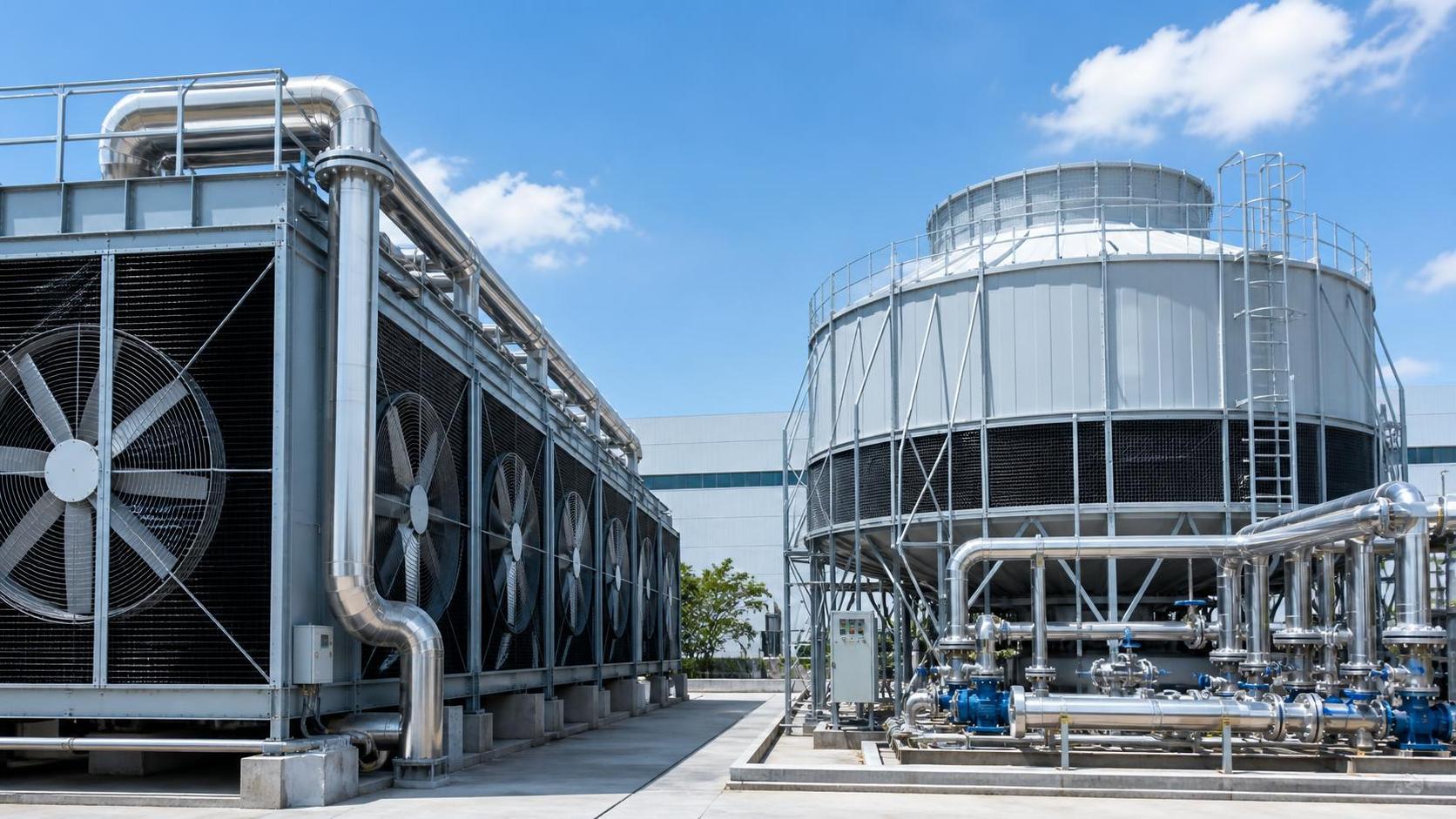
Cooling towers, dry coolers, condensers, and ventilation-supported cooling equipment are strongly influenced by outdoor temperature, humidity, and site contamination. A unit sized from annual average weather may perform poorly during the hottest weeks, which are often the exact periods of highest production demand. Dust, scale, airborne oil, or water quality issues further reduce heat rejection, making the original margin disappear faster than expected.
5. Adding safety factors without control
A modest design margin is reasonable. The problem starts when every contributor adds one: process engineer, mechanical contractor, equipment supplier, and end user. A 10 percent buffer added three or four times can become a major oversizing problem. This is common in industrial cooling systems that have evolved through multiple revisions or capacity expansion phases without a shared load model.
6. Failing to account for future process change in a structured way
Some facilities ignore future growth, while others overbuild for uncertain expansion. Both choices create risk. The better approach is modular planning: define today’s verified load, identify probable future scenarios, and build clear upgrade paths in piping, controls, and equipment staging. This avoids buying too much too early while preserving flexibility.
Where these sizing issues show up most often
Although industrial cooling systems vary by sector, certain application categories repeatedly show the same error patterns. After-sales maintenance teams can use these categories to guide inspections and service reviews.
The business value of getting industrial cooling systems right
Accurate sizing is not just a design detail. It improves process consistency, stabilizes maintenance planning, lowers energy consumption, and reduces avoidable emergency calls. In sectors requiring precise thermal control, such as food handling, packaging, electronics support, and industrial utility systems, small temperature instability can have large downstream consequences. Better-sized industrial cooling systems also support cleaner control data, making it easier to apply efficiency analytics and benchmark operating performance over time.
For organizations focused on carbon reduction and high-efficiency manufacturing, sizing accuracy supports wider operational goals. Properly matched cooling equipment reduces compressor lift, pump waste, and unnecessary standby losses. That means less strain on power infrastructure and fewer reactive maintenance events. This system view aligns well with the GTC-Matrix mission of linking thermal performance with energy intelligence and long-term industrial competitiveness.
Practical strategies to avoid sizing errors
After-sales maintenance teams are in a strong position to prevent repeated sizing mistakes because they can compare design intent with operating evidence. The following practices are especially effective in industrial cooling systems:
- Collect measured load data during different shifts, products, and seasons instead of relying only on original specifications.
- Review both full-load and part-load behavior, including cycling frequency, compressor staging, and minimum stable flow.
- Validate pump curves against real pressure drop, including strainers, valves, exchanger fouling, and future tie-ins.
- Separate true safety margin from repeated hidden buffers added by multiple stakeholders.
- Document ambient design basis clearly and compare it with the site’s hottest, dirtiest, or most demanding operating conditions.
- Favor modular expansion logic where future growth is uncertain, especially for chillers, pumps, and cooling towers.
Field warning signs that point to a sizing problem
Maintenance teams should suspect sizing issues when a system repeatedly shows the same symptoms after parts have been replaced or controls have been tuned. Typical warning signs include frequent high-pressure trips, chilled water temperature that never reaches setpoint during peak periods, wide temperature swings at low load, valves staying nearly fully open, persistent bypass flow, and pumps operating far from best efficiency point. Another strong signal is when energy use rises even though production volume stays flat.
These warning signs do not always mean the original industrial cooling systems design was wrong. They may also show that the process has changed, exchanger surfaces have degraded, water treatment is insufficient, or operating patterns have shifted. Still, treating them as possible sizing indicators helps teams move beyond symptom-based repair toward root-cause correction.
A maintenance-centered approach to better decisions
The most effective service organizations treat industrial cooling systems as dynamic assets rather than fixed installations. They maintain load histories, trend key temperatures and pressures, compare actual conditions with design assumptions, and involve field feedback in retrofit planning. This approach turns maintenance data into decision intelligence. It also strengthens communication with plant managers and equipment suppliers, because recommendations are backed by measured evidence instead of assumptions.
If your team supports facilities with recurring cooling instability, rising power cost, or unexplained equipment stress, start by reviewing sizing logic before ordering another replacement component. A structured load audit, flow verification, and seasonal performance check can reveal whether industrial cooling systems are truly matched to the process they serve. In a market shaped by efficiency pressure and thermal performance demands, avoiding sizing errors is one of the most practical ways to protect uptime, energy value, and long-term system reliability.
Related News
- When does an industrial cooling radiator outperform a cooling tower?Author :Thermodynamics Analyst

- EU Cooling Tower Standard EN 13771:2026 Takes EffectAuthor :Thermodynamics Analyst

- EU REACH SVHC Update Triggers Cooling Tower DisclosureAuthor :Thermodynamics Analyst

- SASO Adds Bio-Durability Test for Cooling Tower FillAuthor :Thermodynamics Analyst

- EU REACH Update Bars Phthalates in Cooling Tower PVC FillAuthor :Thermodynamics Analyst

- EU Tightens CE Rules for Cooling Tower Steel PartsAuthor :Thermodynamics Analyst

- Shanghai-Rotterdam Cooling Tower Space TightensAuthor :Thermodynamics Analyst

- Hamburg Port Strike Delays Cooling Tower Parts ClearanceAuthor :Thermodynamics Analyst

- ASHRAE 188-2026 Makes Cooling Tower Microbial Control MandatoryAuthor :Thermodynamics Analyst

- India Enforces BIS IS 17842:2026 for Cooling TowersAuthor :Thermodynamics Analyst

- EU REACH Restricts Zinc Inhibitors in Cooling TowersAuthor :Thermodynamics Analyst

- TUV Rheinland Switches Cooling Tower Labels to IEC 61800-9-2Author :Thermodynamics Analyst

- EU REACH Rule Takes Effect for Cooling Tower CoatingsAuthor :Thermodynamics Analyst

- Vietnam to Require IoT Modules in Imported Cooling TowersAuthor :Thermodynamics Analyst

- How to Compare Industrial Cooling Equipment Dry Coolers for Year-Round EfficiencyAuthor :Thermodynamics Analyst

- SASO Tightens Cooling Tower Import Rules for 2027Author :Thermodynamics Analyst

- REACH SVHC Update Limits Copper Corrosion InhibitorsAuthor :Thermodynamics Analyst

- SASO Starts Cooling Tower Data Rule for CoCAuthor :Thermodynamics Analyst

- Saudi SASO Portal Adds Corrosion Data RuleAuthor :Thermodynamics Analyst

- SASO Adds Corrosion Report Rule for Cooling TowersAuthor :Thermodynamics Analyst

- RDHx Prices Rise as AI Demand Lifts Premium ModelsAuthor :Thermodynamics Analyst

- EU EN 13859-2:2026 Mandates Extreme Humidity Heat-Loss TestsAuthor :Thermodynamics Analyst

- VDE Tightens Cooling Tower Test ScopeAuthor :Thermodynamics Analyst

- SASO Tightens Cooling Tower Test Proof for SaberAuthor :Thermodynamics Analyst

- Saudi SABER Cooling Tower Rule Takes Effect EarlyAuthor :Thermodynamics Analyst

- EU Carbon Labels to Cover Cooling Tower ExportsAuthor :Thermodynamics Analyst

- Saudi SABER Cooling Tower Rule Takes Effect EarlyAuthor :Thermodynamics Analyst

- EU Carbon Label Rule Hits Cooling Tower ExportsAuthor :Thermodynamics Analyst

- Saudi SABER Cooling Tower Rule Adds EN 13859-2 TestAuthor :Thermodynamics Analyst

- Saudi SABER Tightens Cooling Tower Energy Report RulesAuthor :Thermodynamics Analyst

- Saudi SASO Tightens Cooling Tower Efficiency FilingAuthor :Thermodynamics Analyst

- Saudi SABER Tightens Cooling Tower Energy Report ChecksAuthor :Thermodynamics Analyst

- Thermal Management Problems That Cause Equipment DowntimeAuthor :Thermodynamics Analyst

- Saudi Rule Requires Local Certification for Imported Cooling TowersAuthor :Thermodynamics Analyst

- EU Law Tightens Cooling Imports for Data CentersAuthor :Thermodynamics Analyst

- India Extends FRP Duty Relief for Cooling TowersAuthor :Thermodynamics Analyst