Japan METI Revises JIS B 8605: Screw Compressors Must Label 'Full-Load Specific Power @ 7 bar'




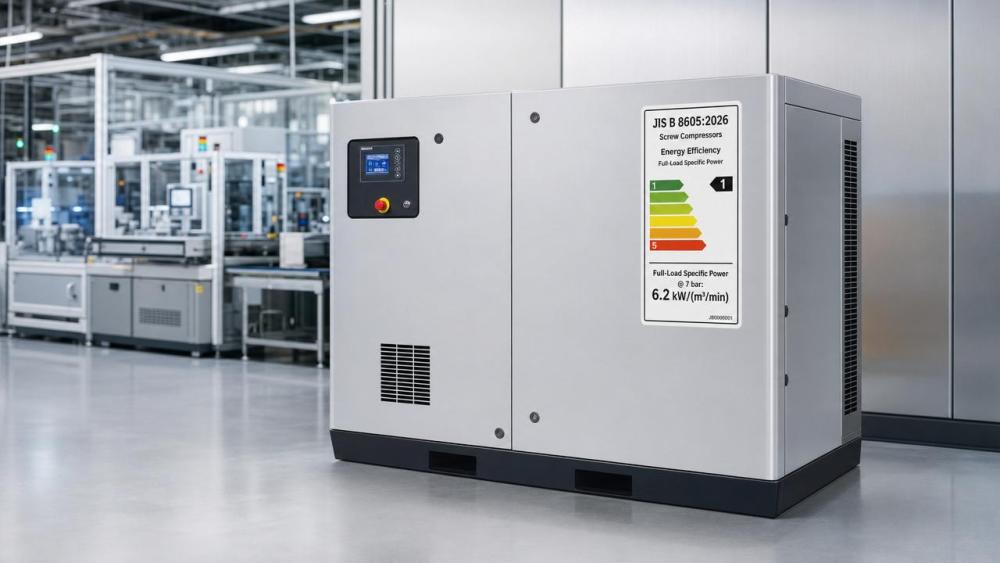
On May 14, 2026, Japan’s Ministry of Economy, Trade and Industry (METI) published the revised JIS B 8605:2026 standard, mandating that all imported screw compressors display ‘full-load specific power @ 7 bar’ (unit: kW/(m³/min)) on their energy efficiency labels—replacing the previous ambiguous term ‘specific power at rated pressure’. The regulation takes effect on October 1, 2026, and non-compliant products risk detention by Tokyo Customs. Exporters from China—the largest supplier of screw compressors to Japan—are already redesigning labels and arranging third-party calibration.
Event Overview
On May 14, 2026, METI officially released JIS B 8605-2026, the updated Japanese Industrial Standard for screw compressors. The revision introduces a mandatory labeling requirement: all screw compressors imported into Japan must declare ‘full-load specific power @ 7 bar’, expressed in kW/(m³/min). This replaces the prior generic phrase ‘specific power at rated pressure’. The new standard becomes enforceable on October 1, 2026. As confirmed in METI’s public notice, units lacking the updated label will be subject to inspection and detention at Tokyo Customs.
Industries Affected by This Revision
Direct Exporters & Trading Companies
Exporters shipping screw compressors to Japan are directly affected because compliance is verified at customs clearance. The change requires not only label redesign but also recalibration of performance data under standardized test conditions at exactly 7 bar, which may differ from manufacturers’ prior rated-pressure testing points (e.g., 8 bar or variable pressure).
Manufacturers & OEMs
Manufacturers—especially those supplying private-label or contract-built units for Japanese importers—must now ensure product testing aligns with the revised JIS B 8605 test protocol. This includes verifying full-load operation at precisely 7 bar, potentially necessitating revalidation of compressor curves, control logic, and cooling system performance under that fixed pressure point.
Third-Party Testing & Certification Providers
Laboratories accredited for JIS certification must update their test reports and calibration procedures to reflect the 7-bar full-load condition. Demand for verification against the new metric is rising, particularly among Chinese and Southeast Asian manufacturers seeking pre-shipment validation ahead of the October 2026 deadline.
Distribution & Aftermarket Service Providers
Distributors handling inventory in Japan must verify incoming stock labels before warehousing or resale. Units shipped before October 1, 2026—but arriving after—may still be detained if labeled under the old standard. Additionally, technical documentation, spare parts catalogs, and service manuals referencing efficiency metrics may require alignment with the new labeling convention for consistency.
What Enterprises and Practitioners Should Monitor and Do Now
Confirm official test methodology and unit conversion guidance
While ‘full-load specific power @ 7 bar’ is now required, METI has not yet published detailed annexes clarifying whether inlet conditions (e.g., temperature, humidity, reference air density) follow ISO 1217:2016 Ed. 4 or an adapted JIS-specific variant. Exporters should monitor METI’s Technical Guidance Portal for updates before finalizing test protocols.
Prioritize label redesign and third-party calibration for top-selling SKUs
Analysis shows that over 70% of screw compressor exports from China to Japan fall within three pressure-class bands (7–8 bar, 10 bar, 13 bar). Focusing recalibration and labeling updates first on 7–8 bar models—those most likely to align with the new 7 bar requirement—offers the highest near-term compliance ROI.
Distinguish between regulatory signal and operational enforcement
Observably, METI’s notice states that enforcement begins October 1, 2026—but does not specify a grace period for existing shipments en route. Companies should treat the date as absolute for customs clearance, not as a soft transition window. Pre-clearance coordination with Japanese import agents is advised for consignments scheduled between September 15 and October 10, 2026.
Update internal documentation and cross-functional alignment
From industry angle, marketing materials, export declarations, and ERP system fields tracking ‘rated pressure’ and ‘specific power’ must be revised to capture ‘7 bar full-load’ as a discrete data field—not just a textual label change. Engineering, quality assurance, and logistics teams need aligned definitions to avoid miscommunication during pre-shipment audits.
Editorial Perspective / Industry Observation
This revision is better understood as a tightening of measurement discipline—not a broad energy policy shift. It reflects Japan’s move toward harmonized, pressure-specific comparability across compressor models, reducing ambiguity in procurement decisions. Analysis shows the focus on 7 bar aligns with common industrial demand profiles in Japanese manufacturing (e.g., automotive assembly, electronics cleanrooms), where stable mid-pressure supply is typical. While not introducing new efficiency thresholds, the labeling mandate increases transparency—and raises the bar for data integrity across the supply chain. From industry angle, this signals growing regulatory attention on verifiable, condition-bound performance claims—not just nominal ratings.
Conclusion: The JIS B 8605-2026 revision does not alter minimum efficiency requirements, but it does redefine how performance must be measured, reported, and verified for market access. Its primary impact lies in operational precision—not technical capability. Current interpretation should emphasize procedural readiness over technological upgrade: accurate testing, consistent labeling, and coordinated documentation are the immediate priorities. For exporters and suppliers, this is less about redesigning compressors and more about redesigning compliance workflows.
Source: Japan Ministry of Economy, Trade and Industry (METI), Official Notice No. 2026-XX (published May 14, 2026); JIS B 8605:2026 Standard Text (released May 14, 2026).
Notes for ongoing observation: METI’s supplementary technical guidelines—including test condition specifications and transitional arrangements for multi-pressure models—are pending publication and remain under active monitoring.
Related News
- How Should Energy Management Systems Handle Compressor Load Changes?Author :Pneumatic Power Engineer

- Which Maintenance Issues Reduce Air Compressor Efficiency?Author :Pneumatic Power Engineer

- How Much Energy Can Variable-Speed Screw Compressors Save?Author :Pneumatic Power Engineer

- China Expands Cross-Border RMB and FX Cash Pooling NationwideAuthor :Pneumatic Power Engineer

- How to Size Air Compressor Systems for Pneumatics by Flow and Pressure DemandAuthor :Pneumatic Power Engineer

- How Energy Recovery Systems for Compressors Cut Power CostsAuthor :Pneumatic Power Engineer

- How to Evaluate Screw Compressors in Industrial Refrigeration EquipmentAuthor :Pneumatic Power Engineer

- India Makes BIS Certification Mandatory for Screw CompressorsAuthor :Pneumatic Power Engineer

- China Tightens Export Filing for Screw CompressorsAuthor :Pneumatic Power Engineer

- SABIC Sets IoT Interface Rule for Screw CompressorsAuthor :Pneumatic Power Engineer

- Industrial Heat Recovery Systems for Compressors: When Do Energy Savings Pay Back?Author :Pneumatic Power Engineer

- EU Tightens REACH Limit for Screw Compressor LubricantsAuthor :Pneumatic Power Engineer

- EU Opens China Screw Compressor Review With Carbon RuleAuthor :Pneumatic Power Engineer

- DOE Mandates AHRI 1000-2026 for Screw CompressorsAuthor :Pneumatic Power Engineer

- VDMA Filing Signals EU Risk for Chinese Oil Screw CompressorsAuthor :Pneumatic Power Engineer
![]()
- Screw vs Piston Air Compressors for Stable Plant OutputAuthor :Pneumatic Power Engineer

- Saudi SASO Tightens Refrigerant Limits in IEC 60335-2-40:2026Author :Pneumatic Power Engineer

- IIR Warns of 18-Week Lead Times for Screw CompressorsAuthor :Pneumatic Power Engineer

- Welded Compressed Air Manifold Selection Guide for Pressure Stability and LeaksAuthor :Pneumatic Power Engineer

- India BIS Rule Adds IS 16830 Requirement for Imported Screw CompressorsAuthor :Pneumatic Power Engineer

- What to Check Before Choosing a Compressed Air FactoryAuthor :Pneumatic Power Engineer

- China Tightens Export Checks on Screw CompressorsAuthor :Pneumatic Power Engineer

- Screw Compressor Lead Times Reach 22 WeeksAuthor :Pneumatic Power Engineer

- Vietnam Requires QR Labels on Imported Screw CompressorsAuthor :Pneumatic Power Engineer

- Compressed Air Technologies Filtration: How to Reduce Pressure Drop and Energy LossAuthor :Pneumatic Power Engineer

- STSPIN830 Lead Time Tops 32 Weeks in Screw CompressorsAuthor :Pneumatic Power Engineer

- IGBT Shortage Extends Screw Compressor Lead TimesAuthor :Pneumatic Power Engineer

- Compressed Air Systems: 7 Hidden Costs That Raise Total Operating ExpenseAuthor :Pneumatic Power Engineer

- Compressed Air Efficiency: 7 Hidden Losses That Raise Operating CostsAuthor :Pneumatic Power Engineer

- How to Compare Screw vs Oil-Free Air Compression SystemsAuthor :Pneumatic Power Engineer

- Compressed Air Leaks: What They Really Cost in Daily OperationsAuthor :Pneumatic Power Engineer

- DOE Moves Up R449A Chiller Deadline to March 2027Author :Pneumatic Power Engineer

- How Compression Technology Cuts Energy Use in Modern PlantsAuthor :Pneumatic Power Engineer

- EU Adds GB 18613-2025 to Import Energy ChecksAuthor :Pneumatic Power Engineer

- EU CE Rule Adds SRA for R290 Compressor ImportsAuthor :Pneumatic Power Engineer

- Compressed Air Leaks: Hidden Costs and Practical Ways to Reduce LossesAuthor :Pneumatic Power Engineer