



Japan METI Revises JIS B 8605: Screw Compressors Must Label Full-Load Specific Power @7 bar




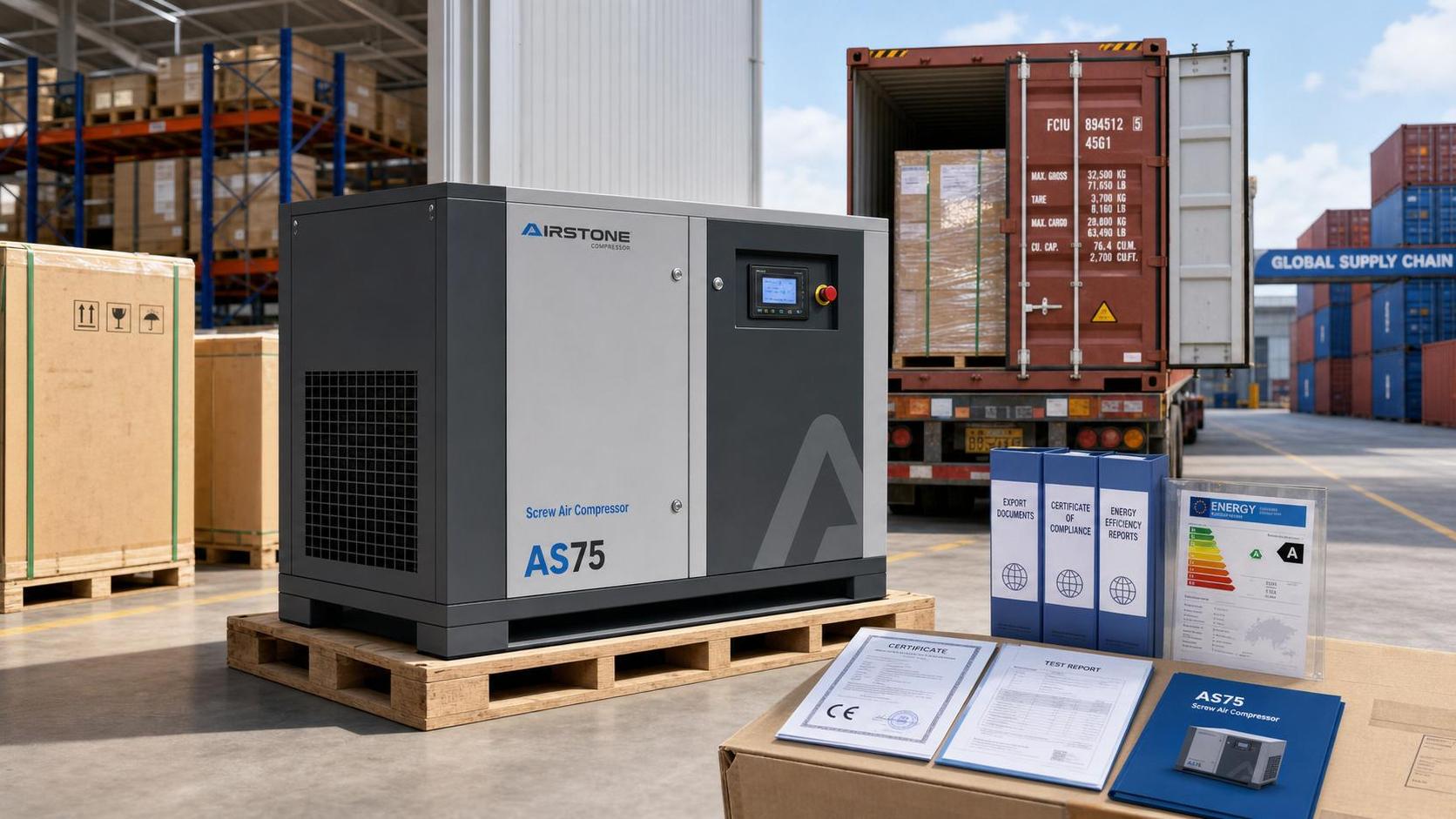
On May 13, 2026, Japan’s Ministry of Economy, Trade and Industry (METI) published the revised JIS B 8605:2026 standard, mandating that all screw compressors imported into Japan must display ‘Full-Load Specific Power @7 bar’ (unit: kW/(m³/min)) on their energy efficiency labels starting October 1, 2026. This change replaces the previous ambiguous term ‘specific power at rated discharge pressure’. Exporters—particularly manufacturers and traders of industrial air compression equipment—must update test reports and nameplate data accordingly, or risk customs rejection at Tokyo ports.
Event Overview
On May 13, 2026, METI officially released JIS B 8605-2026, the updated Japanese Industrial Standard for screw compressors. The revision introduces a mandatory labeling requirement: from October 1, 2026 onward, all screw compressors placed on the Japanese market must state ‘Full-Load Specific Power @7 bar’ on their energy efficiency labels. The unit is specified as kW/(m³/min). This replaces the prior formulation ‘specific power at rated discharge pressure’, which lacked a standardized pressure reference point. The change is codified in the official JIS publication and applies to all imports subject to JIS conformity assessment.
Industries Affected by This Revision
Direct Exporters & Trading Companies
Exporters shipping screw compressors to Japan will face immediate compliance obligations. Since the label is part of the product’s conformity documentation, failure to reflect the new metric may result in shipment rejection by Tokyo Customs. Affected companies must verify label content, test report alignment, and supporting documentation before each export batch.
Manufacturers of Screw Compressors (Including OEM/ODM Suppliers)
Manufacturers—especially those supplying to Japanese distributors or end-users—must revise internal testing protocols and certification documentation. The new metric requires full-load testing specifically at 7 bar(g), not at variable or nominal pressures. This affects factory test procedures, calibration of instrumentation, and reporting templates used for JIS certification.
Supply Chain Service Providers (e.g., Certification Agencies, Lab Testing Services)
Testing laboratories and certification bodies supporting JIS compliance must update their test methods, reporting formats, and audit checklists to include verification of the 7 bar full-load condition. Clients relying on these services will need to confirm whether existing test certificates remain valid post-revision—or require retesting.
Key Points for Enterprises and Practitioners to Monitor and Act Upon
Confirm alignment between test reports and label specifications
Verify that current test reports explicitly record full-load performance at exactly 7 bar(g), with ambient conditions per JIS B 8605-2026 Annex A. Do not assume prior ‘rated pressure’ tests satisfy the new requirement—even if the rated pressure was 7 bar, the test protocol and reporting format must match the revised standard.
Update nameplate and user manual documentation ahead of October 2026
Revise physical nameplates, digital product listings, and technical documentation to feature ‘Full-Load Specific Power @7 bar’ as the sole specific power value. Avoid dual labeling or footnotes referencing older metrics; METI’s enforcement guidance indicates strict adherence to the single defined term.
Engage with Japanese import partners to clarify documentation expectations
Contact Japanese importers or local representatives to confirm whether additional declarations—such as signed compliance statements or third-party verification letters—are expected beyond standard JIS conformity documents. Some distributors may impose internal checks ahead of METI’s enforcement date.
Monitor for potential transitional provisions or interpretation notices
Although the effective date is fixed at October 1, 2026, METI or the Japanese Standards Association (JSA) may issue clarifications on borderline cases (e.g., units already in transit, or models certified under the 2015 version). Subscribe to official JSA and METI notifications for updates.
Editorial Perspective / Industry Observation
Observably, this revision signals Japan’s tightening of technical barriers for energy-efficient industrial equipment—not merely a terminology update but a calibrated shift toward system-level energy accountability. Analysis shows the choice of 7 bar reflects the most common operating pressure across Japanese manufacturing facilities using compressed air for pneumatic tools, conveyors, and process control. From an industry perspective, it better aligns compressor efficiency evaluation with real-world system integration, where pressure drop and regulation losses are significant. Current more appropriate interpretation is that this is both a compliance milestone and a forward-looking signal: similar pressure-specific metrics may emerge in other markets seeking harmonized air-system efficiency benchmarks. Continued monitoring is warranted—not only for enforcement consistency, but also for how it influences IEC or ISO working group discussions on global compressor testing standards.
This revision underscores a broader trend: regulatory precision is increasingly replacing functional flexibility in industrial equipment energy labeling. For exporters, it is less about adapting to a new ‘efficiency threshold’ and more about standardizing measurement context—making comparability across products technically robust and legally enforceable. At present, the measure is best understood not as a sudden barrier, but as a formalization of an emerging global expectation: that energy performance claims must be anchored to repeatable, application-relevant operating conditions.
Information Source: Official JIS B 8605-2026 publication by the Japanese Standards Association (JSA), announced by METI on May 13, 2026. Ongoing implementation details—including customs inspection protocols and transitional arrangements—are pending further notice from METI or JSA and remain under observation.
Related News
- How Should Energy Management Systems Handle Compressor Load Changes?Author :Pneumatic Power Engineer

- Which Maintenance Issues Reduce Air Compressor Efficiency?Author :Pneumatic Power Engineer

- How Much Energy Can Variable-Speed Screw Compressors Save?Author :Pneumatic Power Engineer

- China Expands Cross-Border RMB and FX Cash Pooling NationwideAuthor :Pneumatic Power Engineer

- How to Size Air Compressor Systems for Pneumatics by Flow and Pressure DemandAuthor :Pneumatic Power Engineer

- How Energy Recovery Systems for Compressors Cut Power CostsAuthor :Pneumatic Power Engineer

- How to Evaluate Screw Compressors in Industrial Refrigeration EquipmentAuthor :Pneumatic Power Engineer

- India Makes BIS Certification Mandatory for Screw CompressorsAuthor :Pneumatic Power Engineer

- China Tightens Export Filing for Screw CompressorsAuthor :Pneumatic Power Engineer

- SABIC Sets IoT Interface Rule for Screw CompressorsAuthor :Pneumatic Power Engineer

- Industrial Heat Recovery Systems for Compressors: When Do Energy Savings Pay Back?Author :Pneumatic Power Engineer

- EU Tightens REACH Limit for Screw Compressor LubricantsAuthor :Pneumatic Power Engineer

- EU Opens China Screw Compressor Review With Carbon RuleAuthor :Pneumatic Power Engineer

- DOE Mandates AHRI 1000-2026 for Screw CompressorsAuthor :Pneumatic Power Engineer

- VDMA Filing Signals EU Risk for Chinese Oil Screw CompressorsAuthor :Pneumatic Power Engineer
![]()
- Screw vs Piston Air Compressors for Stable Plant OutputAuthor :Pneumatic Power Engineer

- Saudi SASO Tightens Refrigerant Limits in IEC 60335-2-40:2026Author :Pneumatic Power Engineer

- IIR Warns of 18-Week Lead Times for Screw CompressorsAuthor :Pneumatic Power Engineer

- Welded Compressed Air Manifold Selection Guide for Pressure Stability and LeaksAuthor :Pneumatic Power Engineer

- India BIS Rule Adds IS 16830 Requirement for Imported Screw CompressorsAuthor :Pneumatic Power Engineer

- What to Check Before Choosing a Compressed Air FactoryAuthor :Pneumatic Power Engineer

- China Tightens Export Checks on Screw CompressorsAuthor :Pneumatic Power Engineer

- Screw Compressor Lead Times Reach 22 WeeksAuthor :Pneumatic Power Engineer

- Vietnam Requires QR Labels on Imported Screw CompressorsAuthor :Pneumatic Power Engineer

- Compressed Air Technologies Filtration: How to Reduce Pressure Drop and Energy LossAuthor :Pneumatic Power Engineer

- STSPIN830 Lead Time Tops 32 Weeks in Screw CompressorsAuthor :Pneumatic Power Engineer

- IGBT Shortage Extends Screw Compressor Lead TimesAuthor :Pneumatic Power Engineer

- Compressed Air Systems: 7 Hidden Costs That Raise Total Operating ExpenseAuthor :Pneumatic Power Engineer

- Compressed Air Efficiency: 7 Hidden Losses That Raise Operating CostsAuthor :Pneumatic Power Engineer

- How to Compare Screw vs Oil-Free Air Compression SystemsAuthor :Pneumatic Power Engineer

- Compressed Air Leaks: What They Really Cost in Daily OperationsAuthor :Pneumatic Power Engineer

- DOE Moves Up R449A Chiller Deadline to March 2027Author :Pneumatic Power Engineer

- How Compression Technology Cuts Energy Use in Modern PlantsAuthor :Pneumatic Power Engineer

- EU Adds GB 18613-2025 to Import Energy ChecksAuthor :Pneumatic Power Engineer

- EU CE Rule Adds SRA for R290 Compressor ImportsAuthor :Pneumatic Power Engineer

- Compressed Air Leaks: Hidden Costs and Practical Ways to Reduce LossesAuthor :Pneumatic Power Engineer