



Industrial Refrigeration Upgrades That Reduce Downtime and Product Loss




For quality control and safety teams, industrial refrigeration failures can trigger downtime, compliance risks, and costly product loss within hours. Strategic industrial refrigeration upgrades help stabilize temperature control, improve system reliability, and protect sensitive goods across demanding production environments. This article explores practical upgrade paths that reduce operational disruptions while supporting safer, more efficient manufacturing performance.
Why a checklist approach works better for industrial refrigeration decisions
When a plant reviews industrial refrigeration performance, broad discussions about efficiency are not enough. Quality control teams need measurable temperature stability, while safety managers need confidence that alarms, backup response, and refrigerant risk controls will perform under stress. A checklist-based review helps both groups focus on what matters first: where downtime starts, how product loss happens, and which upgrades create the fastest reduction in operational risk.
This matters across food processing, cold storage, chemicals, pharmaceuticals, plastics, electronics, and other temperature-sensitive operations. In each setting, the most effective industrial refrigeration upgrade is rarely the most visible one. In many facilities, better controls, leak detection, redundancy planning, or evaporator improvements can deliver more value than a simple like-for-like equipment replacement.
First review: the key warning signs that justify an upgrade
Before comparing vendors or technologies, confirm whether the current system is already showing failure patterns. If several of the following conditions are present, industrial refrigeration upgrades should move from a maintenance discussion to a business continuity priority.
- Frequent temperature deviations during shift changes, sanitation cycles, loading periods, or peak ambient conditions.
- Product holds, quality investigations, or scrap events linked to delayed pull-down or uneven cooling.
- Recurring compressor trips, high discharge temperatures, oil carryover, frost buildup, or unstable suction pressure.
- Rising energy consumption without corresponding production growth.
- Obsolete controls, poor alarm visibility, or manual logging that delays corrective action.
- Unsafe refrigerant handling conditions, weak ventilation design, or limited emergency response planning.
- Long lead times for replacement parts or dependence on a single critical machine with no backup path.
For QC and safety personnel, these indicators are especially important because they signal not only maintenance inefficiency, but also exposure to traceability failures, customer complaints, and compliance gaps.
Core industrial refrigeration upgrade checklist for reducing downtime
Use the following checklist to evaluate upgrade priorities. The strongest industrial refrigeration strategies usually improve several of these areas together rather than optimizing only one component.
1. Controls and monitoring should be reviewed first
Modern controls often provide the fastest reliability gain. Confirm whether the system can trend suction and discharge pressure, evaporator temperature, compressor loading, defrost timing, and alarm history. If operators still rely on local panels and delayed manual reports, the facility may be reacting to failures after product is already at risk.
Priority checks include remote alarm escalation, data logging for audits, automatic setpoint adjustment, and integration with plant supervisory systems. For quality teams, this improves root-cause visibility. For safety teams, it shortens response time when a dangerous condition develops.
2. Compressor reliability and capacity flexibility must be validated
Many industrial refrigeration failures start with compressors that are oversized, poorly staged, heavily worn, or forced to run outside ideal load conditions. Variable-speed drives, improved sequencing logic, oil management upgrades, and condition monitoring can significantly cut nuisance trips and inefficient cycling.
Ask whether the current compressor package can handle seasonal swings, sanitation recovery loads, and partial-load operation without causing unstable control. If not, downtime risk remains high even if the machine is still technically operational.
3. Heat exchanger performance should not be treated as a secondary issue
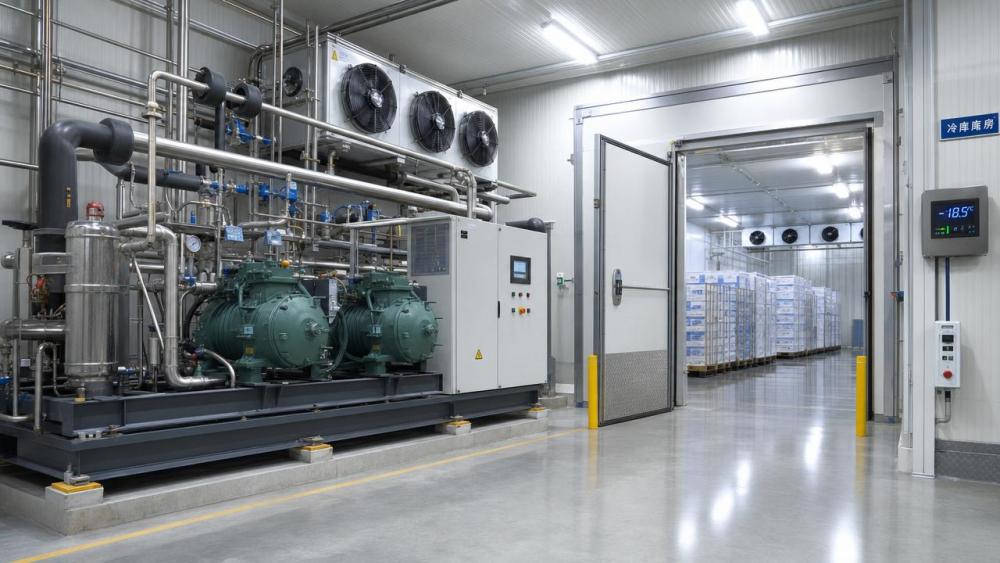
Condensers and evaporators directly affect pull-down speed, energy use, and temperature uniformity. Fouling, airflow imbalance, corrosion, scale, and outdated coil design all reduce system resilience. Upgrades such as high-efficiency evaporators, microchannel solutions in suitable applications, or improved condenser fan control can protect both uptime and product consistency.
QC teams should pay special attention to hot spots, slow recovery after door openings, and repeated deviations at specific storage locations. These are often heat transfer issues rather than simple sensor problems.
4. Defrost strategy and airflow management deserve closer scrutiny
In many plants, industrial refrigeration reliability is undermined by excessive frost, poor air distribution, or defrost schedules that disrupt production. Confirm whether defrost is time-based when it should be demand-based, whether fans are properly controlled during sensitive operations, and whether airflow is blocked by storage layout changes.
An upgrade in this area can reduce energy waste and temperature excursions without requiring a full system replacement.
5. Refrigerant safety and leak response need formal verification
For safety managers, this is a non-negotiable review area. Check gas detection coverage, emergency ventilation performance, isolation capability, relief path design, and operator response procedures. Industrial refrigeration upgrades should also consider future refrigerant availability, environmental compliance, and the implications of low-GWP transitions where applicable.
A system that runs efficiently but lacks clear leak detection and escalation protocols still exposes the site to severe operational and personnel risk.
Decision table: which upgrades often solve which problems
The table below helps narrow industrial refrigeration priorities based on common plant symptoms.
Different operating scenarios require different upgrade priorities
Not every site should evaluate industrial refrigeration in the same way. QC and safety teams should align the checklist with actual product sensitivity and operating risk.
Food and beverage plants
Prioritize rapid recovery after washdown, strict temperature logging, hygienic coil condition, and dependable door-open event response. Small deviations can quickly turn into spoilage, shelf-life reduction, or failed audits.
Pharmaceutical and life science environments
Focus on validated monitoring, alarm traceability, redundant capacity, and documented change control. In these operations, industrial refrigeration upgrades must support both product integrity and regulatory defensibility.
Chemical and process manufacturing
Look closely at continuous duty reliability, hazardous area requirements, refrigerant safety barriers, and the impact of cooling instability on reaction control or downstream equipment.
Cold storage and logistics
Emphasize airflow mapping, door traffic impact, staging capacity during loading peaks, and remote system visibility across multiple zones. Here, industrial refrigeration improvements often depend as much on control strategy as on hardware.
Commonly missed issues that increase downtime and product loss
Some of the most expensive failures come from items that are not reviewed during standard capital planning. These deserve explicit attention.
- Sensor drift that creates false confidence in displayed temperature.
- Control deadbands that are too wide for sensitive products.
- Drainage and frost issues that affect sanitation or slip hazards.
- Single points of failure in power supply, controls, or communication networks.
- Maintenance access limitations that delay cleaning, inspection, or emergency repair.
- Poor coordination between refrigeration teams, production, QC, and EHS during alarm events.
These factors may appear minor individually, but together they often explain why industrial refrigeration systems underperform even after expensive equipment upgrades.
Practical execution steps for a low-risk upgrade program
To reduce disruption during implementation, follow a staged process rather than replacing everything at once.
- Step 1: Gather 12 months of alarm logs, downtime records, product hold events, maintenance history, and utility data.
- Step 2: Rank risks by product impact, personnel safety exposure, recovery time, and cost of failure.
- Step 3: Separate quick wins such as controls, sensors, leak detection, and airflow corrections from major capital items.
- Step 4: Validate expected performance with site-specific operating conditions, not generic vendor assumptions.
- Step 5: Plan commissioning around production windows, sanitation schedules, and contingency storage options.
- Step 6: Update SOPs, alarm response instructions, and training materials before startup.
This stepwise method helps industrial refrigeration upgrades deliver measurable uptime gains without creating a new wave of startup-related risk.
What QC and safety teams should ask before approving a project
A strong proposal should answer operational questions clearly. Before moving forward, ask:
- Which failure modes will this industrial refrigeration upgrade eliminate, reduce, or only monitor?
- How will temperature stability be proven under worst-case production conditions?
- What backup measures protect product during commissioning or unexpected shutdown?
- How are leak detection, ventilation, alarms, and emergency shutdowns being improved?
- What KPIs will confirm success after installation: deviation rate, downtime hours, spoilage cost, or energy per unit output?
Final guidance for moving from review to action
The most valuable industrial refrigeration upgrades are the ones that directly reduce instability, protect product quality, and improve response to abnormal events. For quality control and safety leaders, the goal is not simply newer equipment. It is a system that can maintain specification, recover quickly, signal risk early, and support compliance with less manual intervention.
If your organization is preparing the next step, prioritize a structured discussion around current failure data, target temperatures, product sensitivity, refrigerant strategy, alarm philosophy, redundancy needs, budget boundaries, installation timing, and expected payback. With those inputs clarified early, industrial refrigeration planning becomes faster, safer, and far more likely to reduce downtime and product loss in real operating conditions.
Related News
- How to Compare Semiconductor Cooling Solutions by Heat Load and Uptime RiskAuthor :Cryogenic Systems Expert

- EU Label Deadline Hits China Chiller ExportsAuthor :Cryogenic Systems Expert

- How Smart Thermal Systems Improve Industrial Cooling EfficiencyAuthor :Cryogenic Systems Expert

- How to Choose Process Cooling Equipment for Stable Temperature ControlAuthor :Cryogenic Systems Expert

- EU Finalizes 2026 HFC Quota Cut for R-134a ChillersAuthor :Cryogenic Systems Expert

- EU Tightens HFC-134a Quotas for Industrial ChillersAuthor :Cryogenic Systems Expert

- REACH SVHC Update Pressures HFC-134a Chiller Supply ChainsAuthor :Cryogenic Systems Expert

- EU PFAS Coolant Ban Reshapes Chiller ExportsAuthor :Cryogenic Systems Expert

- EU REACH Restricts PFAS Cooling Media ImportsAuthor :Cryogenic Systems Expert

- EU Ecodesign Rule Takes Effect for Industrial ChillersAuthor :Cryogenic Systems Expert

- EU REACH Rule Takes Effect for PFAS in Industrial Cooling ExportsAuthor :Cryogenic Systems Expert

- Industrial Cooling for Plastic Processing: How to Size for Stable Cycle TimesAuthor :Cryogenic Systems Expert

- EU F-Gas Update Bars R404A/R507 in Commercial CoolingAuthor :Cryogenic Systems Expert

- DOE Raises Chiller Efficiency Standard From October 2026Author :Cryogenic Systems Expert

- India Mandates BIS Energy Certification for Industrial ChillersAuthor :Cryogenic Systems Expert

- Energy-Efficient Heat Exchange for Process Cooling: Cost vs PaybackAuthor :Cryogenic Systems Expert

- EPA R-134a Import Ban Takes Effect on July 13, 2026Author :Cryogenic Systems Expert

- India BIS Rule Takes Effect for Industrial ChillersAuthor :Cryogenic Systems Expert

- EPA Cuts R134a Import Quotas 20% From July 10Author :Cryogenic Systems Expert

- How to Compare Energy-Efficient Cooling Systems for Factory Expansion ProjectsAuthor :Cryogenic Systems Expert

- Chiller Price Index Rises 11.3% in Q2Author :Cryogenic Systems Expert

- Saudi SASO Tightens Chiller Import Compliance From July 10Author :Cryogenic Systems Expert

- Dubai Opens Fast-Track Chiller TendersAuthor :Cryogenic Systems Expert

- Japan Raises Chiller COP Floor to 6.2 From Sept. 1Author :Cryogenic Systems Expert
![]()
- Compact Thermal Management in Smart Devices: Common Failure RisksAuthor :Cryogenic Systems Expert

- Thermal Management for Batteries: Cooling Methods ComparedAuthor :Cryogenic Systems Expert

- How Compact Thermal Design Extends Smart Device UptimeAuthor :Cryogenic Systems Expert

- Shanghai-Rotterdam Reefer Rates Jump 37% in a WeekAuthor :Cryogenic Systems Expert

- Process Cooling Equipment Low Maintenance: What Cuts Downtime Over 5 Years?Author :Cryogenic Systems Expert

- Semiconductor Cooling Solutions: Which Design Works Best for High-Density Tools?Author :Cryogenic Systems Expert

- Semiconductor Thermal Management Systems: Preventing Yield Loss from Heat DriftAuthor :Cryogenic Systems Expert

- EPA Clears R-1234ze(E) for Industrial ChillersAuthor :Cryogenic Systems Expert
 for Industrial Chillers")
- DOE Raises Chiller IEER Floor to 12.8 From Oct. 2026Author :Cryogenic Systems Expert

- Singapore Refrigeration Show Adds Green Compliance HubAuthor :Cryogenic Systems Expert

- How Food Industry Temperature Control Systems Reduce Product LossAuthor :Cryogenic Systems Expert

- EU REACH Adds 12 SVHCs, Raising Chiller Compliance RiskAuthor :Cryogenic Systems Expert