Environmentally Friendly Refrigerants: What to Check Before Switching




Switching to environmentally friendly refrigerants can improve compliance, safety, and sustainability, but the decision involves more than replacing one gas with another. Quality control and safety managers must assess system compatibility, operating pressure, flammability class, regulatory obligations, and lifecycle efficiency before making the move. A careful review helps reduce operational risk while ensuring reliable performance and long-term environmental value.
Why scenario-based evaluation matters before adopting environmentally friendly refrigerants
For quality control personnel and safety managers, the real question is not whether environmentally friendly refrigerants are good in principle. The practical question is whether a specific refrigerant is suitable for a specific operating environment. A food cold room, a pharmaceutical clean utility plant, a supermarket display system, and a high-temperature industrial chiller may all pursue lower global warming potential, yet their risk tolerance, maintenance routines, leakage consequences, and compliance demands are very different.
This is why a one-size-fits-all refrigerant change often leads to avoidable problems: unstable capacity, poor lubricant return, pressure mismatch, unsafe charge size, training gaps, or inspection failures. In many facilities, the switch to environmentally friendly refrigerants is triggered by policy pressure, equipment phaseout plans, customer sustainability goals, or insurance review. But successful implementation depends on matching the refrigerant choice to the application scene, service conditions, and control capability on site.
From the perspective of GTC-Matrix, industrial thermal systems should be judged as integrated energy and risk systems. That means the refrigerant itself cannot be reviewed in isolation. Compressors, valves, piping, ventilation, electrical zoning, leak detection, operator behavior, and maintenance quality all shape the final outcome. For this reason, quality and safety teams need a structured checklist built around actual use cases.
Where environmentally friendly refrigerants are commonly considered
In practice, the move toward environmentally friendly refrigerants appears in several common business scenarios. Each one has a different decision logic.
- Existing equipment retrofit to meet new environmental regulations or reduce high-GWP dependence
- New facility design where low-emission performance and future compliance are included from the beginning
- Critical process cooling environments where product quality is sensitive to temperature drift
- Public or occupied spaces where flammability, toxicity, and emergency response planning carry greater weight
- Export-oriented operations where regional standards, customer audits, and ESG reporting influence refrigerant selection
In all of these scenarios, environmentally friendly refrigerants may deliver environmental benefits, but the selection criteria are not identical. Safety classification, operating envelope, and cost of adaptation can change significantly from one application to another.
A practical comparison of major application scenarios
Before approving a switch, many organizations benefit from a simple comparison framework. The table below highlights what quality control and safety teams should check first in different operating scenes.
This comparison makes one point clear: environmentally friendly refrigerants should be screened through the lens of operating reality, not marketing language. A refrigerant that is excellent in a purpose-built low-charge system may be a poor fit for a legacy plant with limited ventilation or limited technician skill.
Scenario 1: Retrofitting legacy systems without creating hidden risk
Retrofit projects are among the most common situations where environmentally friendly refrigerants are considered. The appeal is obvious: avoid full equipment replacement, improve regulatory positioning, and extend asset life. However, retrofits are also where misunderstandings happen most often.
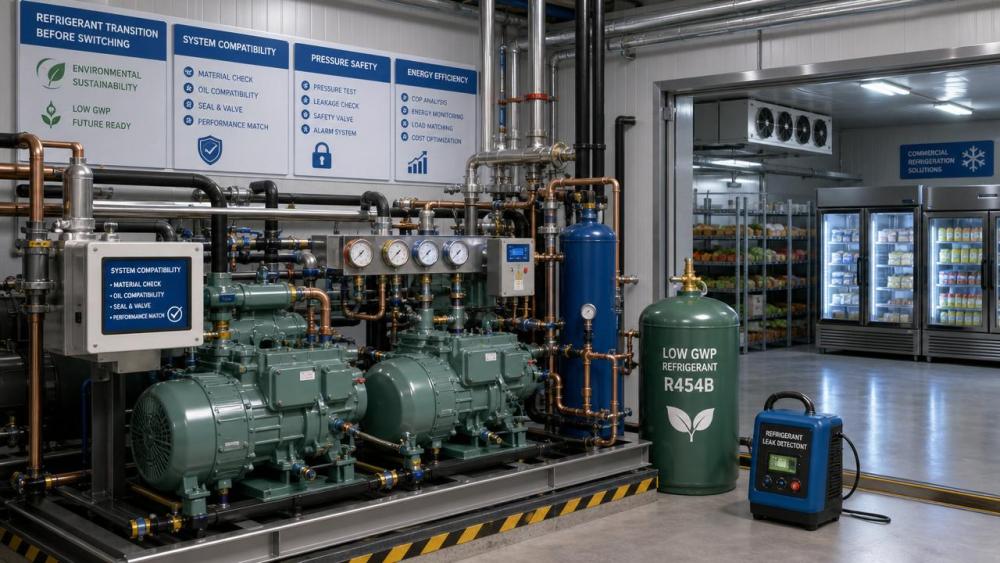
Quality control teams should first verify whether the proposed refrigerant is a true drop-in, a near drop-in, or a refrigerant requiring hardware changes. Even when suppliers describe compatibility positively, pressure-temperature behavior, expansion valve setting, elastomer resistance, and oil miscibility can still differ enough to affect quality outcomes. If the facility depends on stable temperature bands for product integrity, even small control deviations matter.
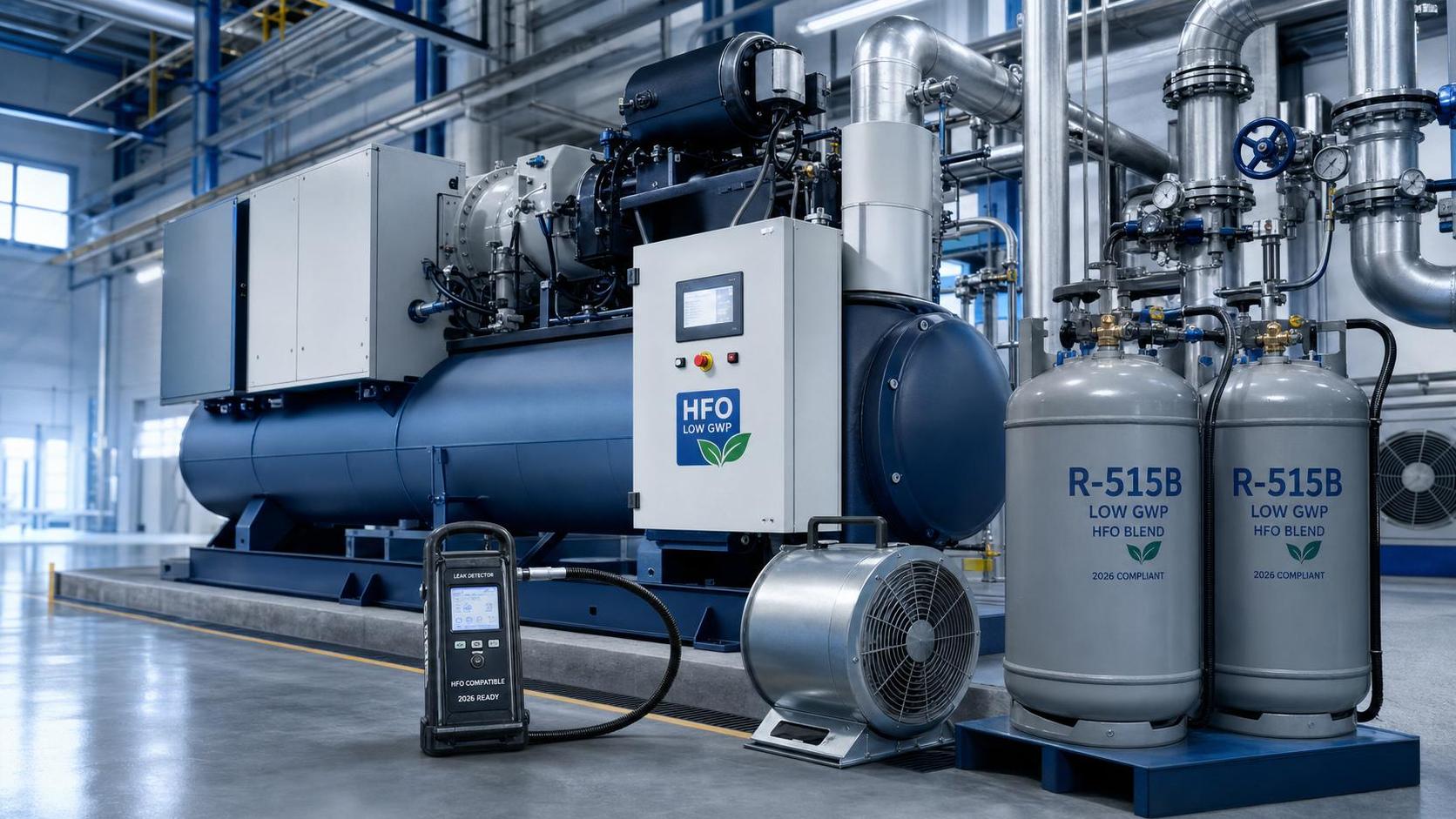
Safety managers should focus on pressure class, flammability rating, and leak consequence. A shift from a non-flammable legacy refrigerant to an A2L option may be acceptable, but only if ignition source control, ventilation, detector placement, and emergency procedures are upgraded accordingly. If these supporting controls are not feasible, the environmentally preferable option on paper may become the wrong operational choice.
Key retrofit checks
- Compressor approval and warranty implications
- Lubricant type and return characteristics
- Seal, hose, and valve material compatibility
- Expected capacity loss or efficiency gain under actual load
- Alarm, detector, and ventilation adequacy for the new safety classification
Scenario 2: New-build projects can optimize for environmentally friendly refrigerants from day one
New facilities have a major advantage: they can be designed around environmentally friendly refrigerants instead of forcing them into older constraints. This expands the feasible choices, including low-GWP blends, A2L refrigerants, natural refrigerants, and architectures with lower charge volumes.
In this scenario, the quality and safety role shifts from compatibility checking to design review. The important question becomes whether the refrigeration concept supports long-term control, serviceability, and regulatory resilience. For example, a distributed low-charge system may lower refrigerant inventory and improve leakage management, while a centralized plant may simplify some maintenance tasks but increase consequences in the event of a major release.
The best environmentally friendly refrigerants for new projects are often the ones that align with future maintenance capability, local technician availability, and the site’s emergency response maturity. Selecting a low-GWP option that few local service teams can safely handle may create downtime risk later, even if the environmental case is strong.
Scenario 3: High-sensitivity production environments require more than compliance
Pharmaceutical manufacturing, semiconductor support systems, precision storage, and laboratory environments present a special challenge. In these applications, environmentally friendly refrigerants must be evaluated not only for safety and emissions but also for repeatable process control. A refrigerant that changes evaporating characteristics or compressor discharge behavior can influence cycle stability, dehumidification consistency, or thermal response time.
For quality teams, this means validation planning is essential. Baseline performance data should be recorded before the switch, including suction and discharge pressures, room pull-down time, compressor current, energy consumption, and alarm frequency. After the change, controlled trials should confirm that process limits remain within tolerance. In regulated sectors, document revision, change control approval, and training records are often just as important as the mechanical conversion itself.
Safety teams in these environments should also consider contamination pathways and confined-space implications. If the refrigerant room is adjacent to controlled production or utility corridors, detector response, ventilation routing, and shutdown logic should be reviewed in greater detail.
Scenario 4: Occupied spaces demand stronger attention to flammability and response planning
Commercial buildings, retail stores, hospitality projects, and mixed-use sites often evaluate environmentally friendly refrigerants as part of modernization or ESG commitments. In these scenes, occupant safety becomes a front-line issue. If the chosen refrigerant has mild flammability or requires strict charge limits, installation quality and emergency planning must be stronger than in isolated machinery areas.
Safety managers should verify applicable standards, building code provisions, ventilation assumptions, and service access. They should also ask a practical question: if a leak occurs during business hours, does the site know exactly what to do? The answer should include detector alarm thresholds, isolation procedure, signage, technician call protocol, and area evacuation rules where relevant.
In these applications, environmentally friendly refrigerants are often fully viable, but only when engineering controls, technician competence, and occupancy considerations are treated as part of one risk package.
What quality control and safety managers should check first
Across most business settings, the most effective review starts with five decision filters. These filters help screen environmentally friendly refrigerants before cost comparison begins.
Common misjudgments when selecting environmentally friendly refrigerants
Several recurring errors appear across industries. Recognizing them early can prevent expensive rework.
- Assuming low GWP automatically means low risk
- Comparing refrigerants by environmental score only, without checking energy performance in the real duty cycle
- Ignoring technician training and service tool readiness
- Overlooking how a refrigerant change may affect product quality, validation status, or uptime
- Failing to update SOPs, permit-to-work procedures, and emergency instructions after conversion
The most dangerous misconception is that environmentally friendly refrigerants are only an engineering issue. In reality, the switch changes the control environment for operators, maintenance teams, EHS staff, and auditors. Decisions should therefore be cross-functional from the start.
A simple action path for site-level decision making
If your facility is evaluating environmentally friendly refrigerants, begin with a structured site review rather than a product shortlist. Map the current refrigerant inventory, identify critical loads, classify occupied versus restricted zones, and gather equipment documentation. Then compare candidate refrigerants against actual operating pressures, temperature range, service access, local code requirements, and maintenance competence.
For quality control teams, define the acceptance criteria in advance: temperature stability, pull-down time, alarm frequency, energy trend, and product protection thresholds. For safety managers, define the required safeguards: ventilation, leak detection, isolation logic, signage, training, hot-work controls, and contractor qualification. This approach turns the refrigerant decision into a measurable risk-management process instead of a purchasing shortcut.
At GTC-Matrix, the broader lesson is clear: the best environmentally friendly refrigerants are those that fit the thermal duty, the compliance path, and the operational discipline of the site. A successful switch is not just about replacing a gas. It is about aligning energy efficiency, safety controls, and business continuity with the realities of the application. If your organization is planning a transition, use your own scene, load profile, and risk level as the starting point for confirmation.
Related News
- EU PFAS Proposal Puts Refrigerant and Vacuum Exports Under ReviewAuthor :Cryogenic Systems Expert

- EU REACH PFAS Draft Raises New Export ChecksAuthor :Cryogenic Systems Expert

- EU Cuts High-GWP Refrigerant Import Quotas by 35%Author :Cryogenic Systems Expert

- EU Cuts Q4 2026 Quotas for High-GWP RefrigerantsAuthor :Cryogenic Systems Expert

- EU F-Gas Revision Cuts R410A Quotas 40%Author :Cryogenic Systems Expert

- EPA Freezes R-410A Quotas, Fast-Tracks R-32Author :Cryogenic Systems Expert

- Low GWP Refrigerants HFO Blends: Key Stability and Safety FactorsAuthor :Cryogenic Systems Expert

- R-32 Price Spike Reshapes Chiller ProcurementAuthor :Cryogenic Systems Expert

- How to Compare Environmentally Friendly Refrigerants by GWP, Safety, and CostAuthor :Cryogenic Systems Expert

- R-454B Export Quota Cut 18% as Lead Times DoubleAuthor :Cryogenic Systems Expert

- Japan Cuts R32 and R290 Import Quotas From July 10Author :Cryogenic Systems Expert

- EPA Cuts R-134a Import Quotas 42% From July 2026Author :Cryogenic Systems Expert
![]()
- Low GWP Refrigerants HFO Blends: Performance and Compliance in 2026Author :Cryogenic Systems Expert

- R-513A Jumps 23% as China Tightens Export QuotasAuthor :Cryogenic Systems Expert

- Environmentally Friendly Refrigerants in 2026: Compliance Risks and Upgrade PrioritiesAuthor :Cryogenic Systems Expert

- Pharmaceutical Temperature Control Systems: Common Compliance RisksAuthor :Cryogenic Systems Expert

- China Tightens Q3 R32 Export QuotasAuthor :Cryogenic Systems Expert

- California EPR Deadline Nears for Refrigeration MakersAuthor :Cryogenic Systems Expert

- Resource Circularity Trends Reshaping Refrigerants and Cooling SystemsAuthor :Cryogenic Systems Expert

- HFCs Filing Rules Enter Full EnforcementAuthor :Cryogenic Systems Expert

- How Environmentally Friendly Refrigerants Affect Chiller ComplianceAuthor :Cryogenic Systems Expert

- EU REACH Tightens Refrigerant Impurity Limits for R134a ExportsAuthor :Cryogenic Systems Expert

- China Seeks Feedback on 2027 Refrigerant QuotasAuthor :Cryogenic Systems Expert

- EU to Ban High-GWP ACs in 2029 as R410A Exits HomesAuthor :Cryogenic Systems Expert

- US, UK Delay HFC Phaseout, Extending R32/R134a Export WindowAuthor :Cryogenic Systems Expert

- EU HFC Cut Tightens by 2029 as Gen-3 Output Falls 10%Author :Cryogenic Systems Expert

- Kuwait Bans HCFC AC Imports as Shift to R32/R290 Speeds UpAuthor :Cryogenic Systems Expert

- Saudi SASO Rules Tighten AC Imports in DecemberAuthor :Cryogenic Systems Expert

- Environmentally Friendly Refrigerants: Compliance, Safety, and Retrofit RisksAuthor :Cryogenic Systems Expert

- SABIC Force Majeure Keeps Chiller Refrigerant Supply TightAuthor :Cryogenic Systems Expert

- SABIC Force Majeure Tightens Refrigerant FeedstocksAuthor :Cryogenic Systems Expert

- UL 60335-2-89 Tightens R290 Leak Test RulesAuthor :Cryogenic Systems Expert
![]()
- UL 60335-2-89 Adds R290 Vacuum Leak TestAuthor :Cryogenic Systems Expert

- Global Refrigerant Price Index Falls 8.3% MoM in MayAuthor :Cryogenic Systems Expert
![]()
- PSA Jurong Island Launches Mandatory Cold-Chain Traceability for RefrigerantsAuthor :Cryogenic Systems Expert
![]()
- 2026 Refrigerants Shift: What Changes for Cold StorageAuthor :Cryogenic Systems Expert